
Good morning, Google just figured out how to shrink AI models by 6x without losing quality, Mistral dropped an open-source speech model that runs on a smartwatch, and OpenAI quietly shelved its plans for an adult chatbot. Here’s what happened 👇

1. Google’s TurboQuant Can Shrink AI Models by 6x Without Losing Quality
Google Research revealed TurboQuant, a new compression algorithm that reduces the memory AI models need by 6x while also running 8x faster. The key part: it does this without sacrificing output quality, which has been the main tradeoff with compression until now.
Here’s what it does in plain English. AI models store a kind of “cheat sheet” (called the key-value cache) so they don’t have to recalculate everything from scratch for every response. That cheat sheet takes up massive amounts of memory. TurboQuant compresses it using a two-step system: first, it converts data coordinates into a more compact format (think “go 5 blocks at 37 degrees” instead of “go 3 blocks east, 4 blocks north”), then applies a 1-bit error-correction layer to clean up any rough spots. The algorithm can be applied to existing models with zero additional training. Within 24 hours of release, the open-source community had already started porting it to popular local AI frameworks like MLX for Apple Silicon and llama.cpp.
Why it matters: This is the kind of breakthrough that makes AI cheaper and more accessible overnight. If models need 6x less memory, that means the AI running on your phone could get dramatically better without sending your data to the cloud. For companies, it means lower server costs. For the open-source community racing to run AI locally, it’s a game-changer. The internet is already calling it “Pied Piper” after the fictional compression company from Silicon Valley.
Sources: Ars Technica, TechCrunch, VentureBeat
2. Mistral Releases Open-Source Speech Model That Runs on a Smartwatch
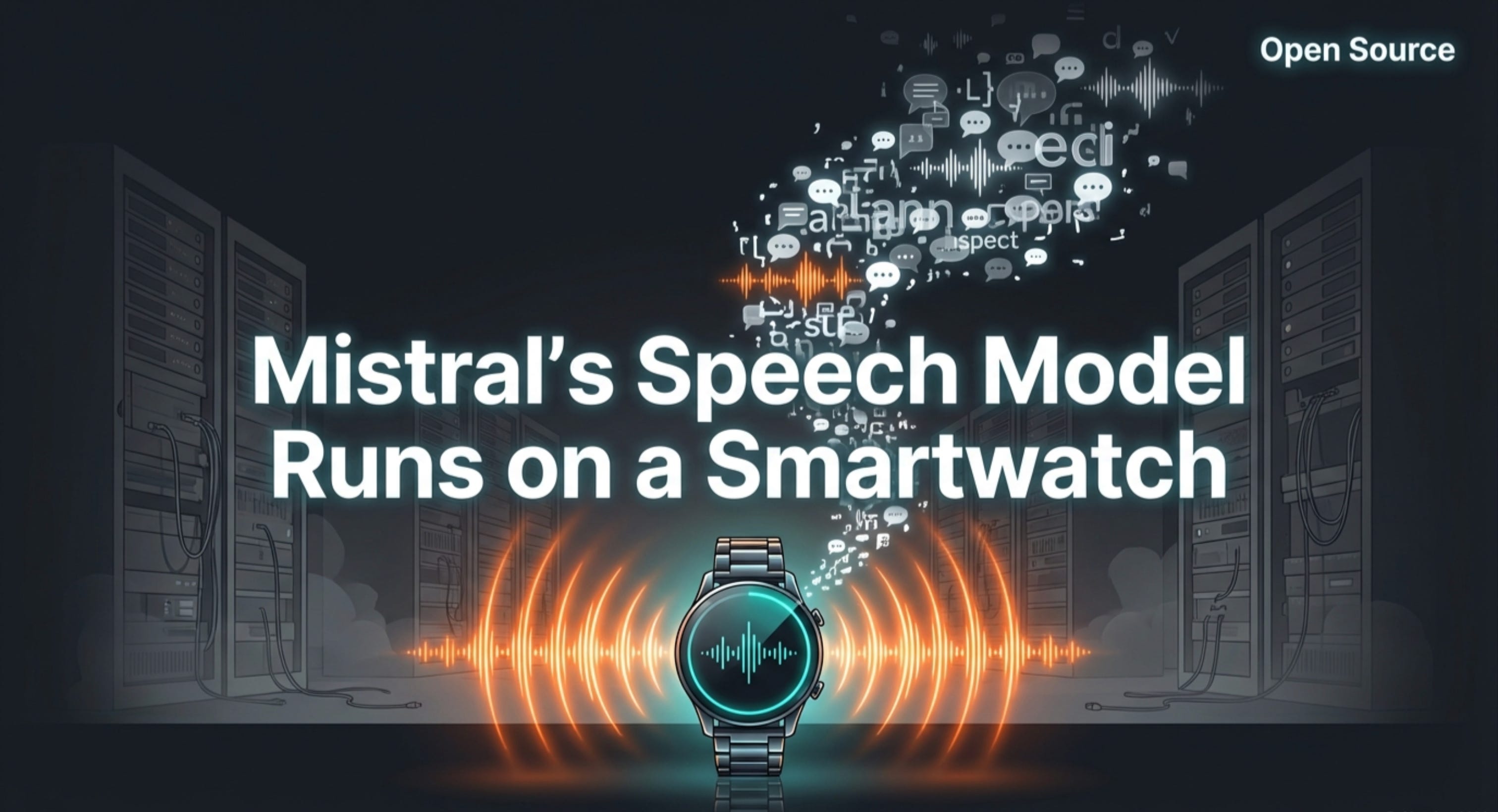
French AI company Mistral released a new open-source model built specifically for speech generation. Unlike the massive models that require expensive servers, this one is small enough to run on a smartwatch or smartphone. The model is available under an open-source license, meaning anyone can download, modify, and build on top of it.
This release caps an aggressive stretch for Mistral: in the past week alone, the company also launched Forge (a platform for building custom AI models), released its Small 4 text model, unveiled an open-source code verification agent, and joined Nvidia’s new open-model coalition. Mistral is positioning itself as the company that helps organizations own their AI instead of renting it from Big Tech.
Why it matters: Voice is the next big frontier in AI, and right now it’s dominated by closed systems from OpenAI, Google, and Apple. An open-source speech model small enough for edge devices means developers can build voice-powered apps that work offline, protect user privacy, and don’t require expensive API calls. If you’ve ever been frustrated by Siri not working without an internet connection, this is the technology that could fix that.
Sources: TechCrunch

3. OpenAI Shelves Plans for an Adult Chatbot Indefinitely
OpenAI has indefinitely paused its plans to release an erotic chatbot, the Financial Times reports. The company is choosing to focus on its core products instead. This comes just days after a report revealed that OpenAI’s own mental health advisors unanimously opposed the “naughty” ChatGPT feature, warning it could become a “sexy suicide coach.”
The decision follows weeks of controversy over OpenAI’s push into adult content. The company had been testing more flirtatious and sexually suggestive responses in ChatGPT, drawing sharp criticism from safety researchers who argued that mixing intimate conversation with a tool used by minors was reckless. OpenAI had initially framed the feature as giving users more “personality” options, but internal experts flagged serious risks around emotional manipulation and parasocial attachment.
Why it matters: This tells you something important about the current moment in AI. Companies are realizing that “move fast and break things” has real consequences when your product is a conversational AI that millions of people (including teenagers) talk to daily. OpenAI backing down suggests the company is calculating that reputational risk outweighs whatever revenue adult content might generate, especially with an IPO on the horizon.
Sources: Reuters, Ars Technica
4. Meta Lays Off Hundreds of Employees as AI Spending Accelerates
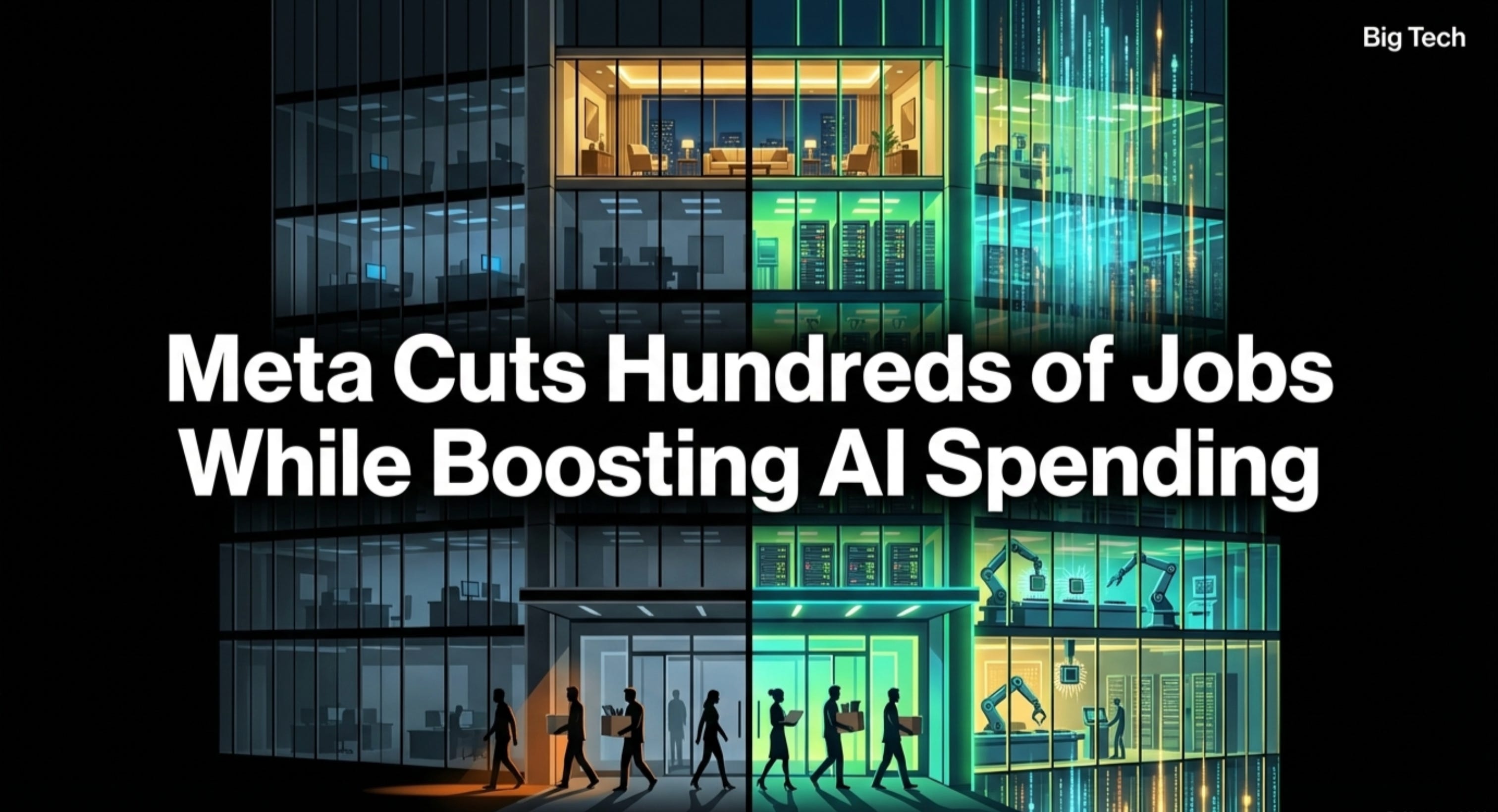
Meta is laying off a few hundred employees across multiple teams, sources confirmed to Reuters. The cuts come in the same week that Meta boosted stock compensation for its top executives to keep them from jumping to AI competitors, and launched a new initiative to drive AI adoption among small businesses.
The layoffs are the latest round in a pattern that has defined Big Tech over the past year: cut headcount in traditional roles while pouring billions into AI infrastructure. Meta has been on an AI spending spree, investing heavily in custom chips, data centers, and the Llama model family. The company recently acquired Chinese AI startup Manus for $2 billion and is now navigating a regulatory challenge from Beijing over that deal.
Why it matters: Meta is doing what most large tech companies are doing right now: quietly replacing human jobs with AI-powered systems while publicly celebrating AI as a tool that “helps” workers. The layoffs happening alongside executive pay boosts paint a clear picture of who benefits first from the AI transition. If you work in tech, the message is hard to miss: your value increasingly depends on how well you can work with AI, not compete against it.
Sources: Reuters
5. Nvidia-Backed Reflection AI in Talks for $25 Billion Valuation
Reflection AI, an AI startup backed by Nvidia, is in talks to raise $2.5 billion at a $25 billion valuation, the Wall Street Journal reports. If the deal closes, it would make Reflection one of the most valuable AI startups in the world, joining the ranks of Anthropic, xAI, and OpenAI in the “mega-valuation” club.
The fundraise comes as AI startup valuations continue to climb at a pace that makes some investors nervous. In the same week, legal AI company Harvey confirmed an $11 billion valuation with Sequoia tripling down on its investment, and meeting-notes startup Granola raised $125 million at a $1.5 billion valuation. Kleiner Perkins just raised $3.5 billion focused almost entirely on AI. The money flowing into AI startups right now is unprecedented.
Why it matters: The pattern is becoming impossible to ignore. AI companies are raising at valuations that would have been unthinkable two years ago, and the biggest investors (Nvidia, Sequoia, Kleiner Perkins) keep doubling and tripling down. Either these companies will grow into these valuations by transforming entire industries, or we’re watching the early stages of a bubble that will be studied in business schools for decades. There’s not much middle ground.
Sources: Reuters
Quick Hits
-
South Korea invests $166 million in AI chip startup Rebellions. The government-backed investment is part of a push to build a homegrown alternative to Nvidia and compete in the global AI chip race. (Reuters)
-
Google launches Lyria 3 Pro, its most advanced music generation model yet. The new model can create full songs with vocals, instruments, and production across genres. The AI music wars are heating up. (TechCrunch)
-
Reddit will now require “fishy” accounts to prove they’re human. The platform is rolling out new verification requirements targeting bot-like behavior, though AI-generated content from verified humans is still allowed. (Ars Technica)
-
SK Hynix files for U.S. listing that could raise up to $14 billion. The South Korean memory chip maker, one of Nvidia’s key suppliers for AI chips, plans to list shares in the second half of 2026. (Reuters)
-
Melania Trump brings a robot to the White House to promote AI teachers. A humanoid robot walked down a red-carpeted White House hallway alongside the First Lady as she urged greater use of AI in education. Yes, really. (Reuters)
That’s it for today. The thread connecting everything this week is clear: AI is getting cheaper, smaller, and more accessible (TurboQuant, Mistral’s tiny speech model) while the money and power surrounding it grows larger by the day ($25B valuations, government-backed chip investments, White House robots). The gap between what AI can do and who gets to control it is the story of 2026.
Forward this to someone who needs to stay in the loop.
Leave a Reply