
Good morning, OpenAI just doubled down on Cerebras with a chip deal that could reach $30 billion, the company also launched an AI model designed specifically for biology and drug discovery, and a robotics startup showed a robot brain that can figure out tasks nobody ever taught it. Here’s what happened 👇

1. OpenAI Doubles Its Cerebras Chip Deal to Over $20 Billion
OpenAI has agreed to pay chip startup Cerebras more than $20 billion over the next three years for servers powered by Cerebras chips, according to The Information. That is double the $10 billion commitment the two companies announced in January. The deal also includes warrants that could give OpenAI up to a 10% equity stake in Cerebras as spending increases, plus $1 billion from OpenAI to help fund Cerebras data centers. Total spending over three years could reach $30 billion.
Cerebras, which makes wafer-scale engine chips that compete with Nvidia’s GPUs, is preparing an IPO in the second quarter at a valuation of roughly $35 billion. OpenAI CEO Sam Altman is an early investor. The deal is the clearest signal yet that OpenAI is building a chip supply chain that does not depend entirely on Nvidia.
Why it matters: Every AI company on Earth is fighting for access to the same pool of Nvidia chips. By locking in $20 billion or more with Cerebras, OpenAI is hedging that dependence and, through its equity stake, turning a supplier relationship into a strategic investment. If Cerebras succeeds, OpenAI owns a piece of the alternative chip ecosystem. If you use ChatGPT, the speed and cost of every answer you get is shaped by which chips are running it. We broke down foundation models, the brains that run on these chips, in our AI Explained series → What Are Foundation Models?
2. OpenAI Launches GPT-Rosalind, a Biology-Tuned AI for Drug Discovery
OpenAI introduced GPT-Rosalind on Thursday, an AI model built specifically for life sciences research. Named after Rosalind Franklin, the scientist whose X-ray crystallography work was central to discovering DNA’s structure, the model is designed to help researchers with evidence synthesis, hypothesis generation, experimental planning, and other multi-step research tasks. It can query databases, read the latest scientific papers, suggest new experiments, and connect to over 50 scientific tools through a free Codex plugin.
OpenAI said it is already working with Amgen, Moderna, and Thermo Fisher Scientific to apply GPT-Rosalind across their workflows. The model is available as a research preview through OpenAI’s trusted access deployment structure.
Why it matters: Drug discovery typically takes over a decade and costs billions. If an AI model can meaningfully accelerate the early stages of research, even by months, the downstream impact on which drugs reach your pharmacy shelves is enormous. This is also OpenAI’s second specialized model in one week, after GPT-5.4-Cyber for cybersecurity. The company is clearly betting that the future of AI is not one model that does everything, but specialized models tuned for high-stakes fields.
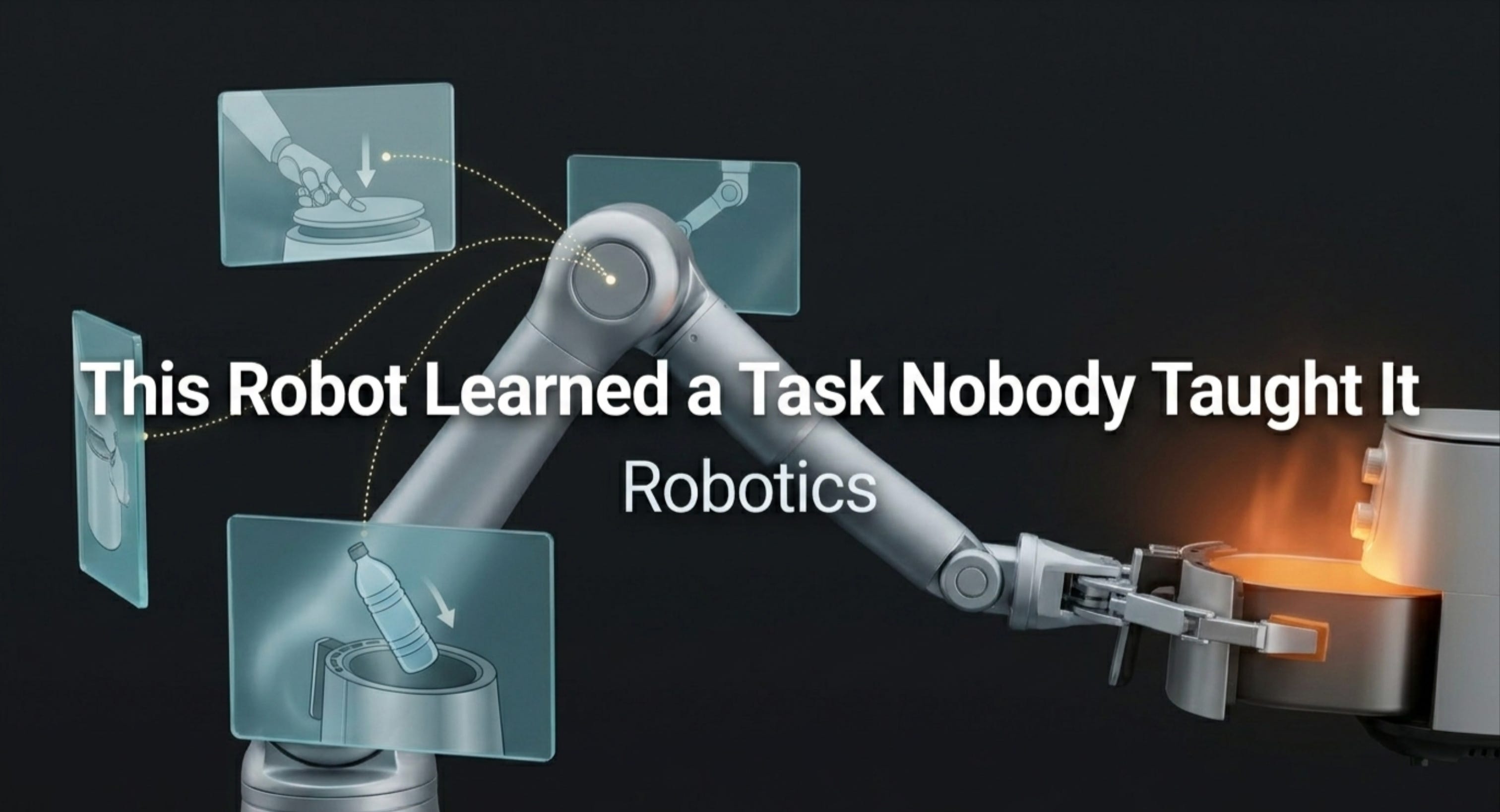
3. This Robot Brain Can Figure Out Tasks Nobody Taught It
Physical Intelligence, a San Francisco robotics startup valued at $5.6 billion, published research on Thursday showing that its latest model can direct robots to perform tasks they were never explicitly trained on. The model, called π0.7, demonstrated what researchers call “compositional generalization,” the ability to combine skills learned in different contexts to solve new problems. In one test, the robot figured out how to use an air fryer despite having only two barely relevant examples in its entire training dataset. With verbal coaching from a human walking it through the steps, it succeeded.
The π0.7 model matched the performance of purpose-built specialist models across complex tasks including making coffee, folding laundry, and assembling boxes. The company is reportedly in talks to raise at an $11 billion valuation.
Why it matters: Until now, training a robot meant collecting data on each specific task and building a model for that task alone. If robots can start remixing skills the way language models remix words, it changes the economics of automation entirely. A warehouse, a hospital, or a restaurant would not need a different robot for every job. They would need one that can be coached. We explained how AI systems learn from data, including the foundations that make this kind of generalization possible, in our AI Explained series → How AI Actually Learns

4. The White House Plans to Give Federal Agencies Access to Anthropic’s Mythos
The U.S. government is preparing to make a version of Anthropic’s Mythos model available to major federal agencies, Bloomberg News reported. Gregory Barbaccia, the federal chief information officer, emailed Cabinet department officials on Tuesday that the Office of Management and Budget was setting up protections to allow agencies to begin using the model. “We’re working closely with model providers, other industry partners, and the intelligence community to ensure the appropriate guardrails and safeguards are in place,” Barbaccia said.
Separately, Anthropic CEO Dario Amodei is scheduled to meet White House chief of staff Susie Wiles on Friday, Axios reported, signaling a possible breakthrough in Anthropic’s ongoing dispute with the Pentagon.
Why it matters: The same model that five major financial regulators spent the past two weeks scrutinizing for cybersecurity risk is now being prepared for use by the very government agencies responsible for protecting critical infrastructure. That is not a contradiction. It is the same logic that drives every advanced weapons system: if something is this powerful, you want your own people to have it first. The Mythos saga is becoming the clearest real-world test case for how governments handle AI models that are simultaneously a defensive tool and a potential threat.
Source: Reuters | Source: Reuters
Quick Hits
-
AI traffic to US retail websites jumped 393% in Q1, and shoppers arriving via AI now convert 42% better than non-AI visitors, according to Adobe data. A year ago, AI traffic converted 38% worse. The turnaround is massive. Source: TechCrunch
-
Anthropic’s chief product officer left Figma’s board after reports that Anthropic plans to offer a competing design product. Source: TechCrunch
-
Mozilla launched Thunderbolt, a new AI client focused on self-hosted infrastructure, built on the open-source Haystack framework toward what it calls a “decentralized open source AI ecosystem.” Source: Ars Technica
That’s it for today. OpenAI is spending like a company that believes compute will be the oil of the next decade, and it is not just buying chips but buying into the companies that make them. Meanwhile, the race to put AI into biology labs, robot arms, and government agencies is accelerating at a pace that makes last year’s “will AI be useful?” debate feel like ancient history.
Forward this to someone who needs to stay in the loop.
Leave a Reply