Author: bakhtsingh.basaram@gmail.com

  • What Is Deep Learning? How AI Learns Like a Human Brain

    What Is Deep Learning? How AI Learns Like a Human Brain

    Deep Learning is a technique where we build complex, layered structures (called Neural Networks) that allow computers to learn from vast amounts of data without us having to tell them what to look for. It’s the technology behind self-driving cars, FaceID, ChatGPT, and voice assistants—allowing machines to see, hear, and create like humans.


    Hey Common Folks!

    We’ve covered the umbrella (AI) and the engine (Machine Learning). Now, we’re going to talk about the rocket fuel that has made AI the hottest topic on the planet for the last decade: Deep Learning (DL).

    If Machine Learning is about teaching computers to find patterns, Deep Learning is about building a “brain” that can find patterns so complex that humans can’t even describe them.

    When you hear about a computer beating a world champion at the game Go, or your phone unlocking by scanning your face, or Siri understanding your accent—that isn’t just generic AI. That’s Deep Learning.


    Deep Learning vs Machine Learning: What’s the Difference?
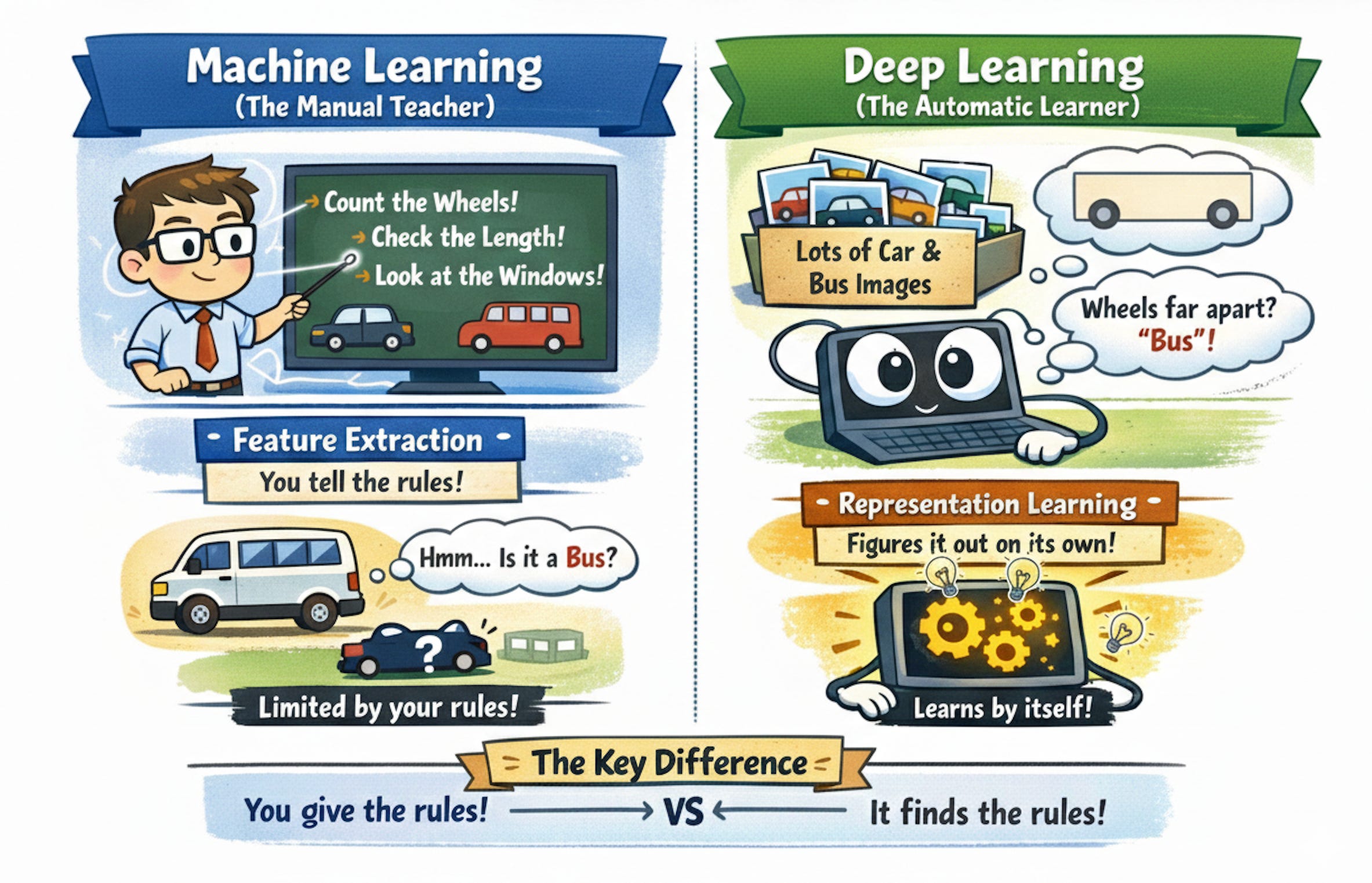
    The most critical difference comes down to one thing: Features.

    Imagine you want to build a system to tell the difference between a Car and a Bus.

    Machine Learning (The Manual Teacher)

    In traditional Machine Learning, you (the human) have to be the expert. You have to tell the computer specific rules or “features” to look for.

    • You tell it: “Look for the number of wheels.”

    • You tell it: “Look at the length of the vehicle.”

    • You tell it: “Look for the number of windows.”

    This is called Feature Extraction. The computer learns the math to separate cars from buses based on the features you gave it. But if you forget to tell it about “height,” it might confuse a tall van with a bus. The computer is limited by your ability to describe the object.

    Deep Learning (The Automatic Learner)

    In Deep Learning, you don’t define the features. You just throw thousands of pictures of cars and buses at the system.
    The system looks at the raw pixels and figures it out on its own.

    • It figures out: “Hey, this long rectangular shape usually goes with the label ‘Bus’.”

    • It figures out: “These two circular patterns (wheels) spaced far apart mean ‘Bus’.”

    It performs Representation Learning. It automatically extracts the features without human intervention.

    The Key Difference: In Machine Learning, you tell the computer what to look at. In Deep Learning, the computer figures out what’s important on its own.
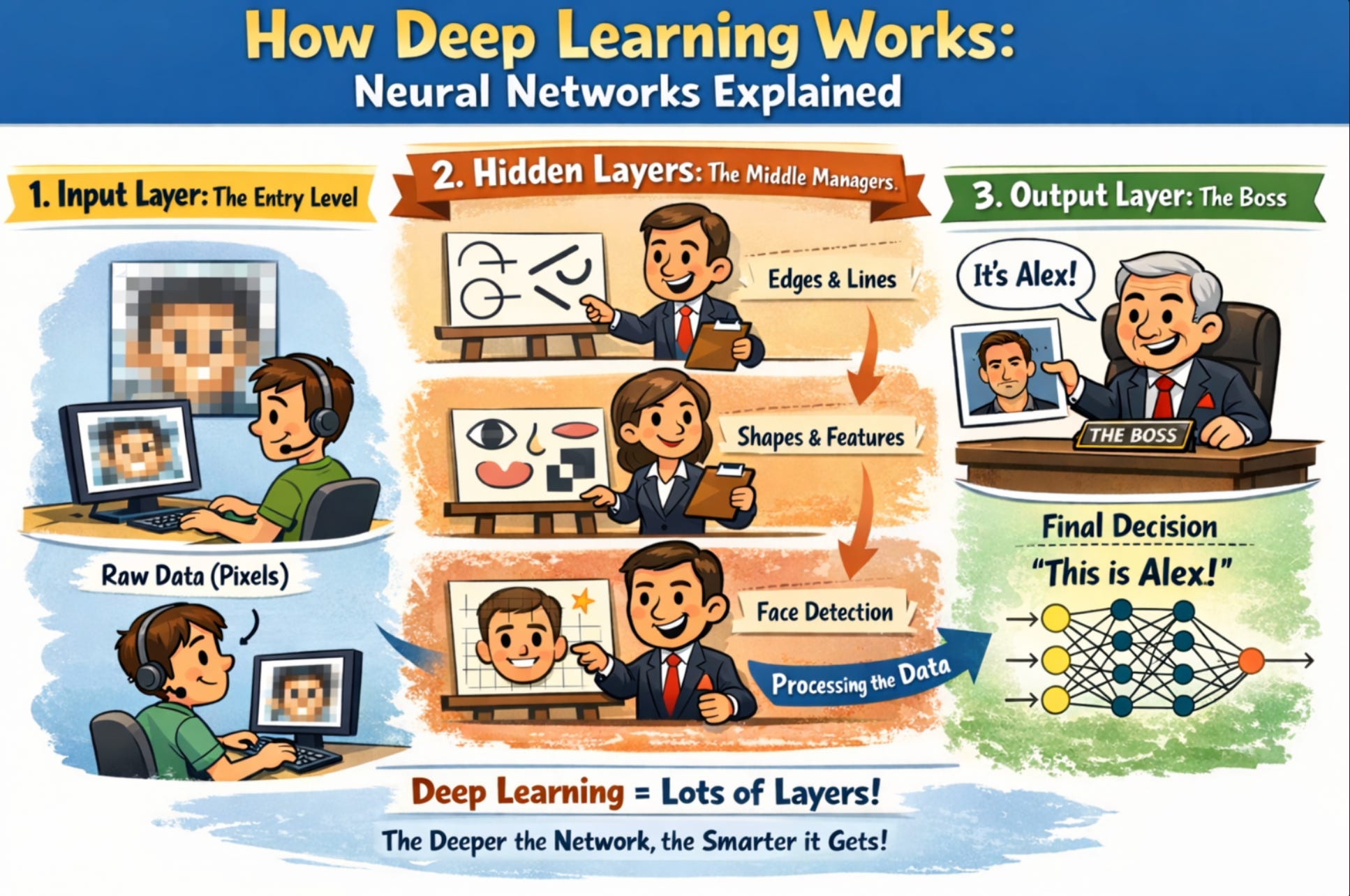

    How Deep Learning Works: Neural Networks Explained

    Deep Learning uses something called an Artificial Neural Network (ANN).

    Imagine a corporate hierarchy or an assembly line.

    1. The Input Layer (The Entry Level):
    This is where the data comes in. If it’s a picture of a face, these are the raw pixels.

    2. The Hidden Layers (The Middle Managers):
    This is where the magic happens. The data passes through multiple layers of “neurons.”

    • The first layer might just detect lines and edges (curves, straight lines).

    • The next layer combines those lines to identify shapes (circles, squares, eyes, noses).

    • The deeper layers combine those shapes to identify complex objects (a human face).

    3. The Output Layer (The Boss):
    This layer gives the final decision: “This is a photo of Alex.”

    We call it “Deep” Learning simply because we stack many, many of these hidden layers on top of each other. The deeper the network, the more complex patterns it can recognize.


    How Does It Actually Learn? The Training Process

    Here’s the key thing most people get confused about: Deep Learning still needs a teacher during training.

    Think of it like teaching a child to recognize animals using flashcards.


    Training Phase (You’re the Teacher):

    1. Show the flashcard
    You hold up a picture of a dog.

    2. Tell them the answer
    You say “DOG” out loud. (This is the correct label you provide.)

    3. They make a guess
    The child looks at the picture and says “Cat!” (Wrong!)

    4. Measure how wrong they are (Loss Function)
    You say, “No, that’s wrong. The right answer is DOG, not CAT.” The child’s brain calculates how wrong they were. Were they completely off, or kind of close?

    5. They adjust their thinking (Backpropagation)
    The child’s brain tweaks itself slightly. It thinks: “Okay, pictures with floppy ears and wagging tails are more likely to be dogs, not cats.” Next time they see similar features, they’ll guess differently.

    6. Repeat thousands of times
    You keep showing flashcard after flashcard. Dog, cat, dog, bird, dog, dog, cat… After seeing thousands of examples WITH your corrections, the child gets really good at recognizing animals.


    Testing Phase (They Work Alone):

    Now you show them a picture of a dog they’ve NEVER seen before—no label, no help.
    The child confidently says “DOG!” ✓


    The Deep Learning Process Works the Same Way:

    During Training:

    • We show it 10,000 pictures of dogs (labeled “DOG”)

    • We show it 10,000 pictures of cats (labeled “CAT”)

    • The network looks at each picture one by one, makes a guess, gets corrected, and adjusts

    • Then it goes through ALL 20,000 pictures again… and again… and again

    • Each complete pass through all the data is called an Epoch

    • Models typically train for 10-100+ Epochs until they get really accurate

    After Training:

    • We show it a NEW picture it’s never seen

    • It correctly identifies “DOG” on its own

    • We don’t give it the answer anymore—it learned the pattern


    The Three Steps Happening Inside (For Each Picture):

    Step 1: The Guess (Forward Propagation)
    The neural network looks at a picture and makes a guess based on its current “knowledge” (the connections between neurons).

    Step 2: The Grade (Loss Function)
    The system compares what it guessed to the correct answer we provided:

    • What it guessed: “CAT”

    • What we told it: “DOG”

    The Loss Function measures how wrong it was. Think of it like grading a test:

    • Totally wrong answer → Big red X → High error score

    • Close but not quite → Partial credit → Medium error score

    • Perfect answer → Gold star → Zero error

    Step 3: The Correction (Backpropagation)
    The network takes that error score and works backward through all its layers, slightly adjusting the connections (called weights) between neurons to make a better guess next time.

    This loop—Guess, Grade, Correct—happens for every single picture in the dataset.


    The Magic Part:

    Yes, during training we give it Input (pictures) AND Output (correct labels). The network learns to find the patterns that connect them.

    The “automatic feature learning” means we don’t tell it “look for floppy ears” or “look for wet noses”—it figures out THOSE details on its own by examining millions of pixels. But we absolutely DO tell it “this picture = dog, this picture = cat” during training.

    Once trained, it can identify dogs in brand new photos without any help.


    The Three Types of Neural Networks

    Just like there are different types of vehicles for different jobs (trucks for hauling, Ferraris for speed), there are different neural networks for different data:

    1. ANN (Artificial Neural Networks):
    The basic version. Good for simple data like spreadsheets or numbers.

    2. CNN (Convolutional Neural Networks):
    The “Eyes” of AI. These are designed specifically for images and videos. They’re brilliant at scanning a photo to find patterns, like identifying a tumor in an X-ray or a stop sign for a self-driving car.

    3. RNN (Recurrent Neural Networks):
    The “Ears” and “Memory” of AI. These are designed for sequential data like text, audio, or time. They remember what happened previously to understand what’s happening now (like predicting the next word in a sentence).


    Where You’re Already Using Deep Learning

    You interact with Deep Learning technology every day:

    • Face ID / Face Unlock → CNNs recognizing your unique facial features

    • Voice Assistants (Siri, Alexa, Google Assistant) → RNNs understanding speech patterns

    • ChatGPT and AI Chatbots → Deep neural networks generating human-like text

    • Self-driving cars → Multiple neural networks processing camera feeds in real-time


    The Takeaway

    Deep Learning is the technology that allows computers to perform tasks that we used to think only humans could do—seeing, hearing, and creating.

    It’s powerful, it’s complex, and it requires massive amounts of data. But at its core, it’s just a system of layers trying to minimize its own mistakes.


    Was this helpful? Reply and let us know what AI term confuses you the most!

    AI for Common Folks,
    Understand AI in plain English.
  • What Is Machine Learning? How AI Actually Learns

    What Is Machine Learning? How AI Actually Learns

    Machine Learning is teaching computers to learn from data, rather than following a list of strict rules. Instead of programming every possible scenario, we show machines examples, and they figure out the patterns themselves—like a child learning to recognize dogs by seeing hundreds of different breeds.

    If AI is the destination, Machine Learning is the vehicle that gets us there. And you’re already using it dozens of times a day without realizing it.


    Hey Common Folks!

    In our last edition, we learned that Artificial Intelligence (AI) is the big umbrella term for machines acting smartly. But how exactly do they get smart? They don’t just wake up one day knowing how to drive a car or recommend your next Netflix binge.

    They have to learn.

    Today, we’re zooming in on the most important circle inside that AI umbrella: Machine Learning (ML).


    Machine Learning vs Traditional Programming: The Big Shift

    To understand why Machine Learning is revolutionary, we need to look at how we used to talk to computers versus how we talk to them now.

    The Old Way: Traditional Programming (The Recipe)

    For decades, if we wanted a computer to do something, we had to give it a specific “recipe.”
    We gave the computer the Input (ingredients) and the Rules (recipe), and the computer gave us the Output (the cake).

    Example: If you wanted to write a program to add two numbers, you had to write the rule: If user gives 2 and 2, perform addition. Result is 4.

    The problem? You have to write code for every single scenario. If you want a computer to recognize a dog, you have to write rules for tail length, ear shape, and fur color. But what happens when you show it a Poodle after you wrote rules for a German Shepherd? The program fails. You can’t write enough rules to cover the real world.

    The New Way: Machine Learning (The Detective)

    Machine Learning flips the script. Instead of giving the computer the rules, we give it the Input and the Output (the answers), and we ask the computer to figure out the Rules itself.

    The Analogy:
    Imagine teaching a child to identify a “dog.” You don’t hand the child a dictionary definition of a canine.

    You point to a Golden Retriever and say, “Dog.” You point to a Pug and say, “Dog.” You point to a cat and say, “No, not dog.”

    Eventually, the child’s brain spots the patterns—the snout, the paws, the bark—and learns to recognize a dog they’ve never seen before.

    This is Machine Learning. We feed the computer thousands of photos (Data) and tell it which ones are dogs (Answers). The machine acts like a detective, finding the hidden patterns that make a dog a dog.


    The Three Types of Machine Learning

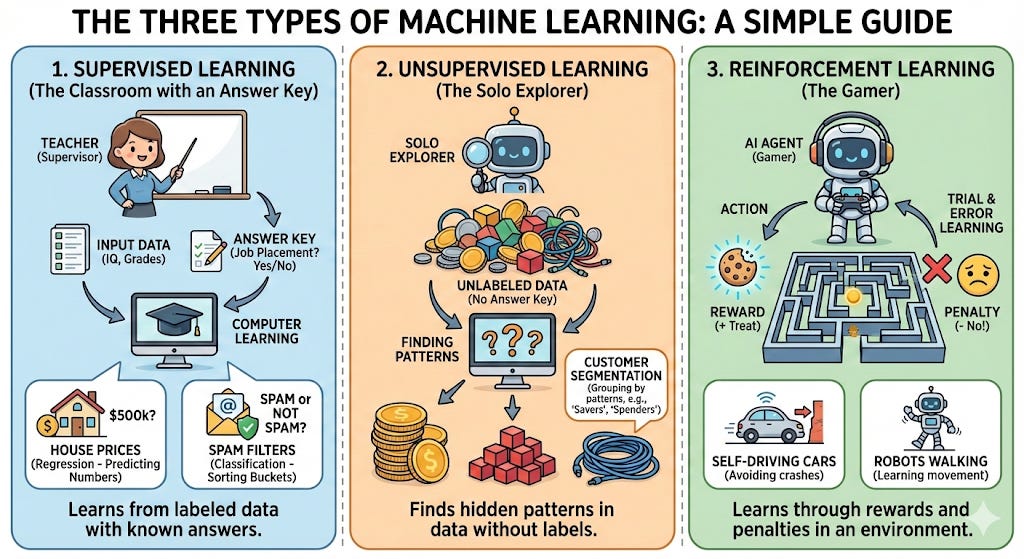
    Not all learning happens the same way. In the world of ML, there are three main ways machines learn. Think of them as different teaching styles:

    1. Supervised Learning (The Classroom with an Answer Key)

    This is the most common type. We act as the “supervisor” or teacher. We give the computer data that includes the right answers.

    How it works: We show the computer data about students—their IQ and their Grades (Input)—and tell it who got a job placement and who didn’t (Output/Answer Key). The computer learns the relationship between grades and getting a job.

    Real Life Examples:

    • House Prices: Predicting if a house will sell for $500k based on its size and location (This is called Regression—predicting a number).

    • Spam Filters: Predicting if an email is “Spam” or “Not Spam” (This is called Classification—sorting things into buckets).

    2. Unsupervised Learning (The Solo Explorer)

    Here, we throw the computer into the deep end without an answer key. We give it data, but no labels. We say, “Here’s a pile of data. Find the patterns yourself.”

    How it works: Imagine you dump a bucket of mixed coins on a table. You don’t need to know the names of the coins to sort them. You can group them by size or color. That’s Unsupervised Learning.

    Real Life Example:

    • Customer Segmentation: A bank looks at millions of transactions and groups customers into “Savers,” “Spenders,” and “Investors” without being told those groups exist beforehand.

    3. Reinforcement Learning (The Gamer)

    This is learning by trial and error. The AI is an “agent” placed in an environment. If it does something good, we give it a reward (like a digital cookie). If it messes up, it gets a penalty.

    The Analogy: It’s exactly like training a dog. If the dog sits, it gets a treat. If it jumps on the couch, it gets a “No!” Eventually, it learns what to do to get the most treats.

    Real Life Examples: Self-driving cars learning not to crash, or robots learning how to walk.


    How Machine Learning Actually Works: The Math Behind It

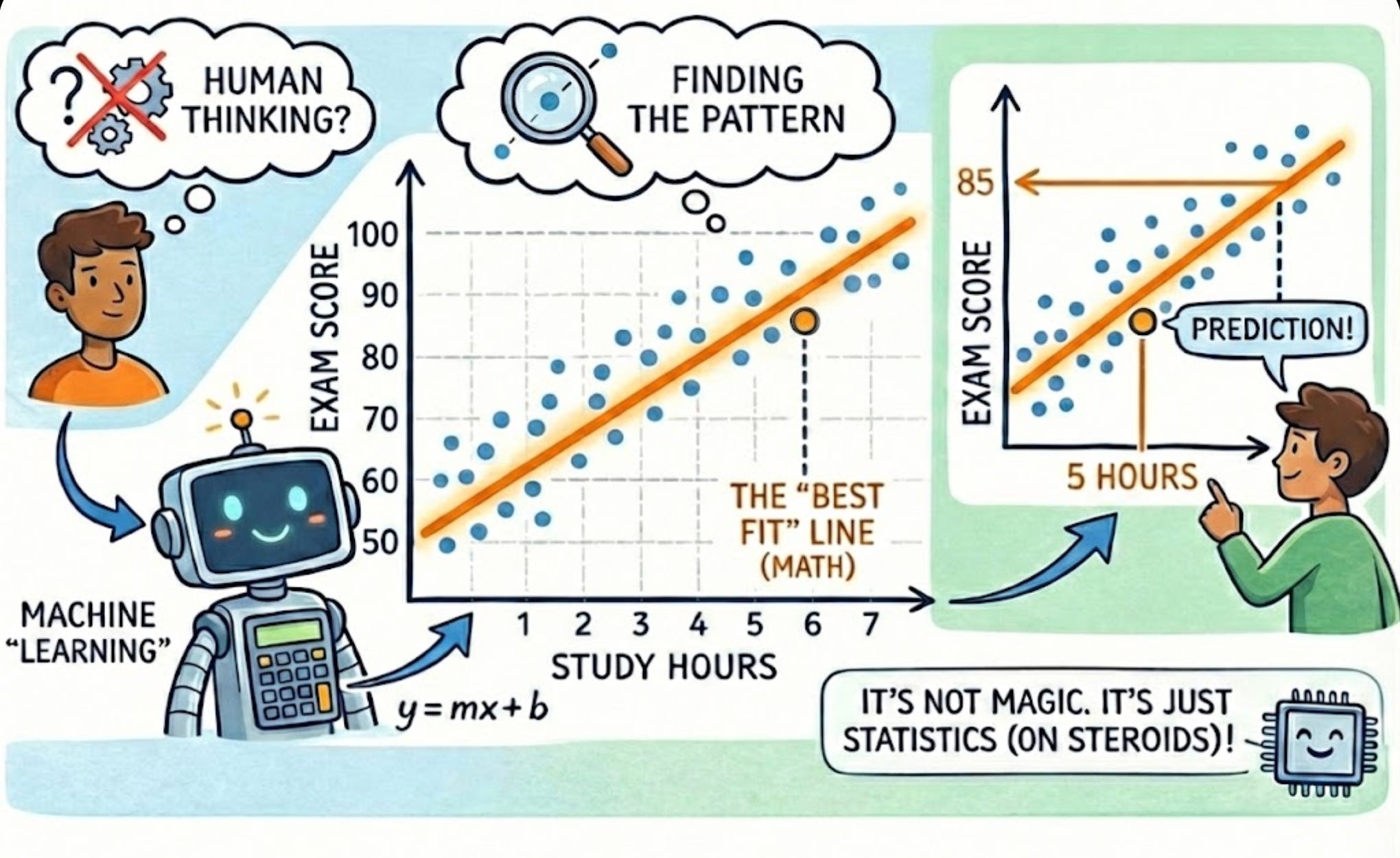
    When we say the machine “learns,” it isn’t thinking like a human. It’s using math to draw a line through data.

    If you plot points on a graph—say, “Study Hours” vs. “Exam Score”—Machine Learning is essentially trying to draw the best possible line that passes through those points.

    Once that line is drawn, if you tell the machine you studied for 5 hours, it looks at the line and predicts your score.

    That’s it. It’s not magic; it’s statistics on steroids.


    Where You’re Already Using Machine Learning

    You interact with Machine Learning every single day:

    • Netflix recommendations → Supervised Learning predicting what you’ll watch next

    • Spam filters → Classification sorting emails into spam or not spam

    • Voice assistants (Siri, Alexa) → Learning to understand your speech patterns

    • Amazon product suggestions → Unsupervised Learning finding patterns in shopping behavior

    • Self-driving cars → Reinforcement Learning improving through millions of practice miles


    The Takeaway

    Machine Learning is the shift from telling computers what to do to teaching computers how to figure it out.

    • It’s Supervised when we give it the answers.

    • It’s Unsupervised when it finds patterns on its own.

    • It’s Reinforcement when it learns by trial and error.

    Next time Netflix suggests a movie you end up loving, you’ll know: that wasn’t a lucky guess. That was a Machine Learning model acting like a detective, analyzing your history to predict your future.

    Coming Up:
    We’ve covered the engine (ML), but what happens when we upgrade that engine to mimic the human brain? Next, we dive into the “Deep” end with Deep Learning and Neural Networks.

  • What Is Artificial Intelligence? A Simple Explanation

    What Is Artificial Intelligence? A Simple Explanation

    Artificial Intelligence (AI) is machines acting smartly—doing things that usually require human intelligence, like recognizing faces, understanding language, or playing chess. It’s not magic. It’s not sentient. It’s math and pattern recognition at scale.

    If you’ve opened a newspaper, scrolled through Twitter (X), or sat in a corporate meeting recently, you’ve heard the term thrown around. Depending on who you listen to, AI is either going to save the world, take our jobs, or turn into a sci-fi movie villain.

    Here’s the secret: Most people using the buzzwords don’t fully understand them either.

    Today, we’re going to strip away the hype and the Hollywood drama. We’re going to look at what AI actually is, how it works, and why it matters to you right now.


    How AI Actually Works: The Two Eras

    To understand AI, you have to understand the shift from “Old AI” to “Modern AI.”

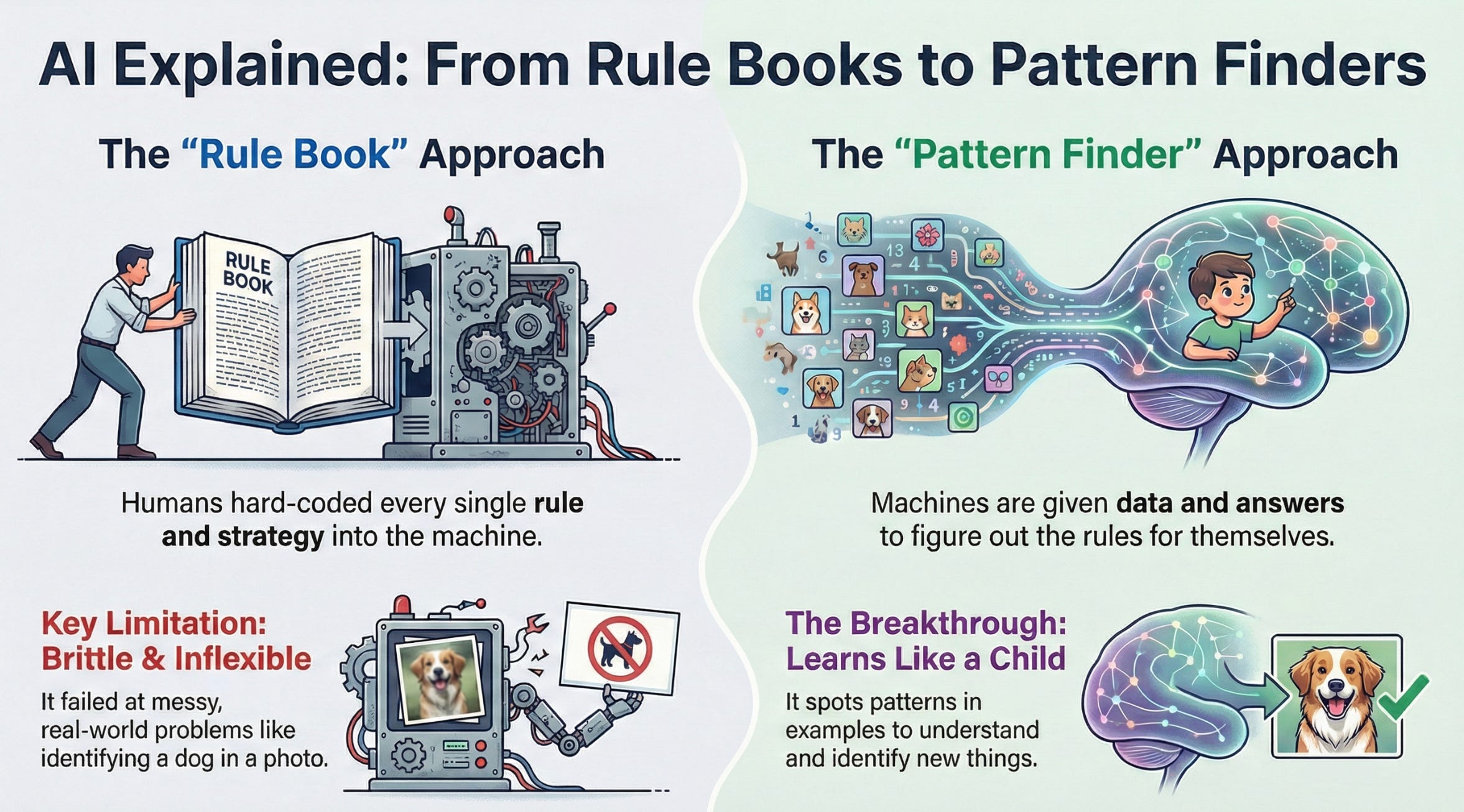
    1. The Old Way: Symbolic AI (The Rule Book)

    For a long time (from the 1950s to the 1990s), if we wanted a computer to be smart, we had to spoon-feed it rules. This was called Symbolic AI.

    Imagine you wanted to teach a computer to play Chess. You would bring in a Chess Grandmaster, sit them down with a programmer, and code every single rule and strategy into the machine. “If the opponent moves the pawn here, you move the knight there.”

    The limitation? It fails at messy, real-world problems.

    If you tried to write rules to recognize a dog in a photo, you would fail.

    • Rule 1: Has floppy ears. (What about German Shepherds?)

    • Rule 2: Has a tail. (What if the tail is hidden?)

    You cannot write enough rules to cover every possibility. Life is too complex for a rule book.

    2. The New Way: Machine Learning (The Pattern Finder)

    This is where the revolution happened. Instead of giving the computer the rules, we started giving it the data and the answers, and we let the computer figure out the rules by itself.

    The Analogy:
    Think of it like teaching a child to recognize a dog. You don’t give a toddler a definition (“Quadrupedal mammal of the genus Canis”).

    You show them a picture and say, “Dog.” You show another and say, “Dog.” You show a cat and say, “No, not dog.”
    Eventually, the child’s brain spots the patterns—the shape of the snout, the texture of the fur—and learns to recognize a dog they’ve never seen before.

    Machine Learning (ML) is exactly this. It’s a subset of AI where machines learn from data without being explicitly programmed for every single scenario.


    The Russian Nesting Doll of AI

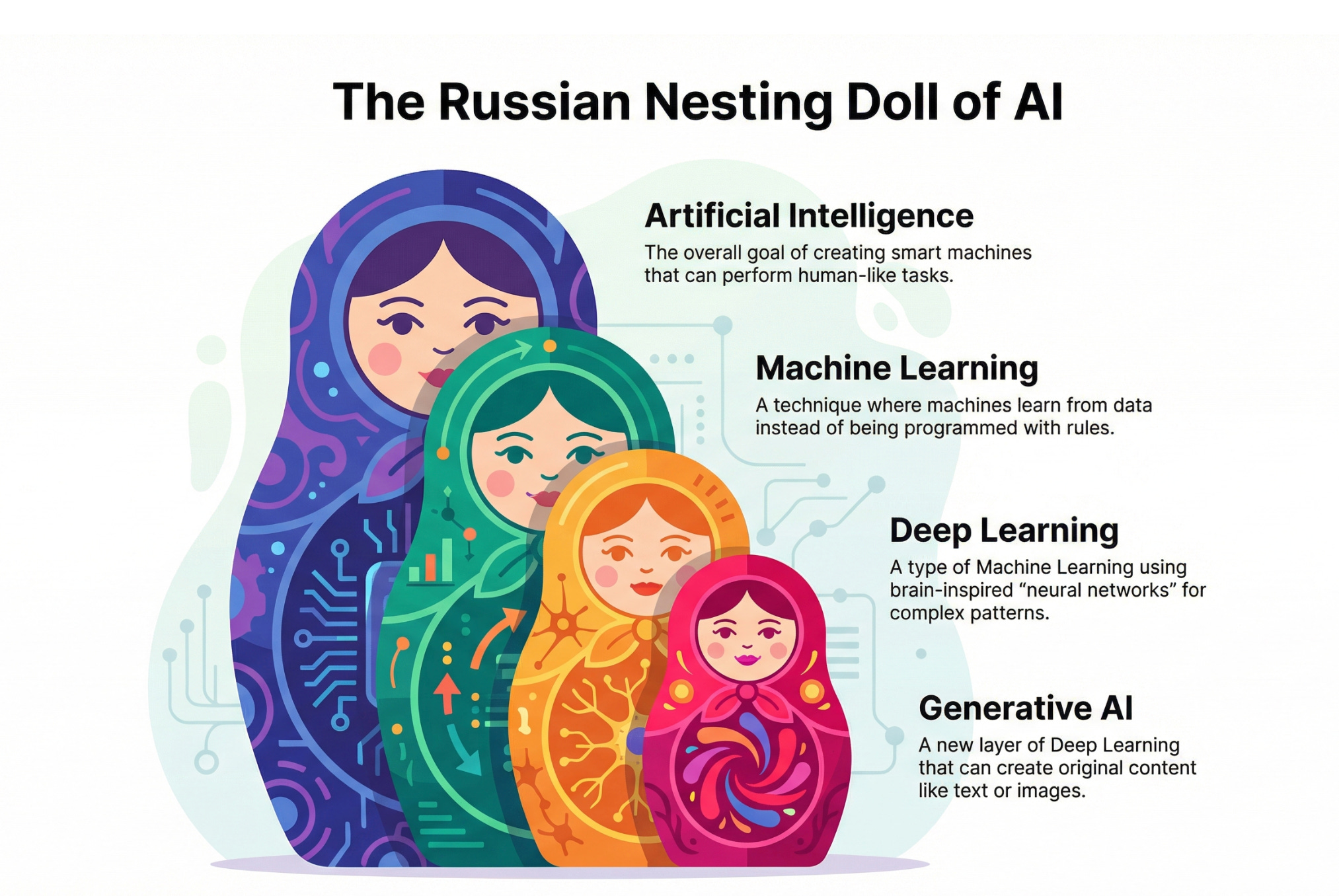
    You’ll hear terms like Machine Learning, Deep Learning, and Generative AI thrown around. It helps to visualize them as circles inside circles (or a Russian nesting doll).

    1. Artificial Intelligence (The Big Circle): The broad goal of smart machines.

    2. Machine Learning (Inside AI): The specific technique of learning from data (stats and math) rather than following hard-coded rules.

    3. Deep Learning (Inside ML): This is the superstar right now. It’s a specific type of Machine Learning inspired by the human brain. It uses layers of “neurons” (mathematical functions) to learn extremely complex patterns. When you hear about self-driving cars or ChatGPT, you’re hearing about Deep Learning.

    4. Generative AI (Inside Deep Learning): The newest layer. While traditional Deep Learning is great at classifying things (is this a cat?), Generative AI can create things (draw me a cat).


    Why Is AI Exploding Now?

    AI has been around since the 1950s. Why did it suddenly take over the world in the last decade?

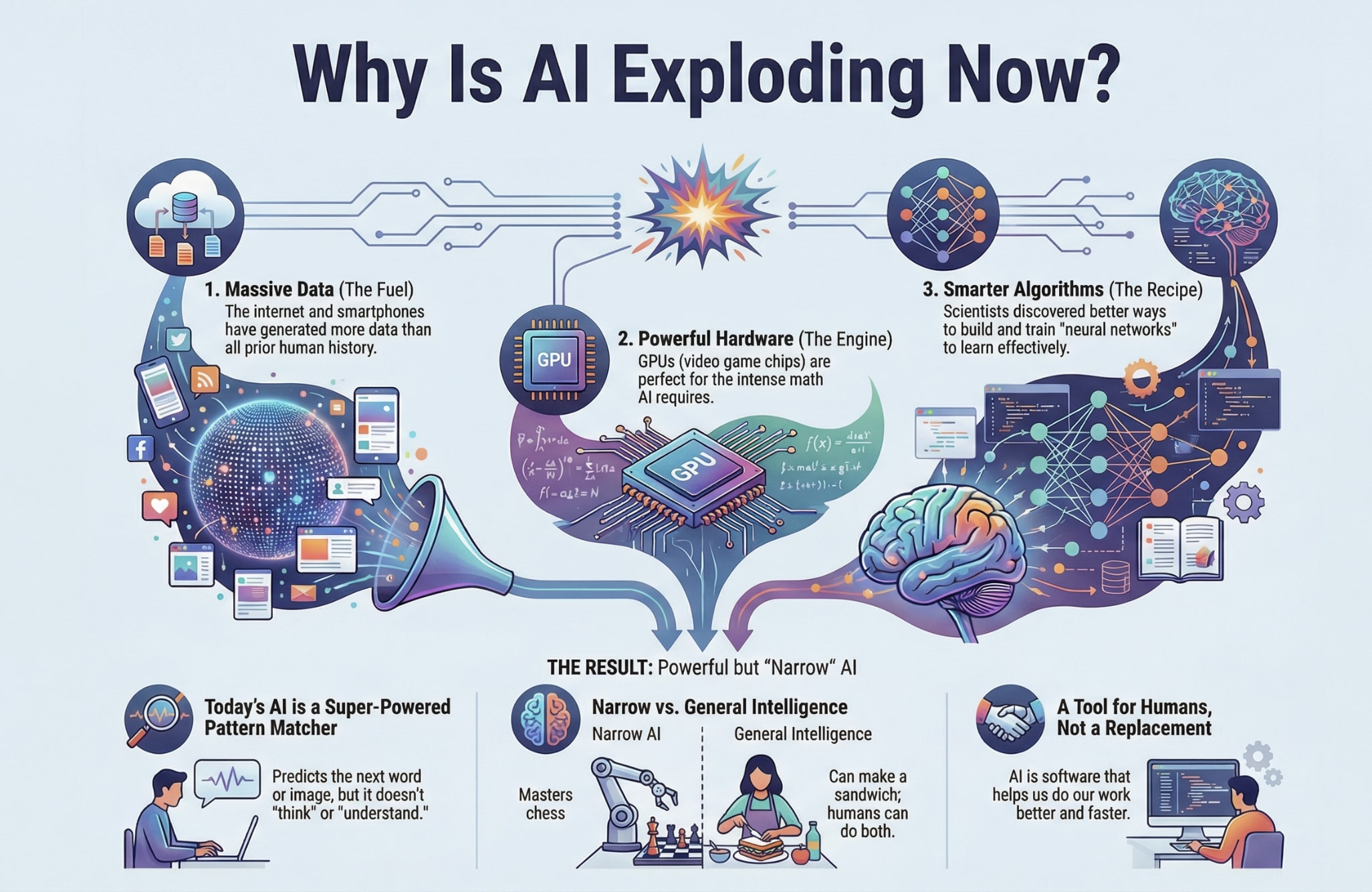
    It comes down to three ingredients:

    1. Data (The Fuel): Deep Learning is “data hungry.” It needs millions of examples to learn. Thanks to the internet and smartphones, we’ve generated more data in the last few years than in all of human history prior.

    2. Hardware (The Engine): Processing all that data requires immense power. We found that GPUs (the chips originally designed for video games) are incredibly good at doing the math required for AI.

    3. Algorithms (The Recipe): Scientists figured out smarter ways to build these “neural networks” so they don’t get stuck while learning.


    But… Is It Actually Intelligent?

    This is the most important thing for “Common Folks” to understand.

    When ChatGPT writes a poem, or a computer spots a tumor in an X-ray, it looks like intelligence. But it’s not “thinking” the way you do.

    Humans have General Intelligence. We can learn to tie our shoelaces and apply that finger dexterity to learn the piano. We have emotions, creativity, and logic.

    Current AI has Narrow Intelligence.
    A chess-playing AI can beat the World Champion, but it can’t play Tic-Tac-Toe. It can’t make a sandwich. It doesn’t know why it’s playing chess.

    It’s essentially a super-powered pattern matching machine. It has seen so much data that it can predict what should come next, whether that’s the next word in a sentence or the next stock price.


    The Takeaway

    Don’t let the sci-fi narratives scare you.

    • AI is not magic; it’s math.

    • It’s not a replacement for humans; it’s a tool for humans.

    • It’s not about robots taking over; it’s about software getting much, much better at helping us do our work.

    By reading this newsletter, you’re already stepping out of the “confused” group and into the “informed” group. You’re building AI Literacy.

    Coming Up:
    In future editions, we’ll break down exactly how these machines learn (without the calculus) and explore the tools that you can use today to make your life easier.

    Was this helpful? Reply and let us know what AI term confuses you the most!


    AI for Common Folks — Making the future make sense.