Good morning, a $29 billion AI coding company just got caught hiding the Chinese model under its hood, Elon Musk wants to build his own chip factories for space and robots, and OpenAI is offering Wall Street 17.5% returns to win the enterprise AI war. Here’s what happened 👇
1. Cursor Got Caught Building Its New AI Model on Top of a Chinese Competitor
Cursor, the AI coding tool valued at $29.3 billion and reportedly generating over $2 billion in annual revenue, launched a new model this week called Composer 2. It promoted it as “frontier-level coding intelligence.” There was just one problem: an X user quickly discovered that Composer 2 was built on top of Kimi 2.5, an open source model from Chinese company Moonshot AI, backed by Alibaba. The giveaway? The Kimi model ID was still visible in the code.
Cursor’s VP of developer education confirmed it, saying about a quarter of the compute came from the Kimi base, with the rest from Cursor’s own training. The company called it “a miss” not to mention Kimi upfront and promised to be transparent next time. Moonshot AI was gracious about it, calling it “the open model ecosystem we love to support.”
Why it matters: Building on top of a Chinese AI model is not inherently wrong. Open source is designed for this. But not disclosing it is a transparency problem, especially when the US-China AI rivalry is framed as an existential competition. If a leading American AI company quietly relies on Chinese models, it raises questions about what “American AI” actually means in practice.
Sources: TechCrunch
2. Musk Announces “Terafab” Chip Factories for SpaceX and Tesla in Austin
Elon Musk announced that SpaceX and Tesla will build two advanced chip factories at a new facility in Austin, Texas, called “Terafab.” One factory will produce chips for Tesla vehicles and Optimus humanoid robots. The other will design chips for AI satellites in space, built to handle harsher environments and higher temperatures. This is the first time SpaceX’s involvement in chip manufacturing has been confirmed publicly.
Musk claims that current global chip production meets only about 3% of his companies’ future needs. Terafab would eventually produce one terawatt of computing capacity per year, compared to about half a terawatt currently generated across the entire United States. He thanked existing suppliers like Samsung, TSMC, and Micron but said demand from his companies would eventually exceed total global output.
Why it matters: Musk has a long history of making massive announcements that face delays or never materialize. But if even part of this comes true, it signals that the biggest AI players are no longer content waiting in line for Nvidia chips. They want to own the entire supply chain, from design to fabrication. For the chip industry, this could mean more competition. For the rest of us, it means AI infrastructure is becoming a geopolitical arms race all on its own.
Sources: Reuters
3. OpenAI Is Offering Wall Street 17.5% Returns to Win the Enterprise AI Battle Against Anthropic
OpenAI is courting private equity firms like TPG and Advent International with an unusual offer: a guaranteed minimum return of 17.5%, plus early access to its newest models, in exchange for forming joint ventures that would deploy AI tools across the hundreds of companies these firms own. Anthropic is running a similar playbook but without the guaranteed returns, instead partnering with Blackstone and others.
The strategy is designed to lock in enterprise customers at scale. Once a company has a customized AI model integrated into its systems, switching to a competitor becomes very difficult. Not everyone is buying in. At least two major PE firms, including Thoma Bravo, passed after questioning the long-term economics. But the race is on: both OpenAI and Anthropic are positioning for potential IPOs, and showing strong enterprise adoption helps the story.
Why it matters: This is the clearest signal yet that AI companies are shifting from consumer hype to enterprise revenue. OpenAI and Anthropic are essentially competing to become the default AI layer for corporate America. If private equity firms deploy these tools across their portfolio companies (think hundreds of mid-size businesses overnight), it could accelerate AI adoption far faster than any consumer app ever did. The question is whether the economics actually work.
Sources: Reuters
Quick Hits
-
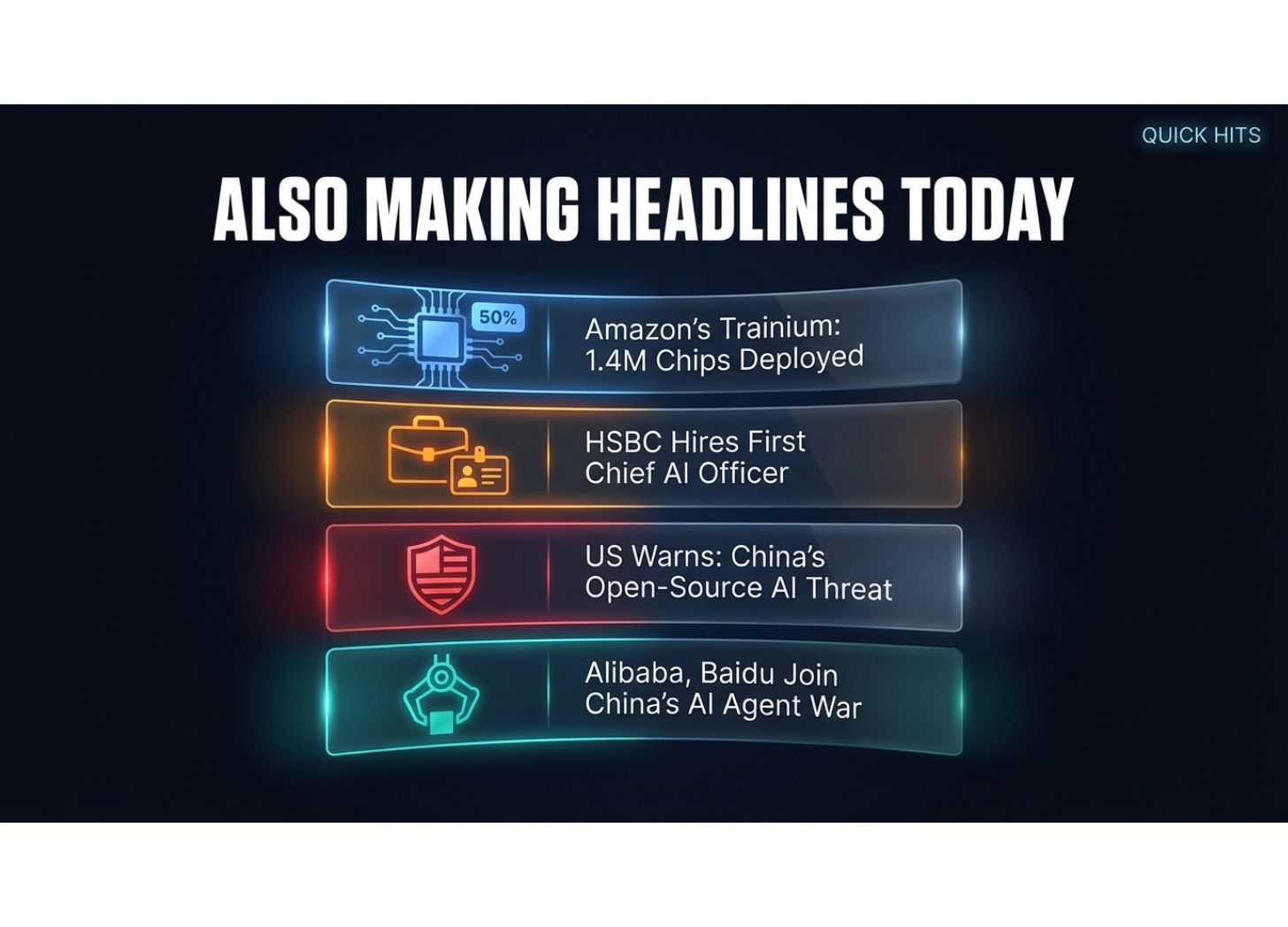
Tencent integrated WeChat with OpenClaw, adding the AI agent as a contact within the messaging app used by over 1 billion people. Alibaba and Baidu are also racing to build OpenClaw-based products. China’s AI agent war is officially on. (Reuters)
-
Amazon gave a rare inside look at its Trainium chip lab in Austin. There are now 1.4 million Trainium chips deployed, with Anthropic’s Claude running on over 1 million of them. Amazon says Trainium3 costs up to 50% less to run than comparable Nvidia setups. (TechCrunch)
-
HSBC appointed its first-ever Chief AI Officer, just days after news broke that the bank plans to cut 20,000 jobs as it bets on AI to replace back-office roles. (Reuters)
-
A US advisory body warned that China’s open-source AI dominance threatens America’s AI lead. The report comes as Chinese models like DeepSeek and Kimi are increasingly showing up in Western products. (Reuters)
That’s it for today. The thread connecting these stories is control: who controls the models, who controls the chips, who controls the enterprise relationships. The AI industry is quickly moving past “who can build the best chatbot” and into “who owns the infrastructure that everything else runs on.”
Forward this to someone who needs to stay in the loop.
Leave a Reply