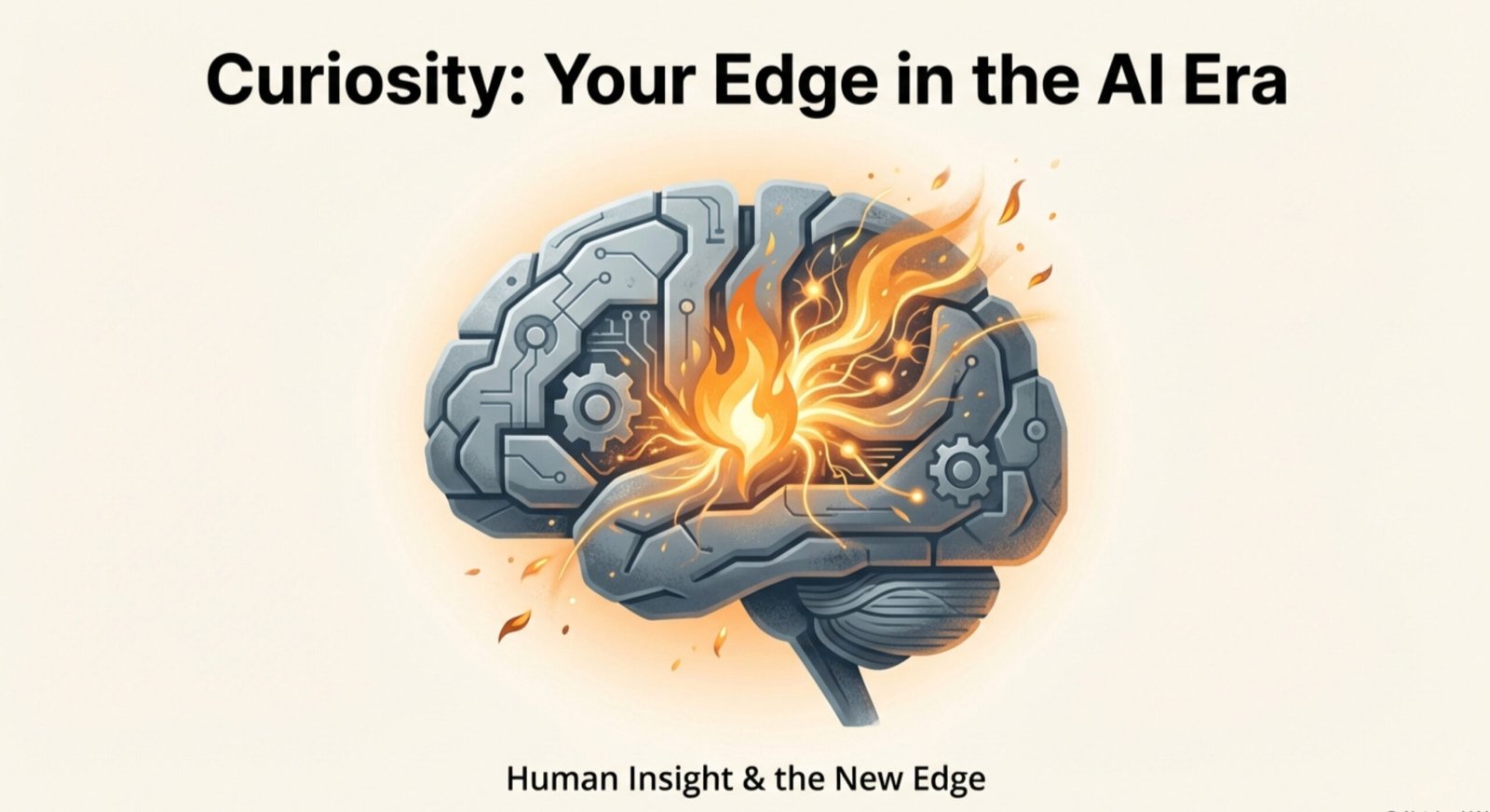
AI can answer every question. It just can’t make you care about asking them.
The Reality
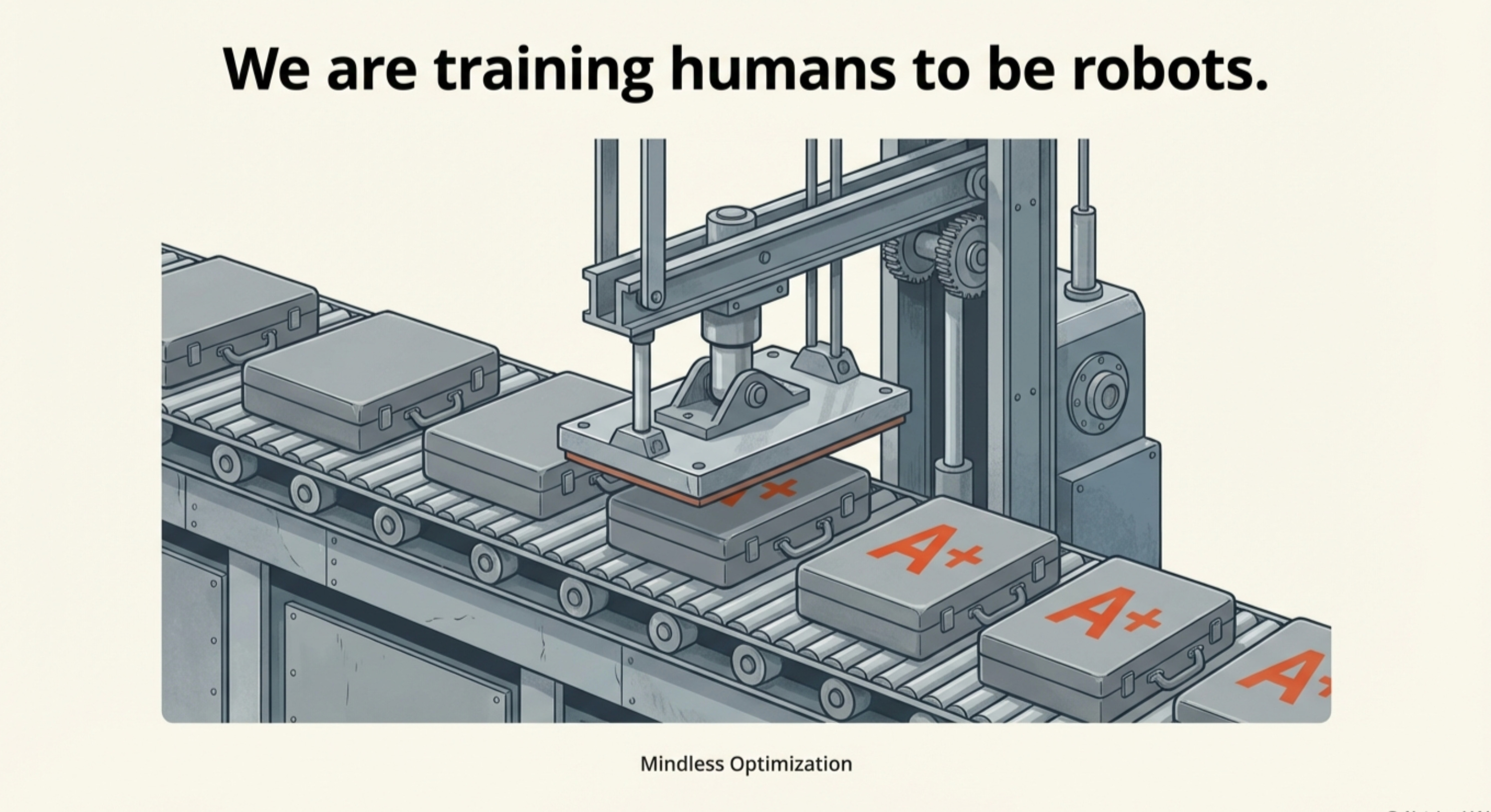
There’s a school in China that recently showed Po-Shen Loh, a Carnegie Mellon mathematician, their new AI-powered app. It was built to help students practice the exact types of problems that appear on standardized exams — optimized for score, engineered for ranking.
One of the curriculum designers turned to Loh and asked: “What do you think?”
He didn’t mince words. “If I was using AI to do education, I don’t think I would do it that way. Because I think that’s just creating people who are human versions of AI. You’re just making human robots.”
That phrase — human robots — should give you pause. Because the same dynamic playing out in Chinese test prep is playing out in offices, universities, and career paths everywhere. We’ve optimized so hard for output that we’ve stopped asking whether the output matters.
The Shift
Here’s the uncomfortable truth about the AI era: access to knowledge is no longer a competitive advantage.
For most of human history, knowing things was rare and valuable. You had to work to find information. You had to go to school, find mentors, read books, live experiences. The people who knew more had a real edge.
That edge is gone. Today, you can open any AI and ask about anything from quantum physics to the Quran to the nutritional content of obscure mushrooms — and get a thoughtful, detailed answer in seconds. “If you just want to go and interact with AI you can. Everyone can have it,” Loh said.
So if information is freely available to everyone, what’s the new differentiator?
Why you want to learn in the first place.
Loh describes two different students. One is running the standard path: study hard, rank high, get into a good university, get a job. It’s a 20-year bet. And increasingly, it’s not paying off. “A lot of people who are running along this pathway… finally they graduate and they still have no job. That’s going to be a major mental health crisis.”
The other student is driven by something internal. They ask questions because they’re genuinely curious. They dig into problems because something about them pulls. They’re not learning to rank — they’re learning because they want to do something real.
The first student is running a race that AI is winning. The second student is playing a different game entirely.
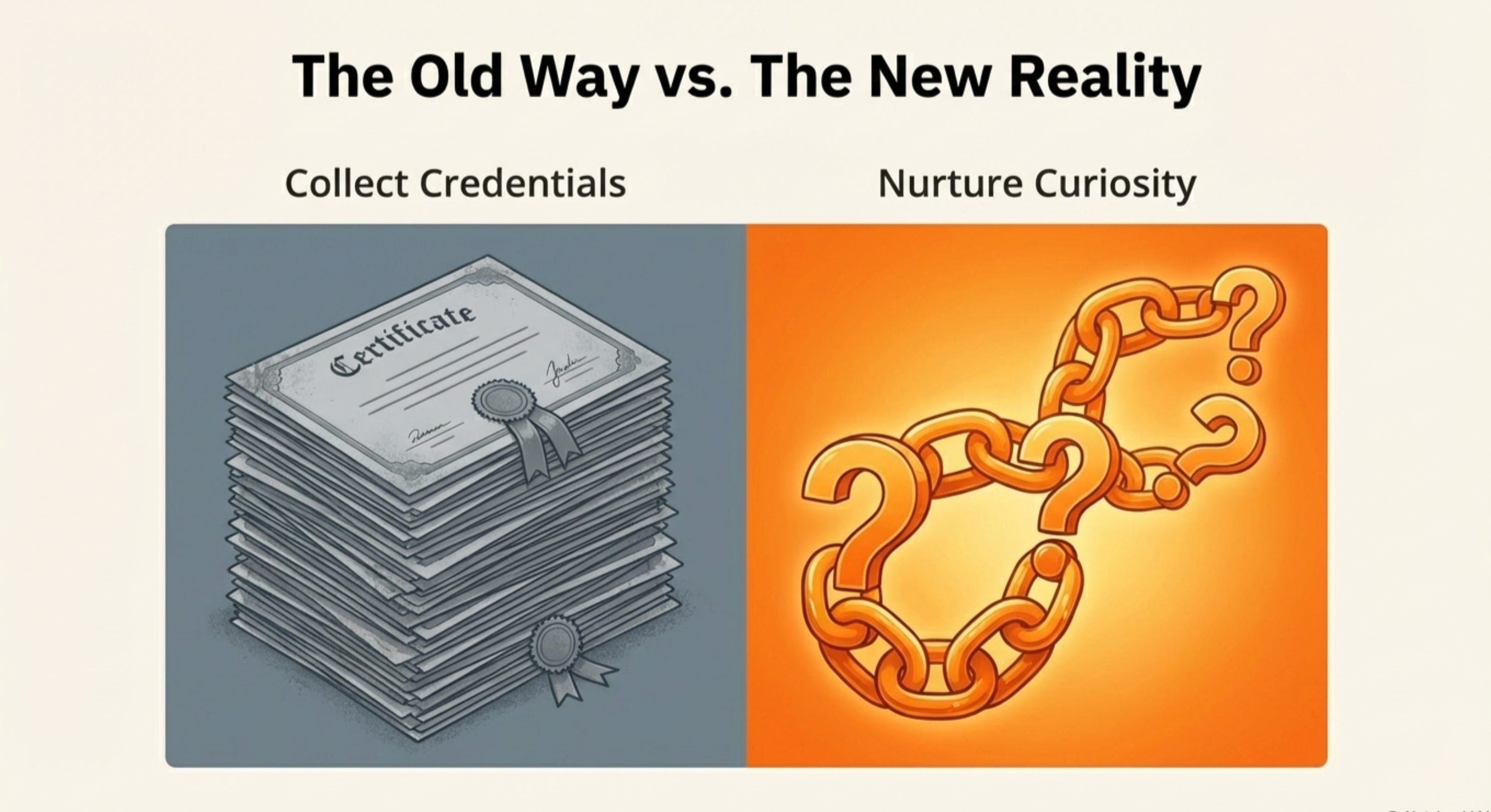
The Old Way: Consume as much knowledge and certification as possible. Credentials signal value.
The New Reality: Credentials are being commoditized. Curiosity — the kind that makes you keep going even when no one is grading you — is what actually produces original thinking.
There’s another layer here that Loh is careful about: you still need to think critically about what AI tells you. “The AI can tell you something and it sounds authoritative but it could be bogus.” Curiosity without judgment is just enthusiasm. You need to ask questions and evaluate the answers. That combination — wanting to know and being willing to scrutinize — is rare and irreplaceable.
What To Do Next
Audit where your learning comes from. Is it driven by something you genuinely want to understand? Or is it driven by a credential you’re trying to earn, a benchmark you’re trying to hit, a performance review you’re trying to pass? There’s nothing wrong with credentials, but if that’s the only motivation, you’re building on sand.
Find the thing that makes you ask the next question. Real curiosity has a chain-link quality — one answer leads to another question, which leads to another answer, which leads to another question. If your learning stops when the assignment ends, that’s a signal. If your learning continues because you got pulled down a rabbit hole, that’s a different signal.
Develop your filter. AI makes it easy to get answers. The harder and more valuable skill is knowing which answers to trust, which to question, and which to follow up on. Practice disagreeing with things you read. Look for the gaps. Notice when an answer sounds right but doesn’t quite add up.
Let purpose lead. Loh’s most consistent observation across impoverished rural communities in the US and developing countries in Africa is this: kids who want to help other people are the ones who become most curious, most engaged, and most capable. Purpose creates energy for learning that no external incentive can match. If you can connect your learning to something you actually care about, you’ll outwork and outlearn almost anyone.
The One Thing to Remember
AI has democratized access to all the world’s knowledge. The new competitive edge isn’t knowing things — it’s being genuinely curious enough to keep asking questions that matter.
This insight comes from “AI Will Create New Wealth, But Not Where You Think” featuring Po-Shen Loh, Carnegie Mellon University. The AI Shift curates wisdom from AI leaders for busy professionals navigating the AI era. What’s the last thing you learned not because you had to — but because you genuinely wanted to?
Leave a Reply