Artificial Intelligence (AI) is machines acting smartly—doing things that usually require human intelligence, like recognizing faces, understanding language, or playing chess. It’s not magic. It’s not sentient. It’s math and pattern recognition at scale.
If you’ve opened a newspaper, scrolled through Twitter (X), or sat in a corporate meeting recently, you’ve heard the term thrown around. Depending on who you listen to, AI is either going to save the world, take our jobs, or turn into a sci-fi movie villain.
Here’s the secret: Most people using the buzzwords don’t fully understand them either.
Today, we’re going to strip away the hype and the Hollywood drama. We’re going to look at what AI actually is, how it works, and why it matters to you right now.
How AI Actually Works: The Two Eras
To understand AI, you have to understand the shift from “Old AI” to “Modern AI.”
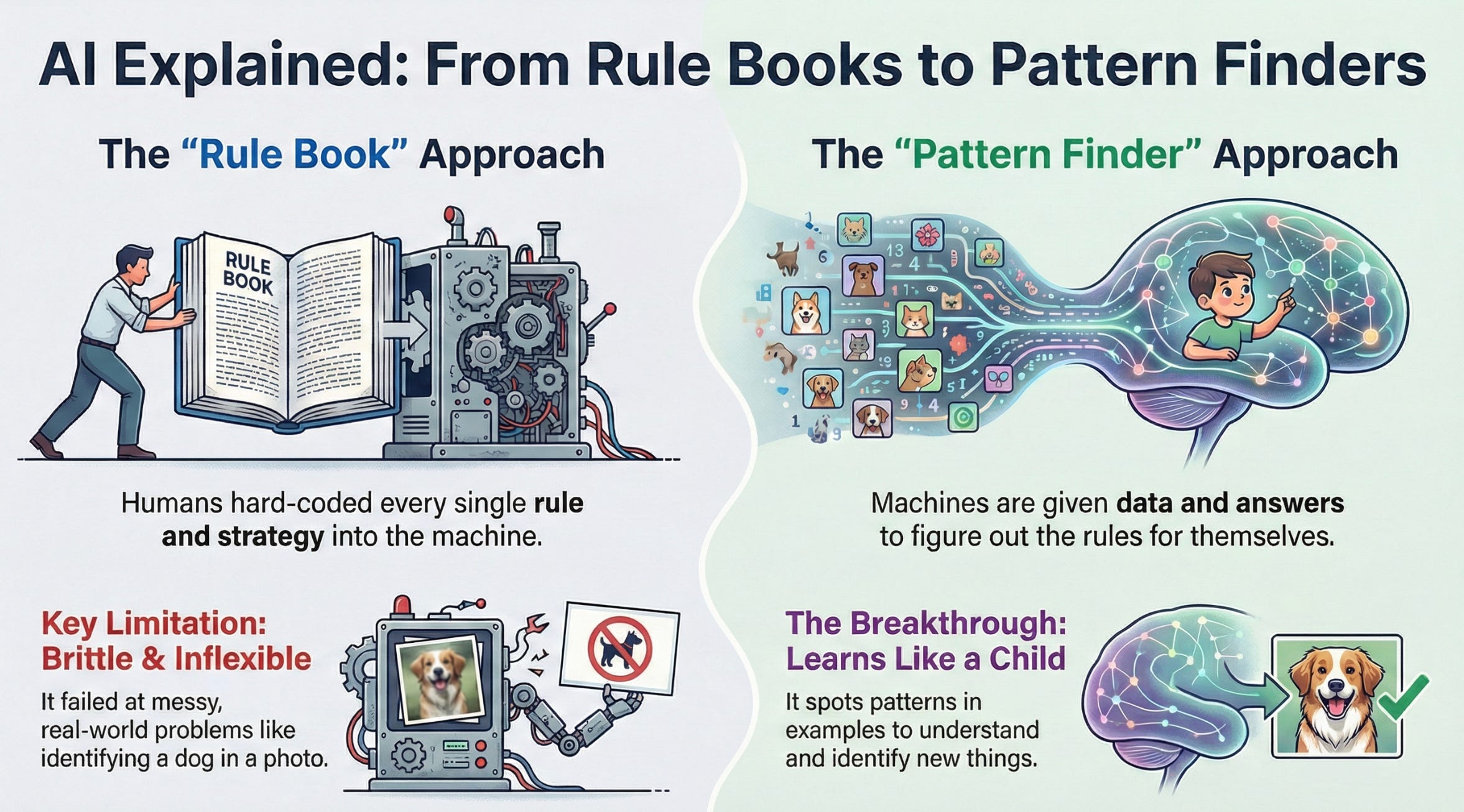
1. The Old Way: Symbolic AI (The Rule Book)
For a long time (from the 1950s to the 1990s), if we wanted a computer to be smart, we had to spoon-feed it rules. This was called Symbolic AI.
Imagine you wanted to teach a computer to play Chess. You would bring in a Chess Grandmaster, sit them down with a programmer, and code every single rule and strategy into the machine. “If the opponent moves the pawn here, you move the knight there.”
The limitation? It fails at messy, real-world problems.
If you tried to write rules to recognize a dog in a photo, you would fail.
-
Rule 1: Has floppy ears. (What about German Shepherds?)
-
Rule 2: Has a tail. (What if the tail is hidden?)
You cannot write enough rules to cover every possibility. Life is too complex for a rule book.
2. The New Way: Machine Learning (The Pattern Finder)
This is where the revolution happened. Instead of giving the computer the rules, we started giving it the data and the answers, and we let the computer figure out the rules by itself.
The Analogy:
Think of it like teaching a child to recognize a dog. You don’t give a toddler a definition (“Quadrupedal mammal of the genus Canis”).
You show them a picture and say, “Dog.” You show another and say, “Dog.” You show a cat and say, “No, not dog.”
Eventually, the child’s brain spots the patterns—the shape of the snout, the texture of the fur—and learns to recognize a dog they’ve never seen before.
Machine Learning (ML) is exactly this. It’s a subset of AI where machines learn from data without being explicitly programmed for every single scenario.
The Russian Nesting Doll of AI
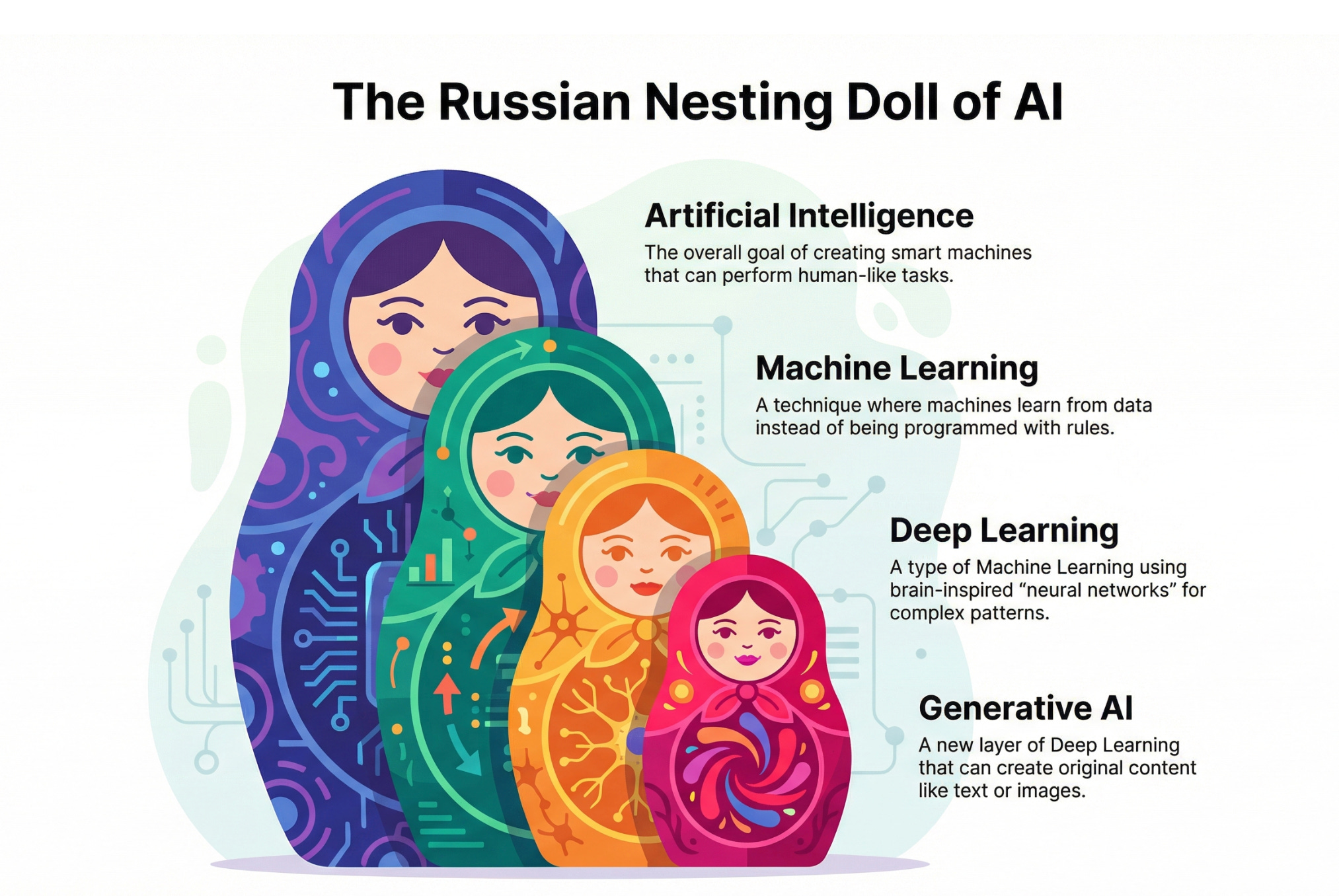
You’ll hear terms like Machine Learning, Deep Learning, and Generative AI thrown around. It helps to visualize them as circles inside circles (or a Russian nesting doll).
-
Artificial Intelligence (The Big Circle): The broad goal of smart machines.
-
Machine Learning (Inside AI): The specific technique of learning from data (stats and math) rather than following hard-coded rules.
-
Deep Learning (Inside ML): This is the superstar right now. It’s a specific type of Machine Learning inspired by the human brain. It uses layers of “neurons” (mathematical functions) to learn extremely complex patterns. When you hear about self-driving cars or ChatGPT, you’re hearing about Deep Learning.
-
Generative AI (Inside Deep Learning): The newest layer. While traditional Deep Learning is great at classifying things (is this a cat?), Generative AI can create things (draw me a cat).
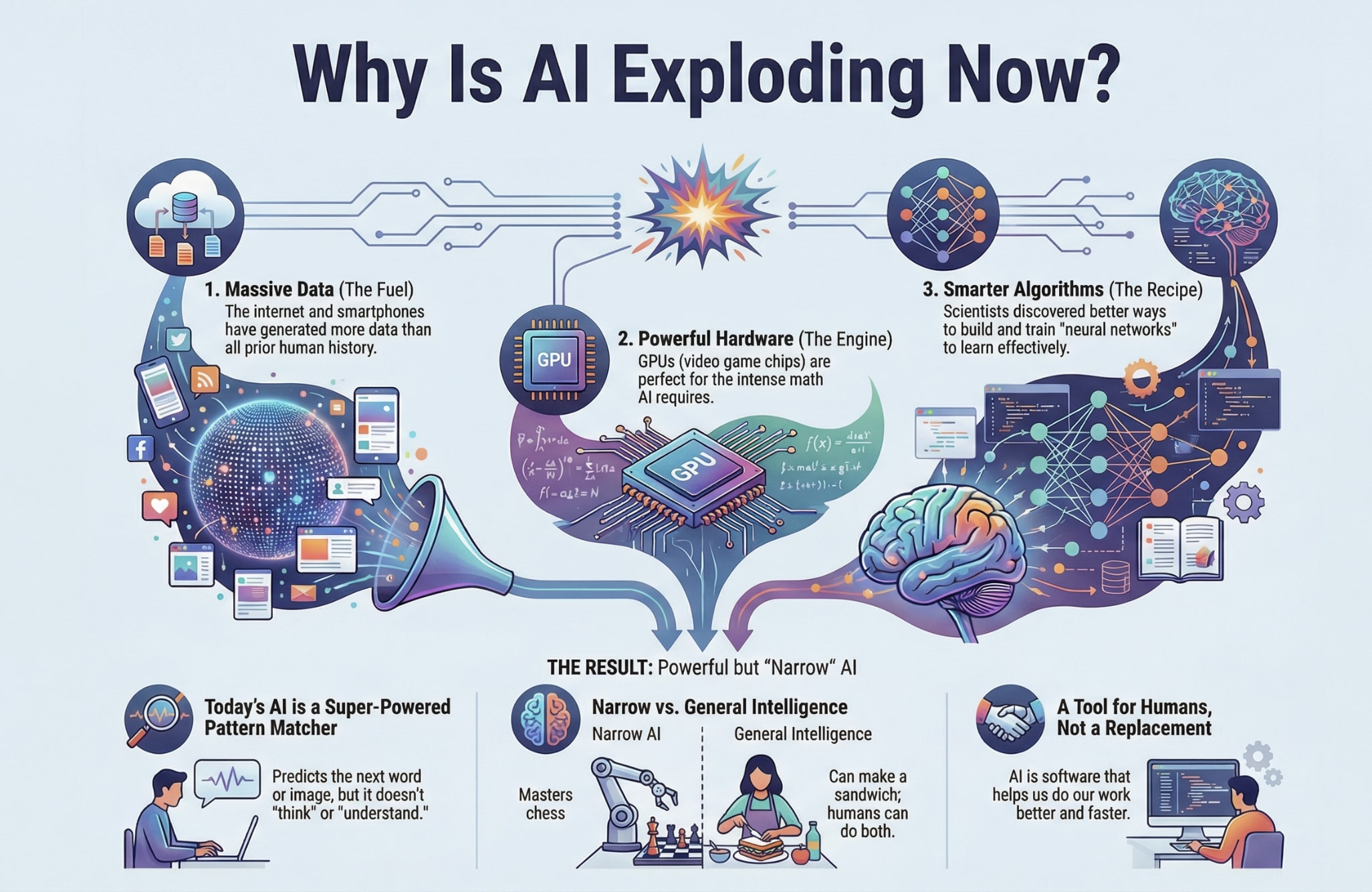
Why Is AI Exploding Now?
AI has been around since the 1950s. Why did it suddenly take over the world in the last decade?
It comes down to three ingredients:
-
Data (The Fuel): Deep Learning is “data hungry.” It needs millions of examples to learn. Thanks to the internet and smartphones, we’ve generated more data in the last few years than in all of human history prior.
-
Hardware (The Engine): Processing all that data requires immense power. We found that GPUs (the chips originally designed for video games) are incredibly good at doing the math required for AI.
-
Algorithms (The Recipe): Scientists figured out smarter ways to build these “neural networks” so they don’t get stuck while learning.
But… Is It Actually Intelligent?
This is the most important thing for “Common Folks” to understand.
When ChatGPT writes a poem, or a computer spots a tumor in an X-ray, it looks like intelligence. But it’s not “thinking” the way you do.
Humans have General Intelligence. We can learn to tie our shoelaces and apply that finger dexterity to learn the piano. We have emotions, creativity, and logic.
Current AI has Narrow Intelligence.
A chess-playing AI can beat the World Champion, but it can’t play Tic-Tac-Toe. It can’t make a sandwich. It doesn’t know why it’s playing chess.
It’s essentially a super-powered pattern matching machine. It has seen so much data that it can predict what should come next, whether that’s the next word in a sentence or the next stock price.
The Takeaway
Don’t let the sci-fi narratives scare you.
-
AI is not magic; it’s math.
-
It’s not a replacement for humans; it’s a tool for humans.
-
It’s not about robots taking over; it’s about software getting much, much better at helping us do our work.
By reading this newsletter, you’re already stepping out of the “confused” group and into the “informed” group. You’re building AI Literacy.
Coming Up:
In future editions, we’ll break down exactly how these machines learn (without the calculus) and explore the tools that you can use today to make your life easier.
Was this helpful? Reply and let us know what AI term confuses you the most!
AI for Common Folks — Making the future make sense.
Leave a Reply