Blog

  • What Is the Engine Behind ChatGPT, Claude, and Gemini?

    What Is the Engine Behind ChatGPT, Claude, and Gemini?

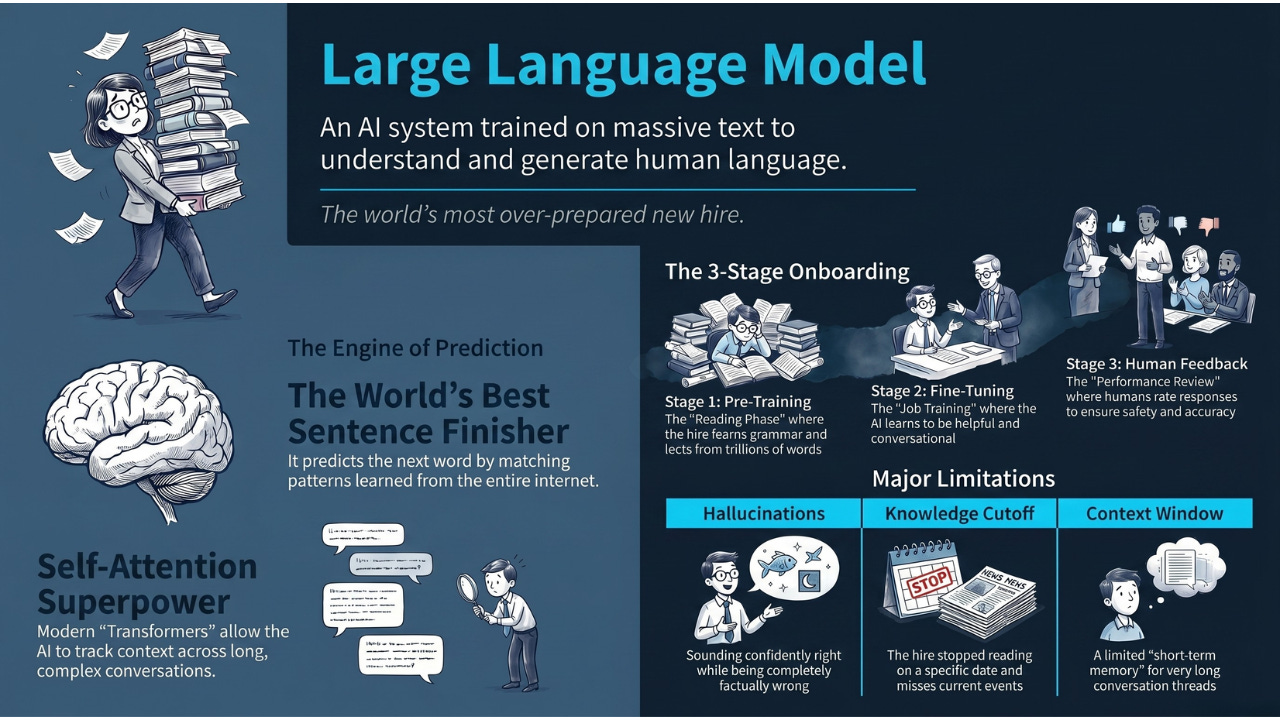
    A Large Language Model (LLM) is an AI system trained on massive amounts of text to understand and generate human language. Think of it as the world’s most over-prepared new hire, one who read every document on the internet before their first day.

    Hey Common Folks!

    In our last two articles, we covered Foundation Models, the massive general-purpose AI brains, and GPT, the most famous family in that category. We talked about the Swiss Army Knives of AI and the three-letter recipe (Generative, Pre-trained, Transformer) that cracked modern language AI.

    But GPT is just one example of a broader category. Claude, Gemini, Llama, DeepSeek — these are all in the same family. That family is called Large Language Models, or LLMs.

    And LLMs are the specific technology powering every AI chatbot you’ve ever used.

    The best way to understand one is to think of it as a new employee at your company. A very unusual one.


    Meet the New Hire

    Imagine your company just hired someone. Before their first day, they did something no human could do: they read every email, every Slack message, every report, every meeting note, every document your company has ever produced. Not just your company, actually. Every company. Every book. Every website. Every Wikipedia article. Every Reddit thread. Every piece of code on GitHub.

    They didn’t understand all of it the way you would. They didn’t form opinions or have experiences. But they noticed patterns. They noticed that after “Dear” people usually write a name. That after “quarterly revenue increased” people usually write “by” followed by a percentage. That when someone asks “how do I” the next words are usually a task, followed by step-by-step instructions.

    This new hire didn’t memorize facts like a textbook. They memorized how language flows. They can finish anyone’s sentence, in any department, on any topic, because they’ve seen millions of similar sentences before.

    That’s an LLM. That’s the whole idea.


    The World’s Best Sentence Finisher

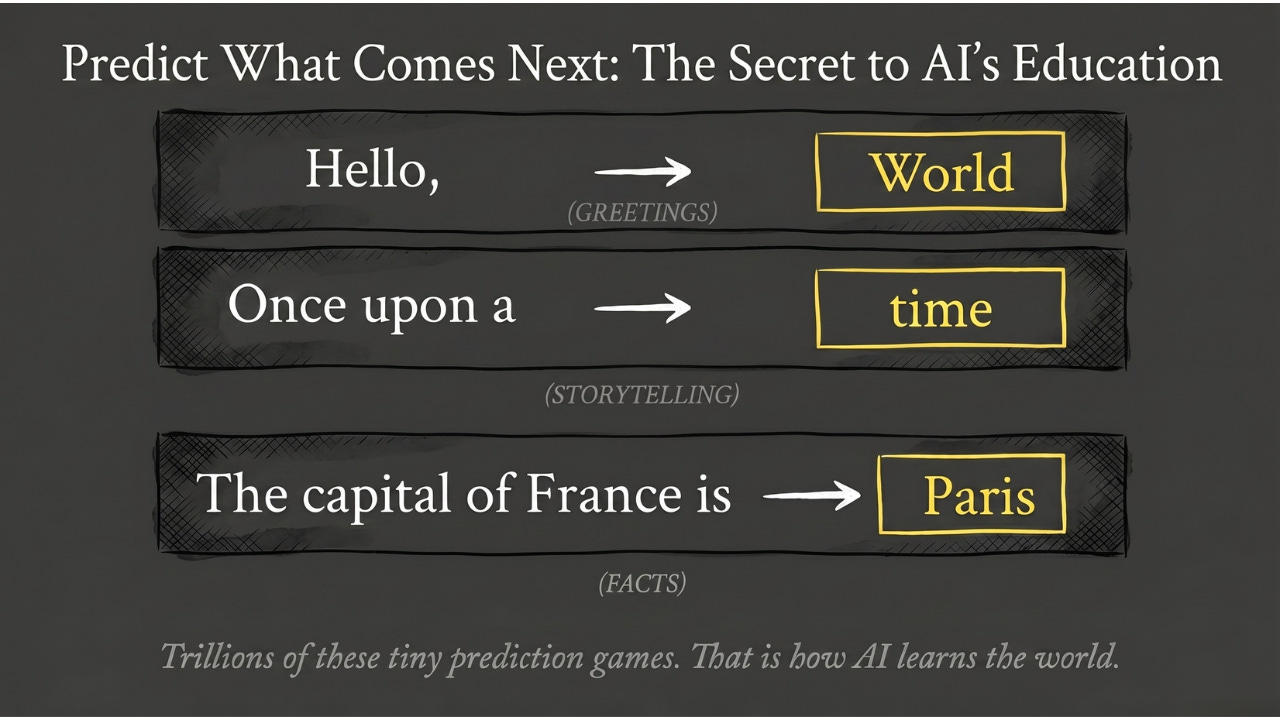
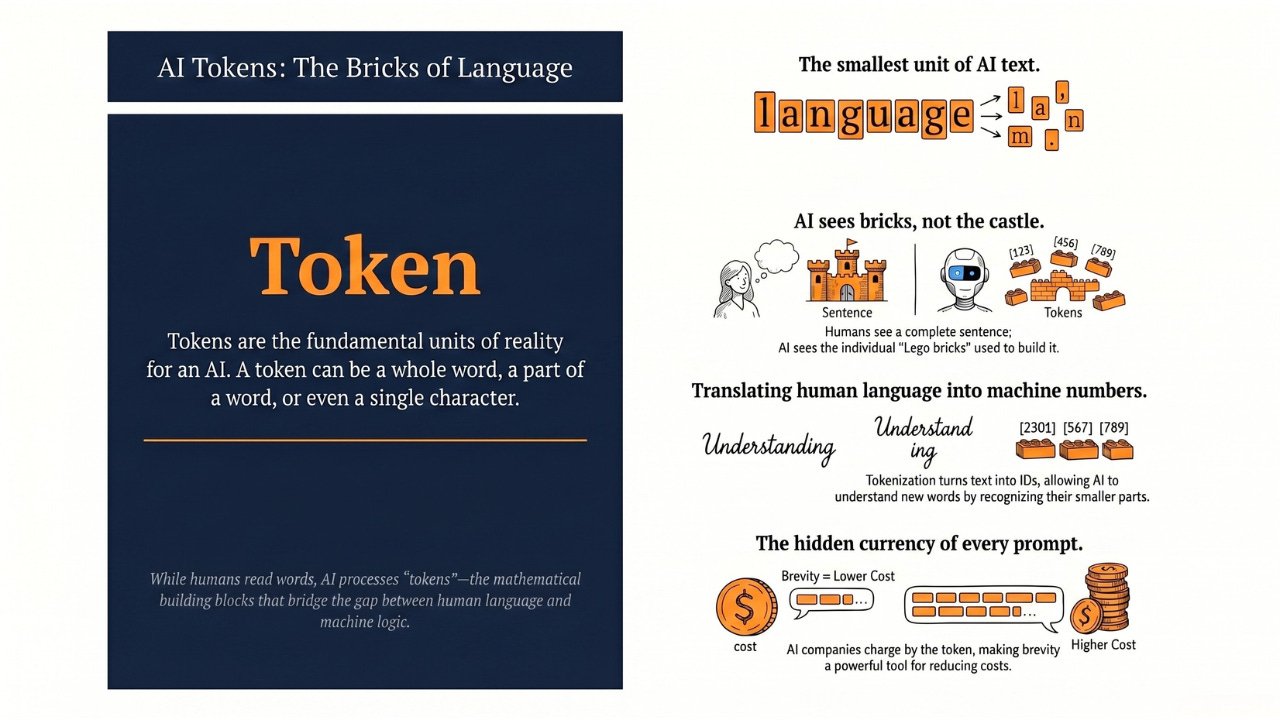
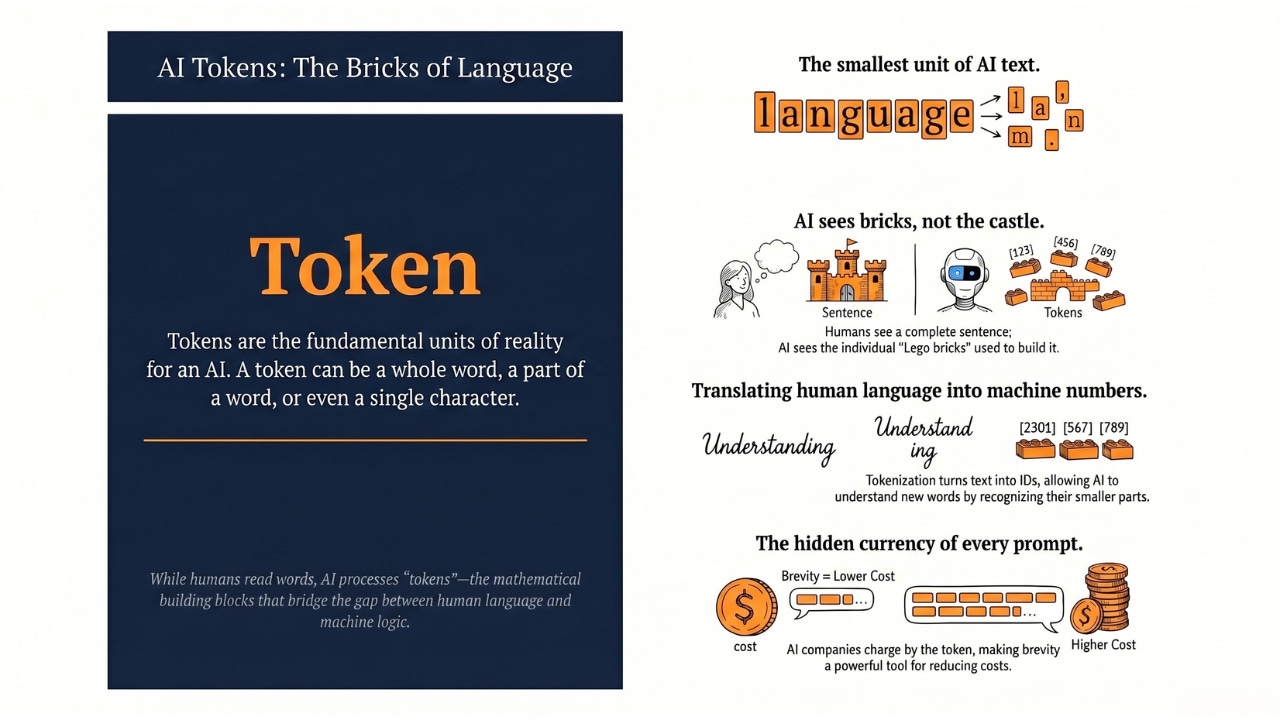
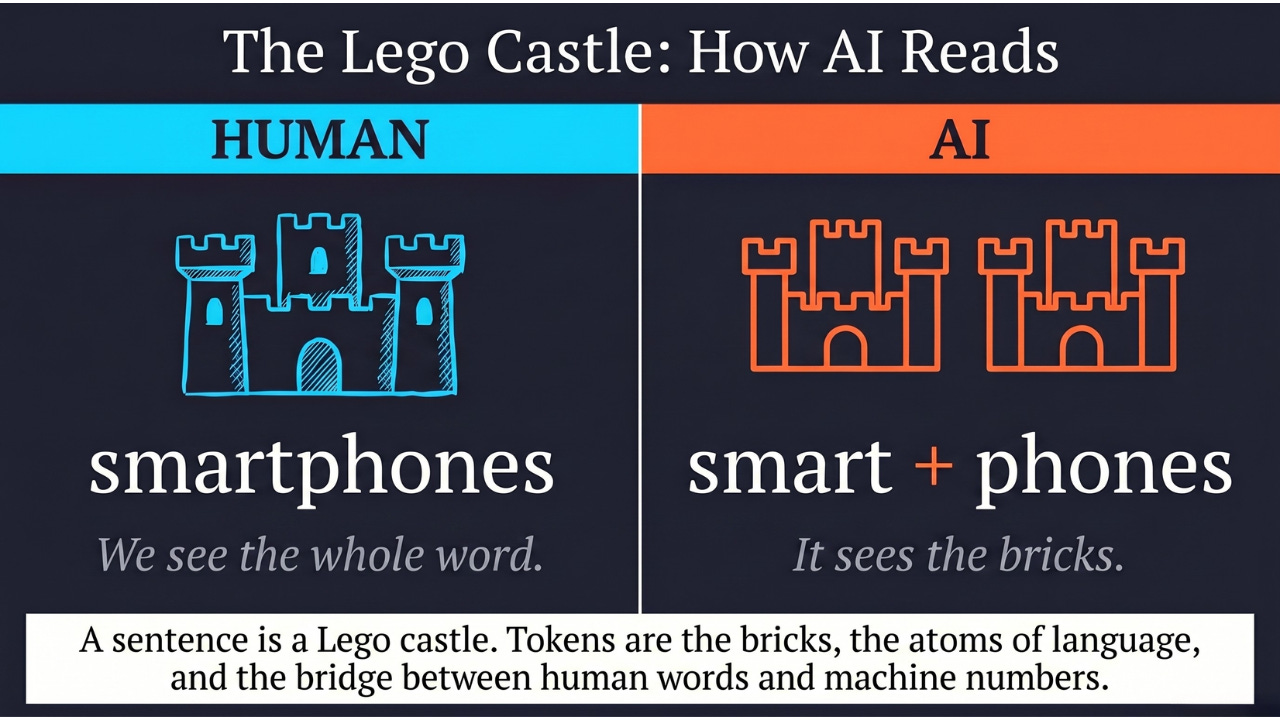
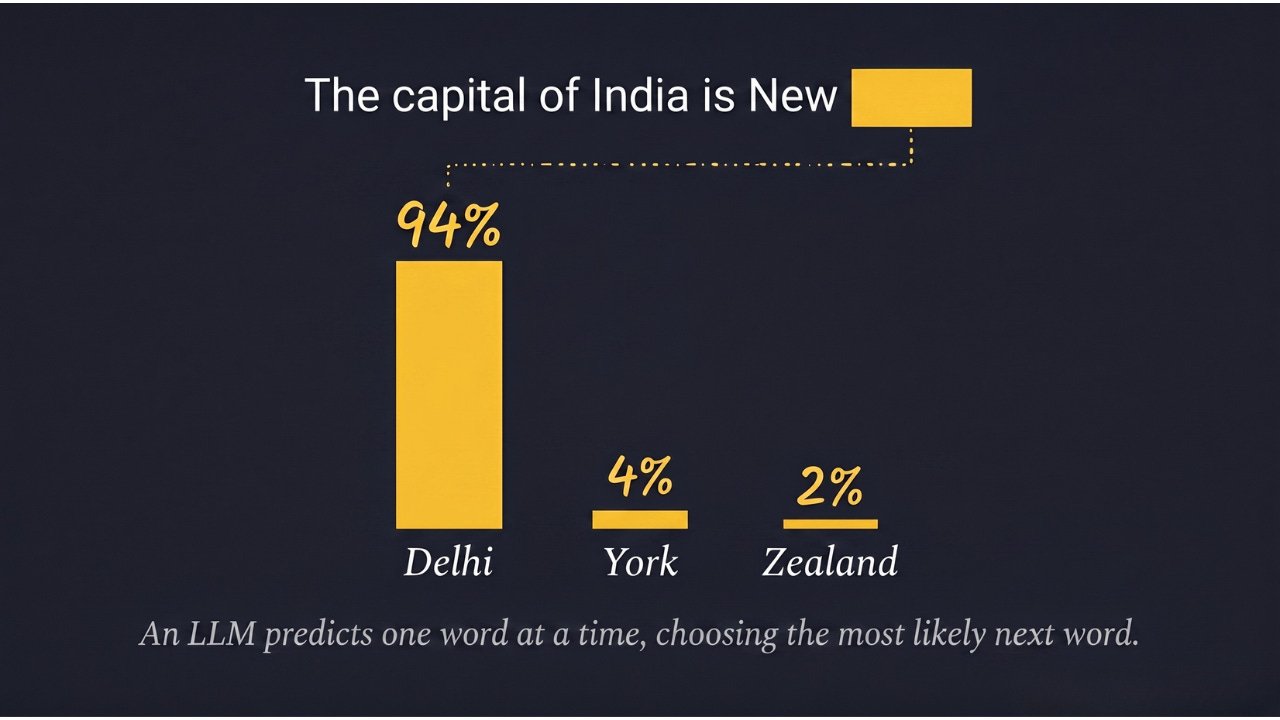
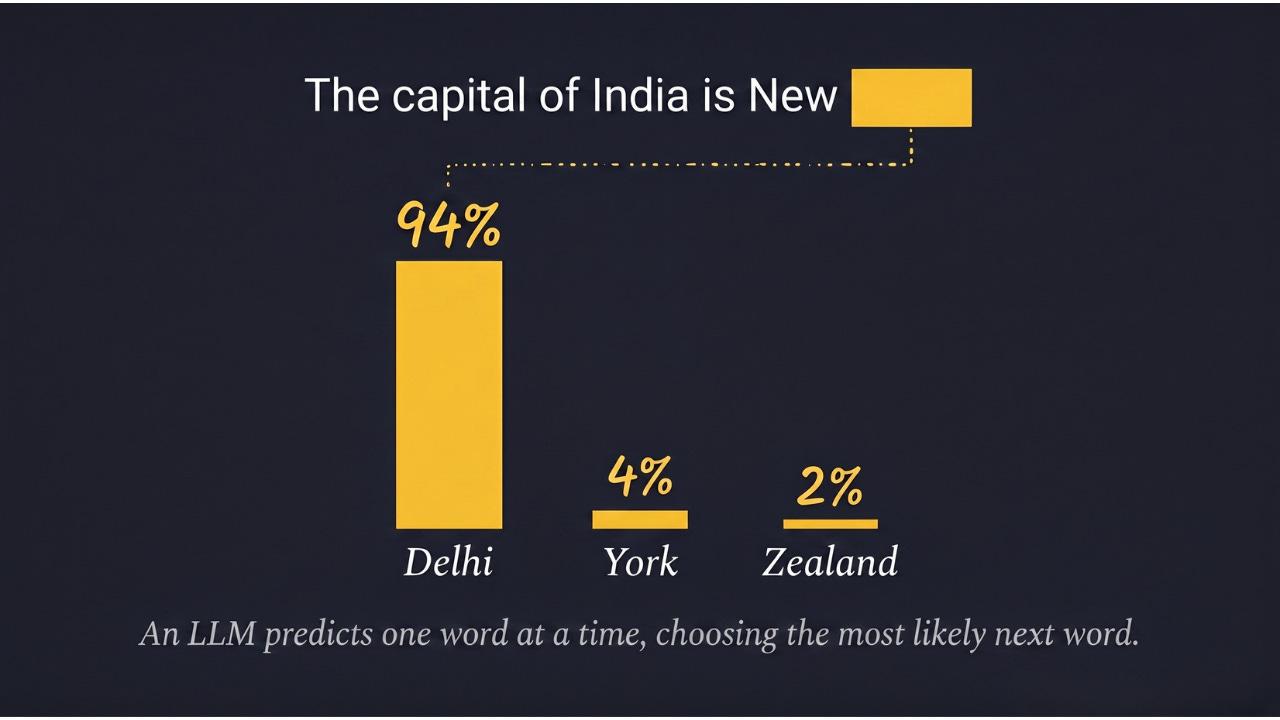
    At its core, an LLM does one thing: predict the next word. (Technically, it predicts the next token — a small chunk of text that’s usually a word or part of a word. We’ll cover tokens in a future article. For now, “word” is close enough.)

    You actually do this too. If I say: “The capital of India is New…”

    Your brain instantly completes: “Delhi.”

    You didn’t look it up. You’ve seen those words together enough times that the completion is automatic.

    Your phone does this too. You type “I am on my…” and your keyboard suggests “way.” Your phone learned this pattern from your text messages.

    Now scale that up dramatically.

    Your phone looks at the last 3 words to guess the next one. An LLM looks at the last 300,000 words. Your phone learned from your texts. An LLM learned from the entire internet.

    Back to our new hire analogy: imagine asking them to finish this sentence: “Based on our Q3 projections and the current market conditions, the board recommends that we…”

    Because they’ve read millions of similar corporate emails, they know what typically comes next. Not because they understand finance. Because they’ve seen this pattern thousands of times. They’re pattern-matching at a scale no human could match.

    That’s how ChatGPT writes entire paragraphs. One word at a time, each chosen because it’s the most likely continuation of everything before it. Like a new hire who’s so well-read that they can finish any sentence in any department.


    How the New Hire Follows Conversations

    Here’s where it gets interesting. Early AI systems were terrible at long sentences. Tell them a long story and by the end, they’d forgotten the beginning. Like a new hire who nods along in a meeting but can’t connect what was said in minute one to what’s being discussed in minute thirty.

    Then in 2017, researchers at Google published a breakthrough called the Transformer. (The “T” in GPT stands for Transformer. That’s how fundamental this is.)

    Transformers gave LLMs a superpower called self-attention. Here’s what that means.

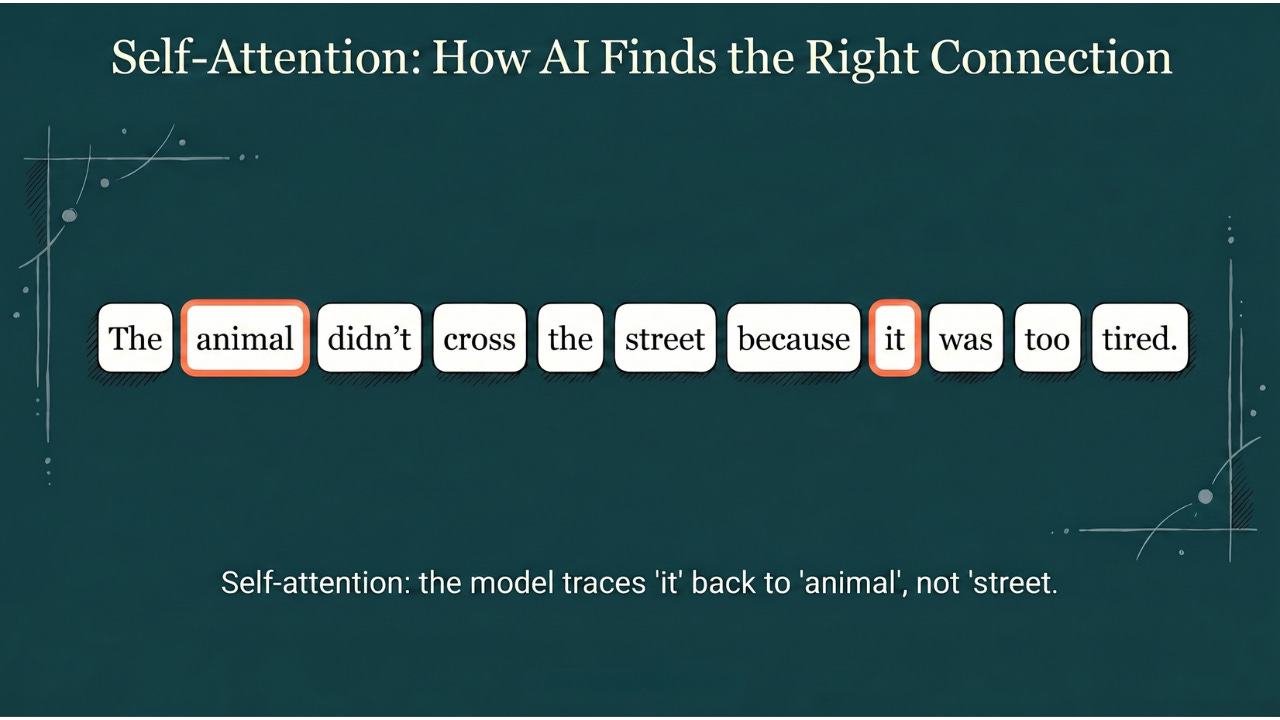
    Consider this sentence: “The animal didn’t cross the street because it was too tired.”

    What does “it” refer to? The animal or the street?

    You know “it” means the animal because the animal is “tired.” Streets don’t get tired.

    Before transformers, AI would struggle with this. It read words one by one, left to right, and by the time it got to “it,” the word “animal” was already fading from memory.

    Self-attention changed that. Now the LLM looks at all the words in the sentence at once and draws connections between them. When it hits the word “it,” it checks: what does “it” connect to? It sees “tired” and traces back to “animal,” not “street.” It understands the relationship.

    Back to our new hire: imagine they’re reading a 50-page email thread where someone says “she approved the budget.” Self-attention is how the new hire traces “she” back to the CFO mentioned 30 emails ago, not the intern mentioned 2 emails ago. They can follow references across long, messy conversations.

    This is what lets LLMs understand context, answer follow-up questions, get jokes, and write code that actually makes sense across hundreds of lines. Before transformers, AI was like a new hire reading one word at a time and forgetting the beginning of the email by the end. After transformers, they can hold the entire conversation in their head at once.


    Training the New Hire: Three Stages

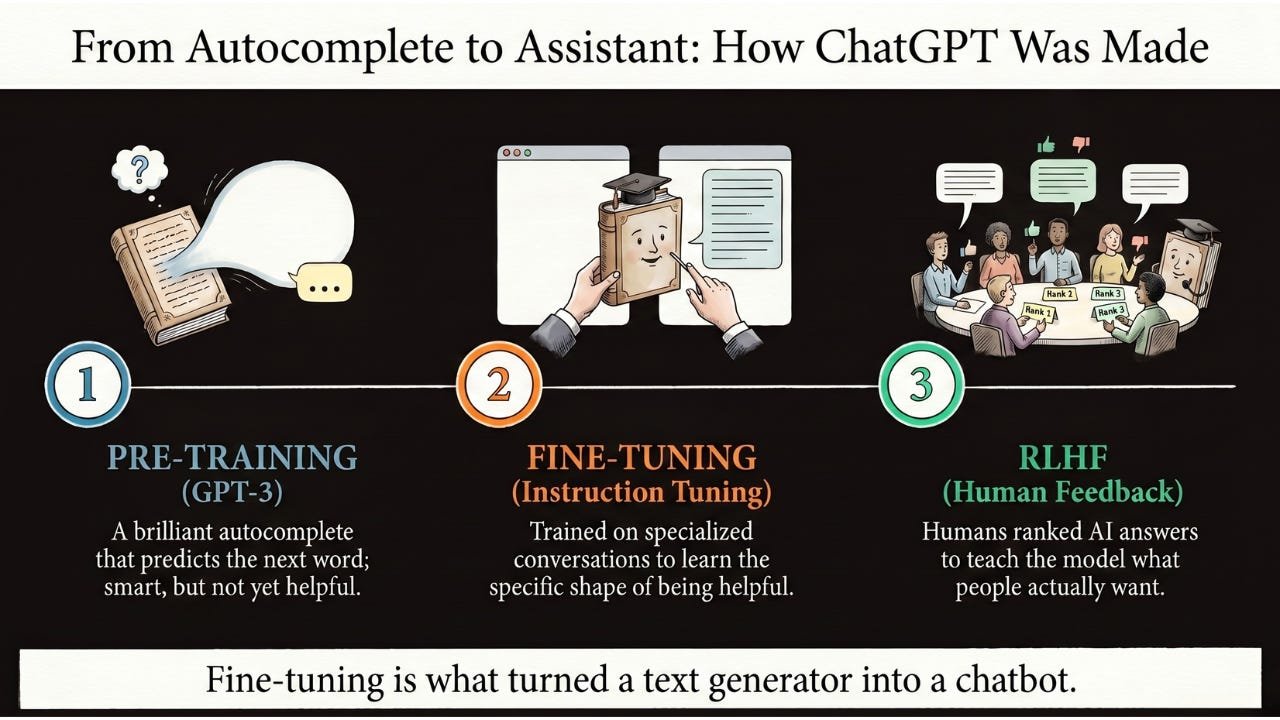
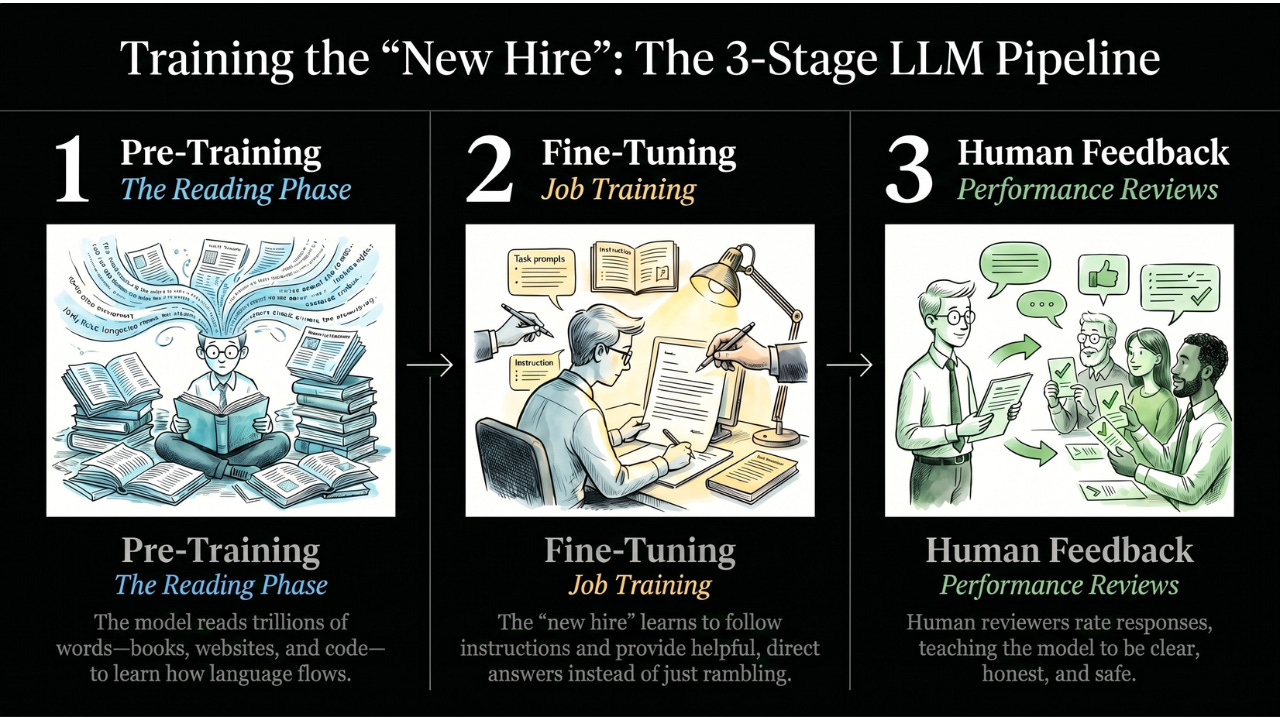
    Building an LLM like ChatGPT or Claude isn’t one step. It’s an onboarding process with three stages. Just like any new hire goes through orientation before they’re ready to talk to customers.

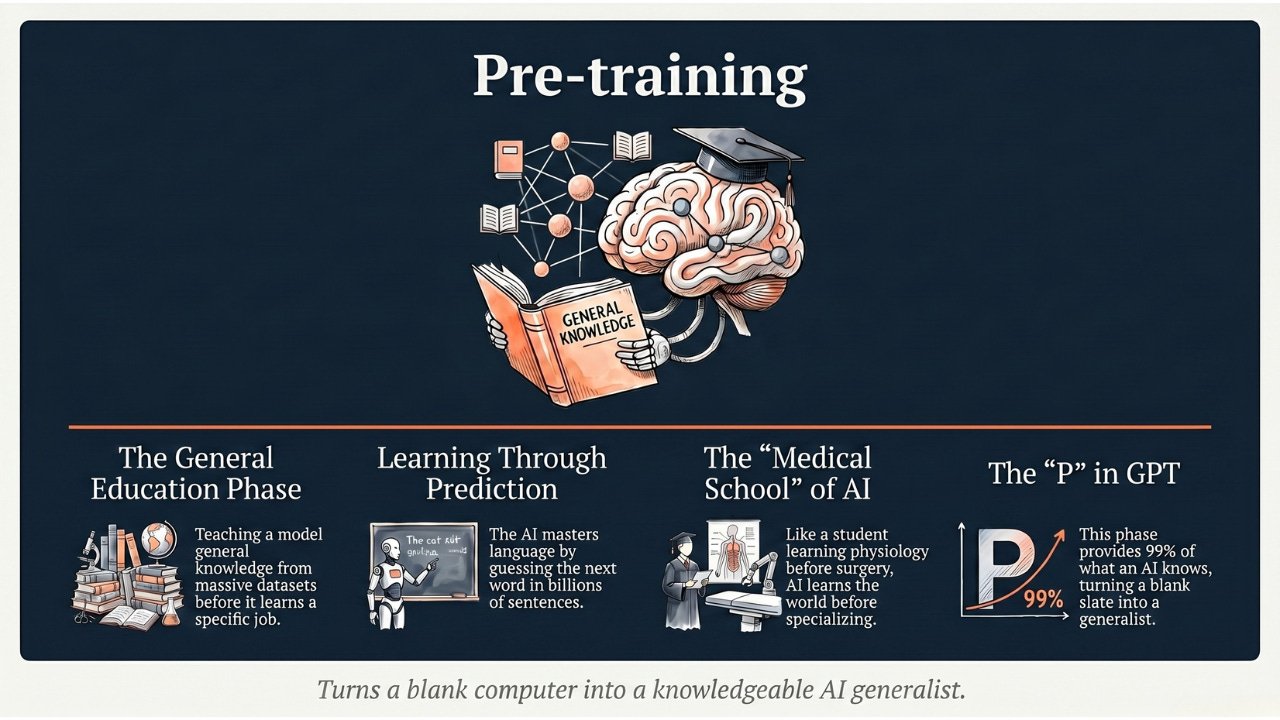
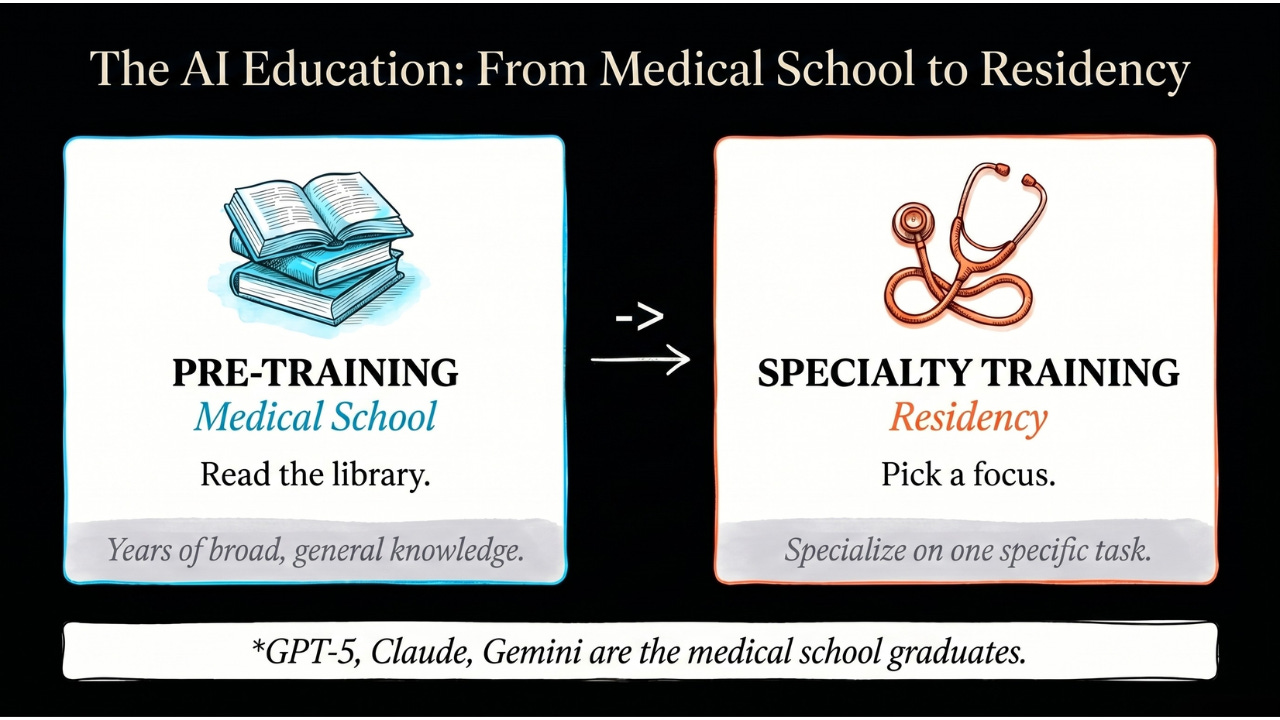
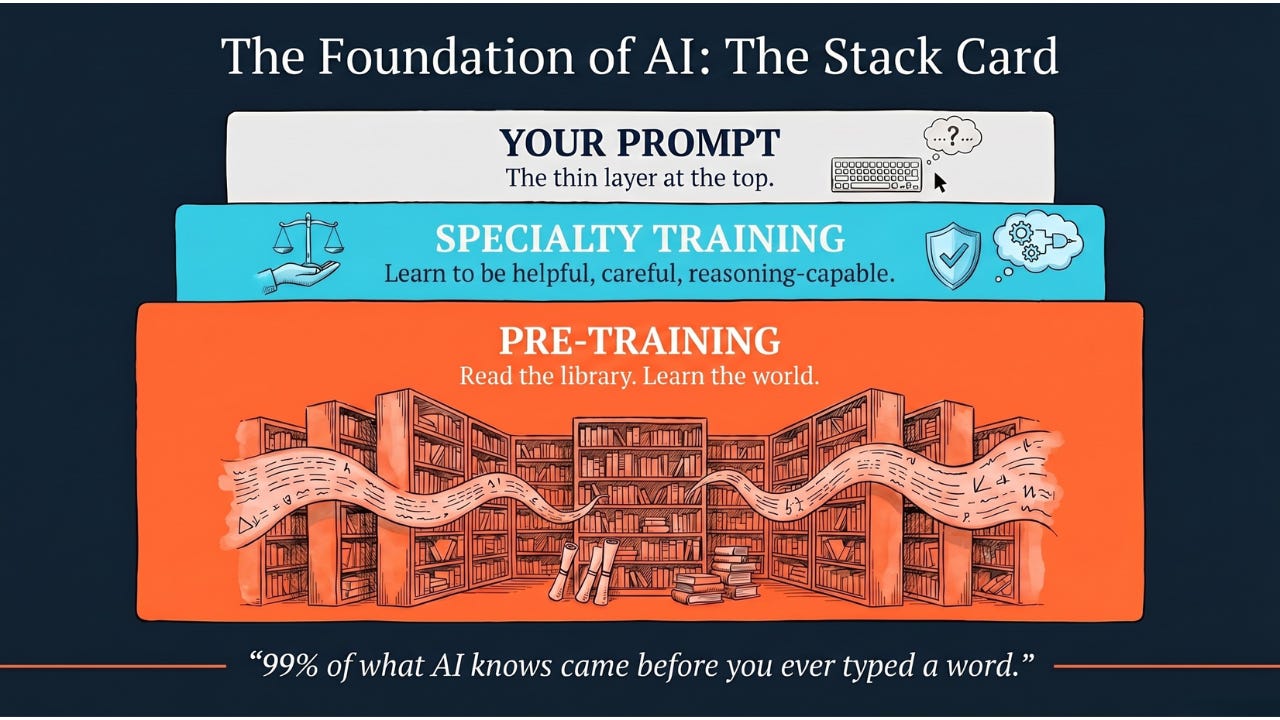
    Stage 1: The Reading Phase (Pre-Training)

    This is where the new hire reads everything. Terabytes of text. Books, websites, Wikipedia, code, academic papers.

    During this phase, the LLM plays a game: we hide a word in a sentence and ask it to guess. If it guesses wrong, it adjusts its internal settings. (Remember the chai analogy? Same loop. Predict, check the error, adjust, repeat. Millions of times.)

    Those “internal settings” are called parameters. Think of them as tiny dials. Modern frontier models (GPT-5, Claude 4, Gemini 2) are believed to have trillions of them, though the exact numbers are kept secret. Each dial is like one of the chai recipe settings from our previous article: a small adjustment that slightly changes the output. Together, trillions of tiny dials produce language that sounds remarkably human.

    That’s what “Large” means in Large Language Model. Large = trillions of adjustable dials, trained on a massive amount of text.

    After pre-training, the new hire knows grammar, facts, writing patterns, coding conventions, and the general structure of human communication. But they’re not helpful yet. Ask them a question and they’ll just keep writing, trying to complete the sentence rather than answer you. They’re like a new hire who’s read the entire company wiki but doesn’t know how to have a normal conversation.

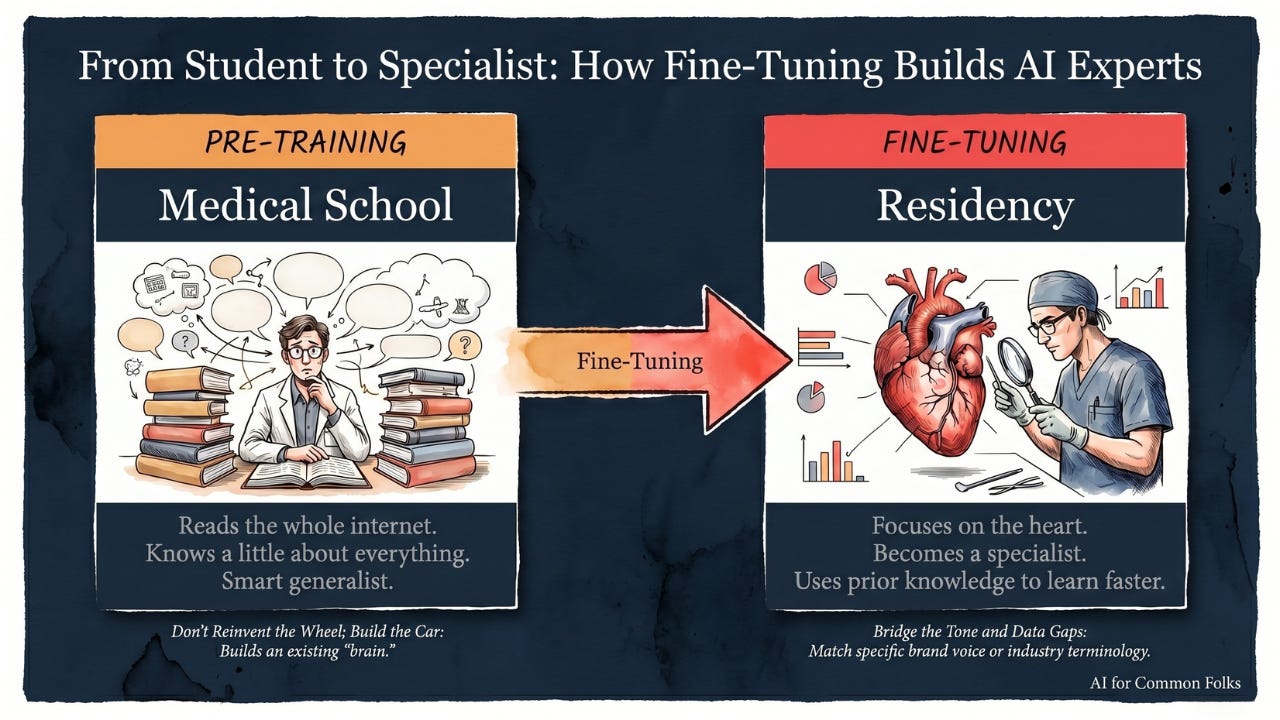
    Stage 2: Job Training (Fine-Tuning)

    Now we teach the new hire how to actually do their job.

    We show them thousands of examples of good conversations:

    • Customer asks: “How do I reset my password?”

    • Good response: “Here are the steps: go to Settings, click Security…”

    • Bad response: “…and also how to reset your username and your profile picture and your billing information and…”

    The new hire learns the format: when someone asks a question, give a direct, helpful answer. Don’t ramble. Don’t go off on tangents.

    This is fine-tuning. Same new hire, same knowledge from the reading phase, but now they know how to channel it into a helpful conversation instead of an endless monologue.

    Stage 3: Performance Reviews (Human Feedback)

    The new hire is now having real conversations. But sometimes they’re rude. Sometimes they make things up. Sometimes they give dangerous advice.

    So we bring in human reviewers. They chat with the LLM and rate the responses. Helpful and accurate? Thumbs up. Rude, wrong, or harmful? Thumbs down.

    The model learns: “Humans prefer it when I’m clear, honest, and careful. They don’t like it when I make things up or lecture them.”

    Think of it as ongoing performance reviews. The new hire adjusts their behavior based on what gets positive feedback and what gets complaints.

    This last stage is why ChatGPT and Claude feel different from each other even though they’re both LLMs. Different companies hire different reviewers with different values. Same new hire, different management styles, different workplace cultures.


    When the New Hire Makes Things Up

    Here’s the catch with our new hire. They’re so well-read and so good at sounding confident that sometimes they make things up. And they deliver the fiction with the exact same confidence as the facts.

    This is called hallucination.

    Remember: the LLM predicts the next most likely word. It doesn’t have a database of facts. It doesn’t “look things up.” It generates text that sounds right based on patterns.

    Imagine asking the new hire: “Who designed the Golden Gate Bridge?”

    They’ve read enough about bridges and famous people that they might say: “The Golden Gate Bridge was designed by Thomas Edison in 1932.” That sentence is completely wrong. But it sounds like a fact. It has the right structure, the right confidence, the right rhythm of a true statement.

    The new hire isn’t lying on purpose. They’re doing what they always do: predicting what the most likely next words would be. And sometimes the most likely-sounding answer isn’t the true answer.

    This is the single most important thing to understand about LLMs: they are designed to sound right. Not to be right.

    Often they are right, because patterns in language usually reflect reality. But not always. And they’ll never pause and say “Actually, I’m not sure about this.” They’ll just keep predicting the next most confident-sounding word.


    Where You Already Use LLMs

    You interact with this new hire more than you realize. They’ve been placed in departments all across your digital life:

    • ChatGPT, Claude, Gemini: The obvious ones. Every conversation is an LLM predicting one word at a time.

    • Email: Gmail’s “Help me write” and Outlook’s Copilot. The new hire is drafting your emails.

    • Code: GitHub Copilot suggests code as developers type. The new hire sits next to every programmer.

    • Search: Google and Bing now use LLMs to summarize search results instead of just showing links. The new hire reads all the results and writes you a summary.

    • Customer service: Many companies have replaced scripted chatbots with LLM-powered support. The new hire handles your complaints now.


    The New Hire’s Limitations (Keeping It Real)

    Our new hire is impressive. But they have real weaknesses you should know about:

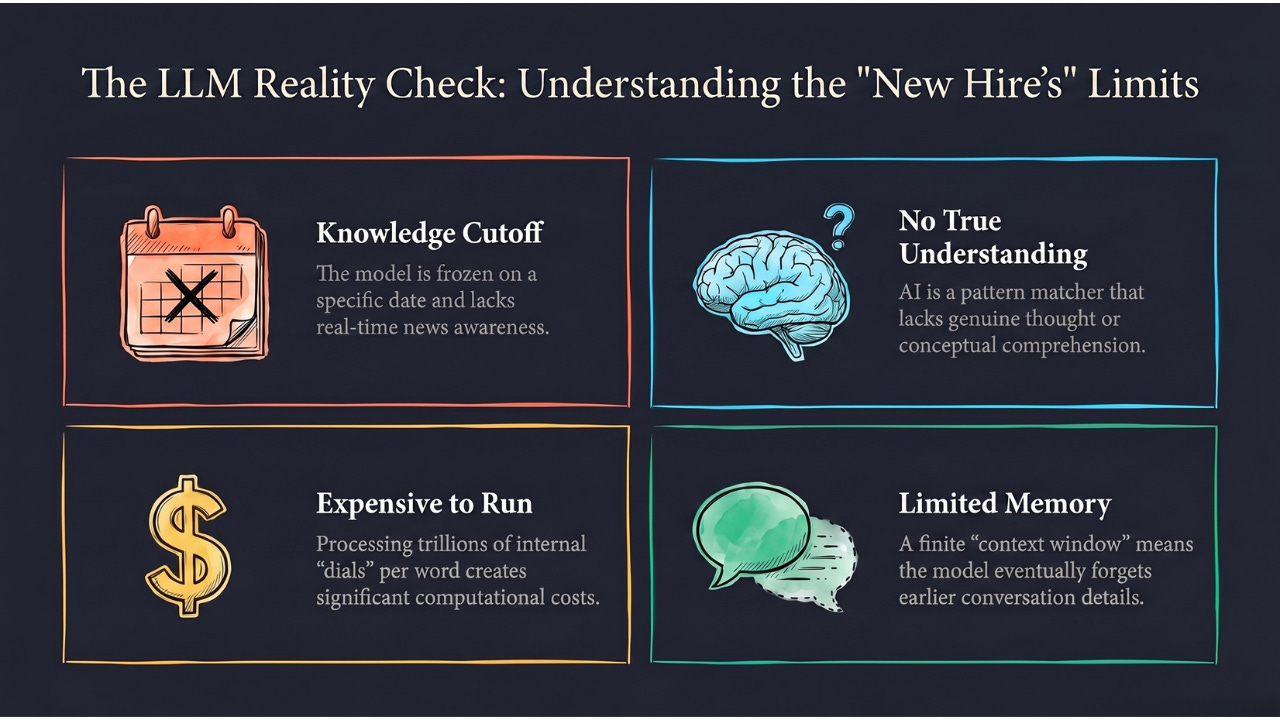
    They stopped reading on a specific date. Every LLM has a knowledge cutoff. Ask about yesterday’s news and they genuinely don’t know. It’s like the new hire read everything up to their start date but hasn’t checked the news since. (Some systems work around this by connecting to the internet, but the core model itself is frozen in time.)

    They don’t truly understand. They’re the world’s best pattern matcher, not a thinker. They can sound confident while being completely wrong. They don’t “know” anything the way you know your own name. They know what words usually follow other words. That’s it.

    They’re expensive to keep around. Every response costs computing power. That’s why advanced AI access isn’t free. Running a trillion dials for every single word in every single response adds up fast.

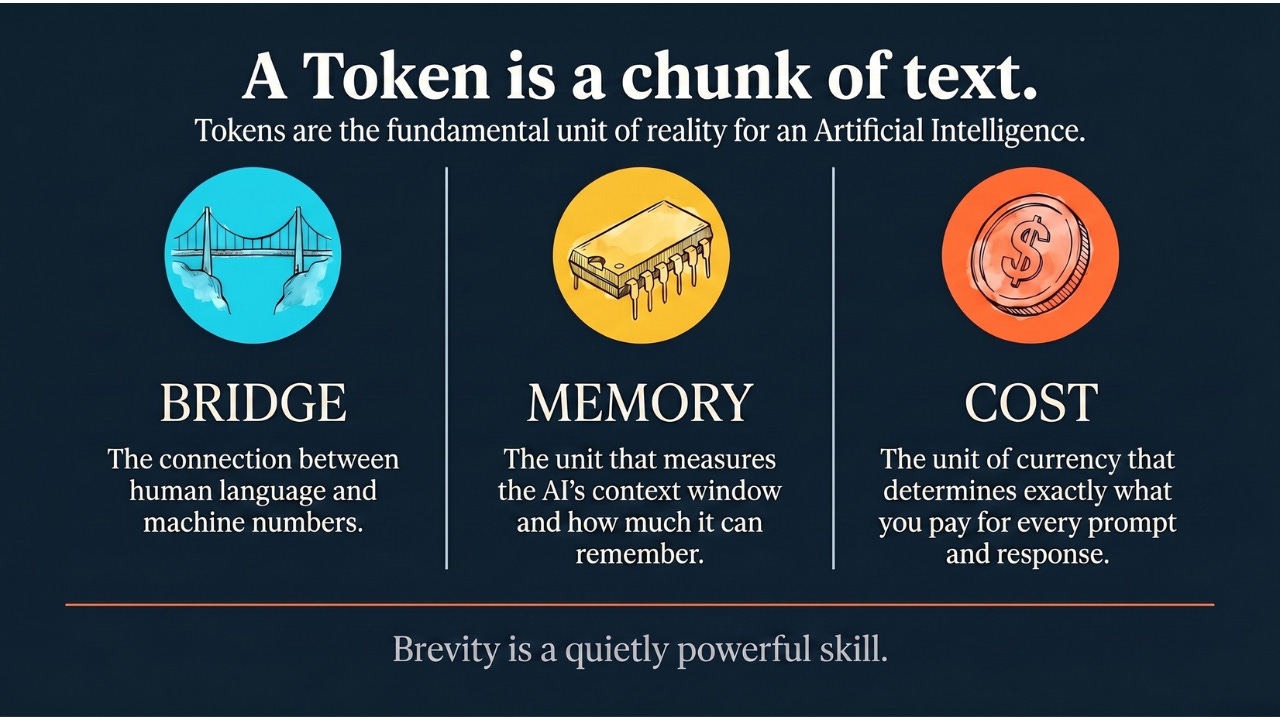
    Their memory has limits. They can only hold so much of the conversation at once. This is called the context window. It’s like the new hire can remember the last hour of conversation clearly but starts forgetting what was said this morning. Long conversations can feel like the AI forgot what you told them earlier, because in a real sense, it did.


    The Takeaway

    A Large Language Model is the engine powering the AI revolution you’re living through right now.

    It’s a new hire who read the entire internet before day one. They predict the next word, one word at a time, with a confidence that makes it look like understanding. They went through reading (pre-training), job training (fine-tuning), and performance reviews (human feedback) to become the helpful assistant you chat with today.

    They’re extraordinary at sounding human. They’re terrible at knowing when they’re wrong. And they’re sitting in more of your apps than you probably realized.

    Under the hood, it’s the same loop you learned about in our How AI Actually Learns article. Predict, check, adjust, repeat. Just with trillions of dials instead of four chai settings.

    Coming Up

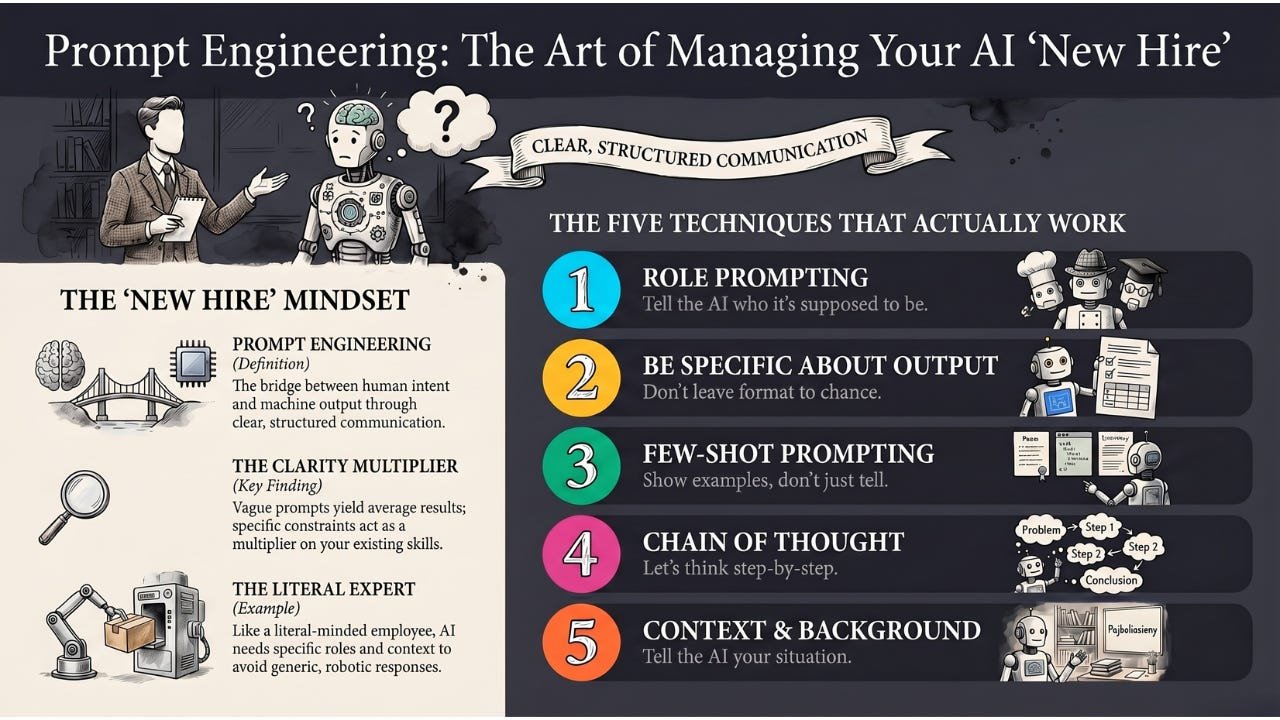
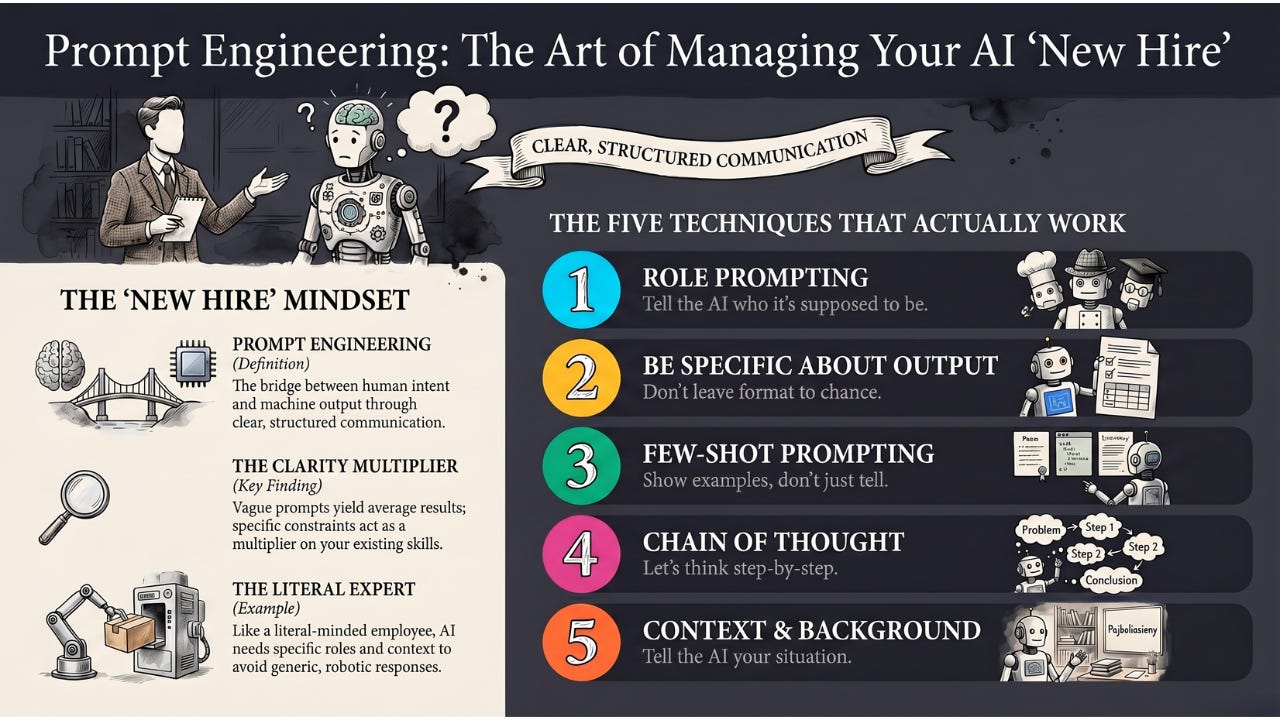
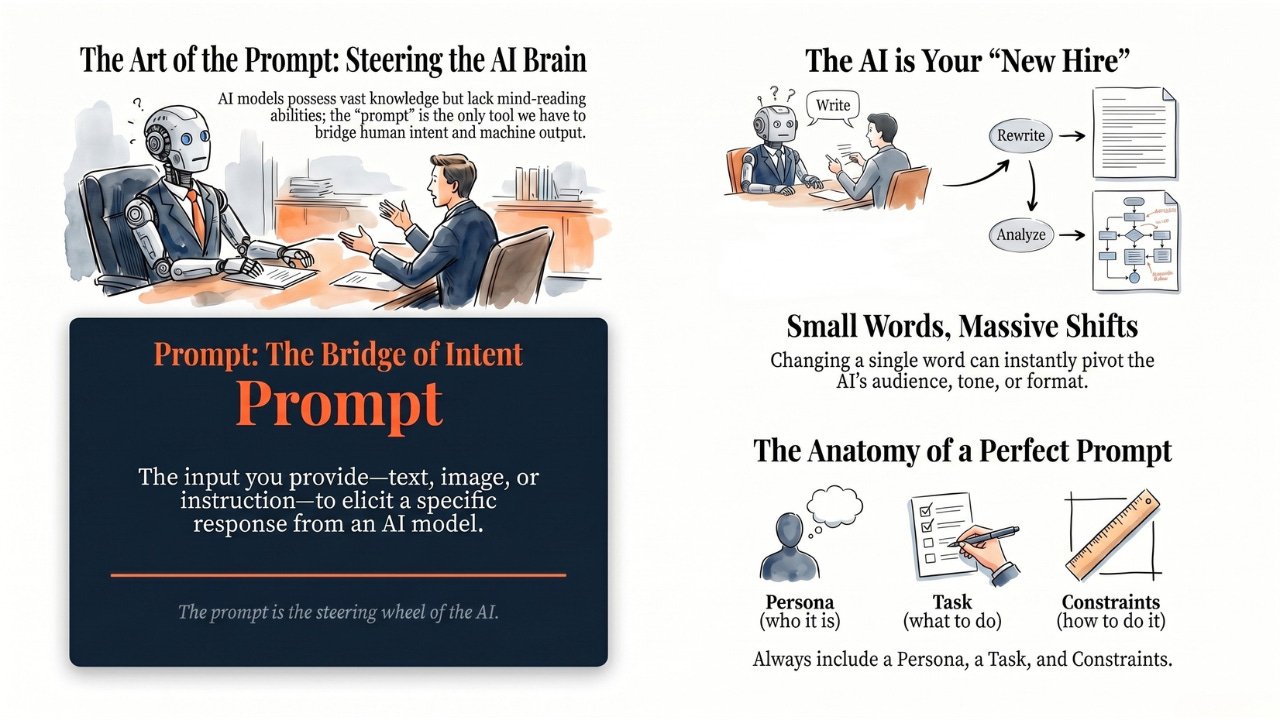
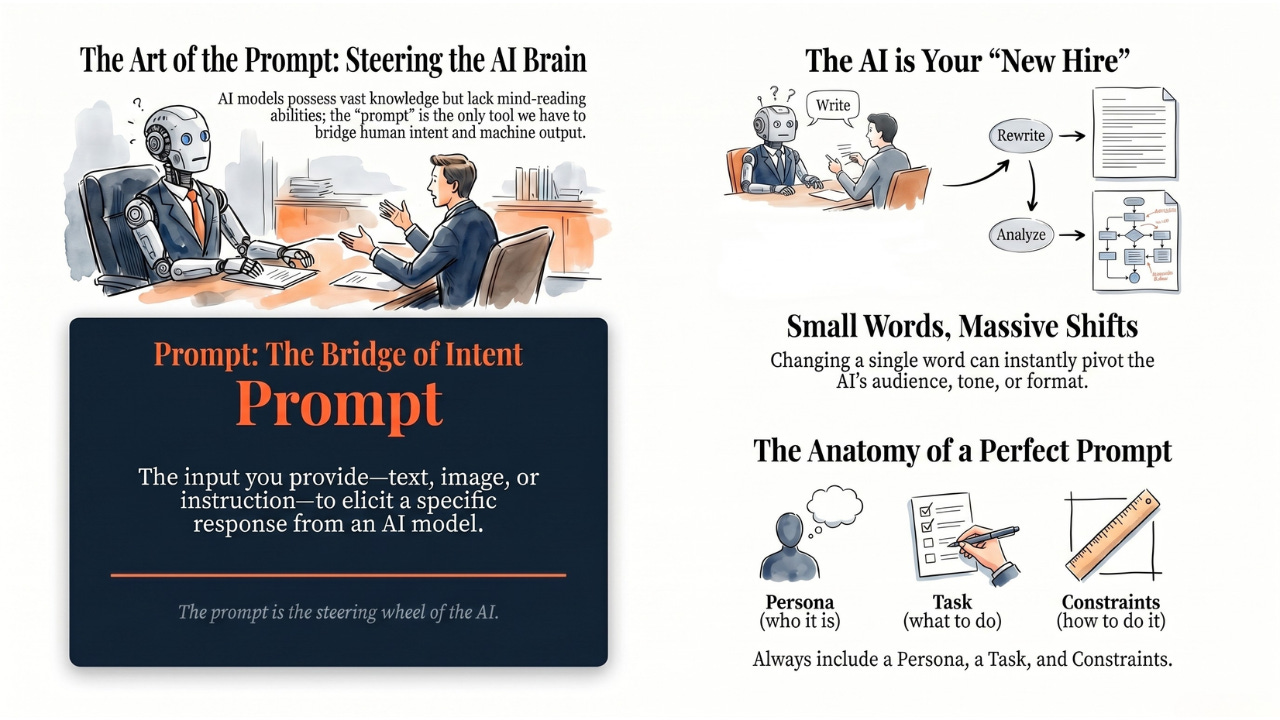
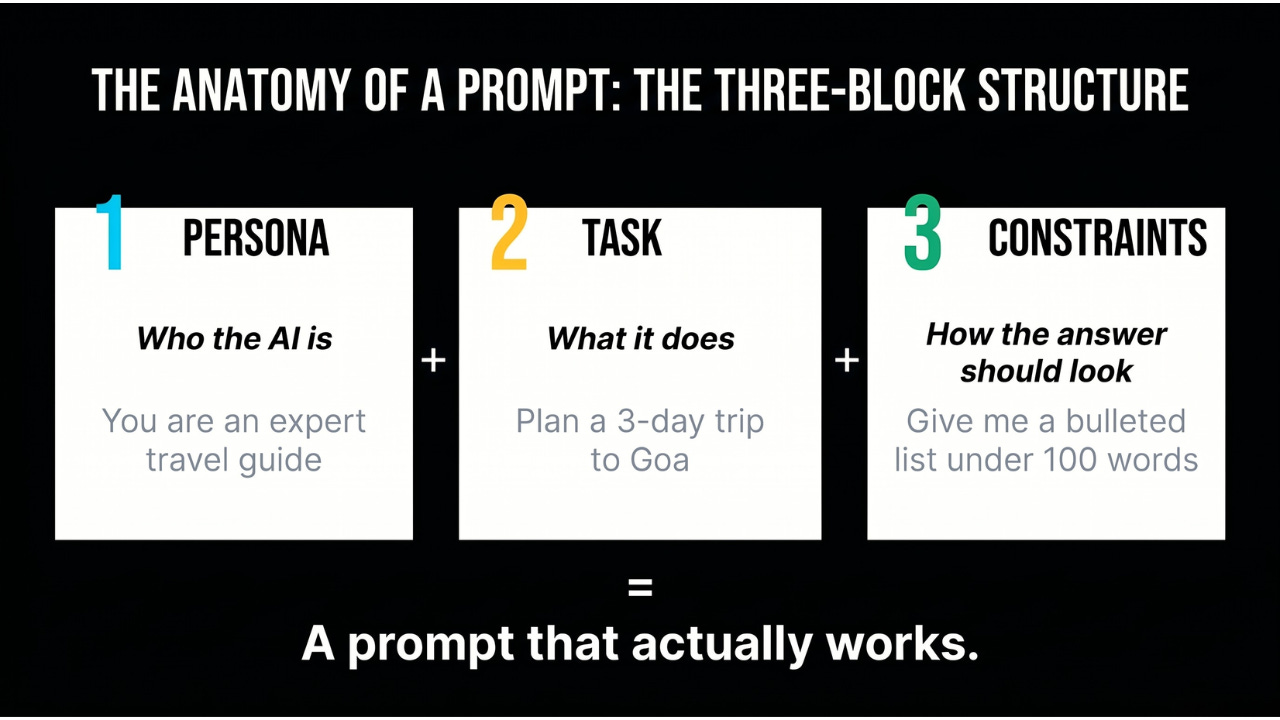
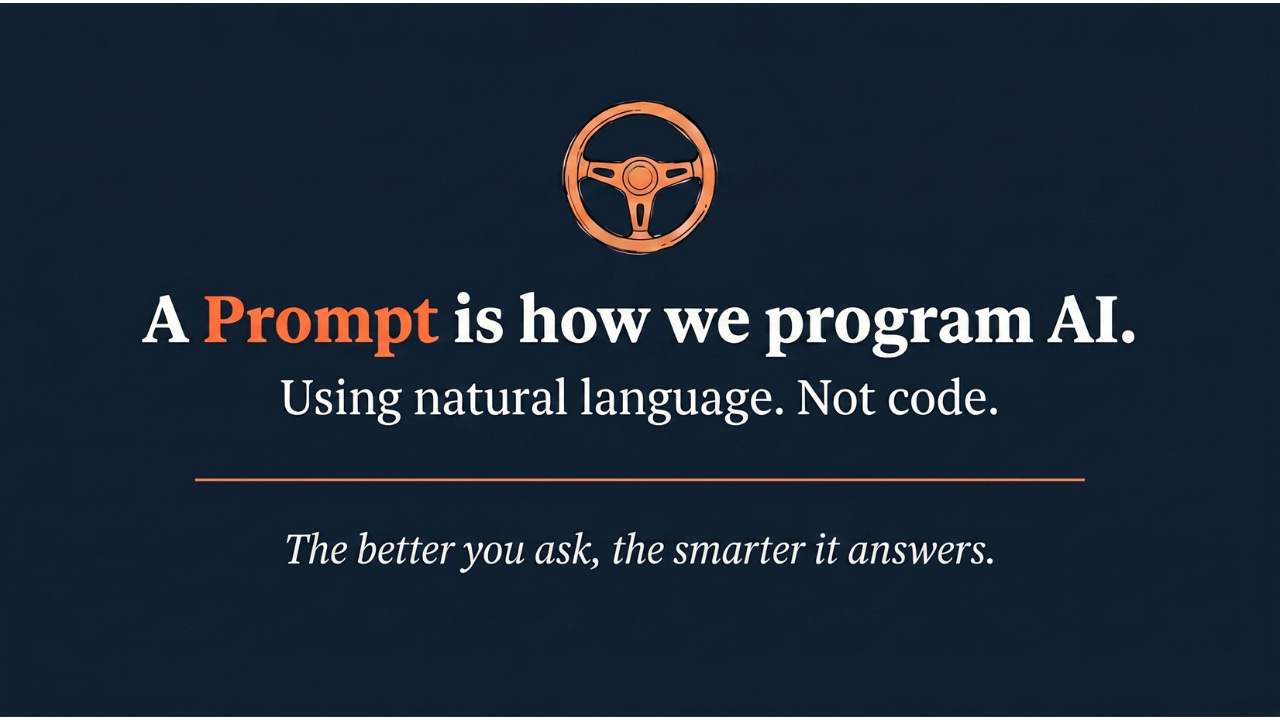
    Now you know what the engine is. But here’s a subtle truth: the same LLM can give you a brilliant answer or a useless one depending entirely on how you ask. That little box where you type your question? It has a name — the prompt — and the words you put in it are the steering wheel of the entire engine. Next, we’ll break down what a prompt actually is and why it matters more than most people realize.


    AI for Common Folks – Making AI understandable, one concept at a time.
    Subscribe now

    Leave a comment

  • OpenAI’s $20B Cerebras Deal, GPT-Rosalind, Robot Learns on Its Own

    OpenAI’s $20B Cerebras Deal, GPT-Rosalind, Robot Learns on Its Own

    Good morning, OpenAI just doubled down on Cerebras with a chip deal that could reach $30 billion, the company also launched an AI model designed specifically for biology and drug discovery, and a robotics startup showed a robot brain that can figure out tasks nobody ever taught it. Here’s what happened 👇


    1. OpenAI Doubles Its Cerebras Chip Deal to Over $20 Billion

    OpenAI has agreed to pay chip startup Cerebras more than $20 billion over the next three years for servers powered by Cerebras chips, according to The Information. That is double the $10 billion commitment the two companies announced in January. The deal also includes warrants that could give OpenAI up to a 10% equity stake in Cerebras as spending increases, plus $1 billion from OpenAI to help fund Cerebras data centers. Total spending over three years could reach $30 billion.

    Cerebras, which makes wafer-scale engine chips that compete with Nvidia’s GPUs, is preparing an IPO in the second quarter at a valuation of roughly $35 billion. OpenAI CEO Sam Altman is an early investor. The deal is the clearest signal yet that OpenAI is building a chip supply chain that does not depend entirely on Nvidia.

    Why it matters: Every AI company on Earth is fighting for access to the same pool of Nvidia chips. By locking in $20 billion or more with Cerebras, OpenAI is hedging that dependence and, through its equity stake, turning a supplier relationship into a strategic investment. If Cerebras succeeds, OpenAI owns a piece of the alternative chip ecosystem. If you use ChatGPT, the speed and cost of every answer you get is shaped by which chips are running it. We broke down foundation models, the brains that run on these chips, in our AI Explained series → What Are Foundation Models?

    Source: Reuters


    2. OpenAI Launches GPT-Rosalind, a Biology-Tuned AI for Drug Discovery

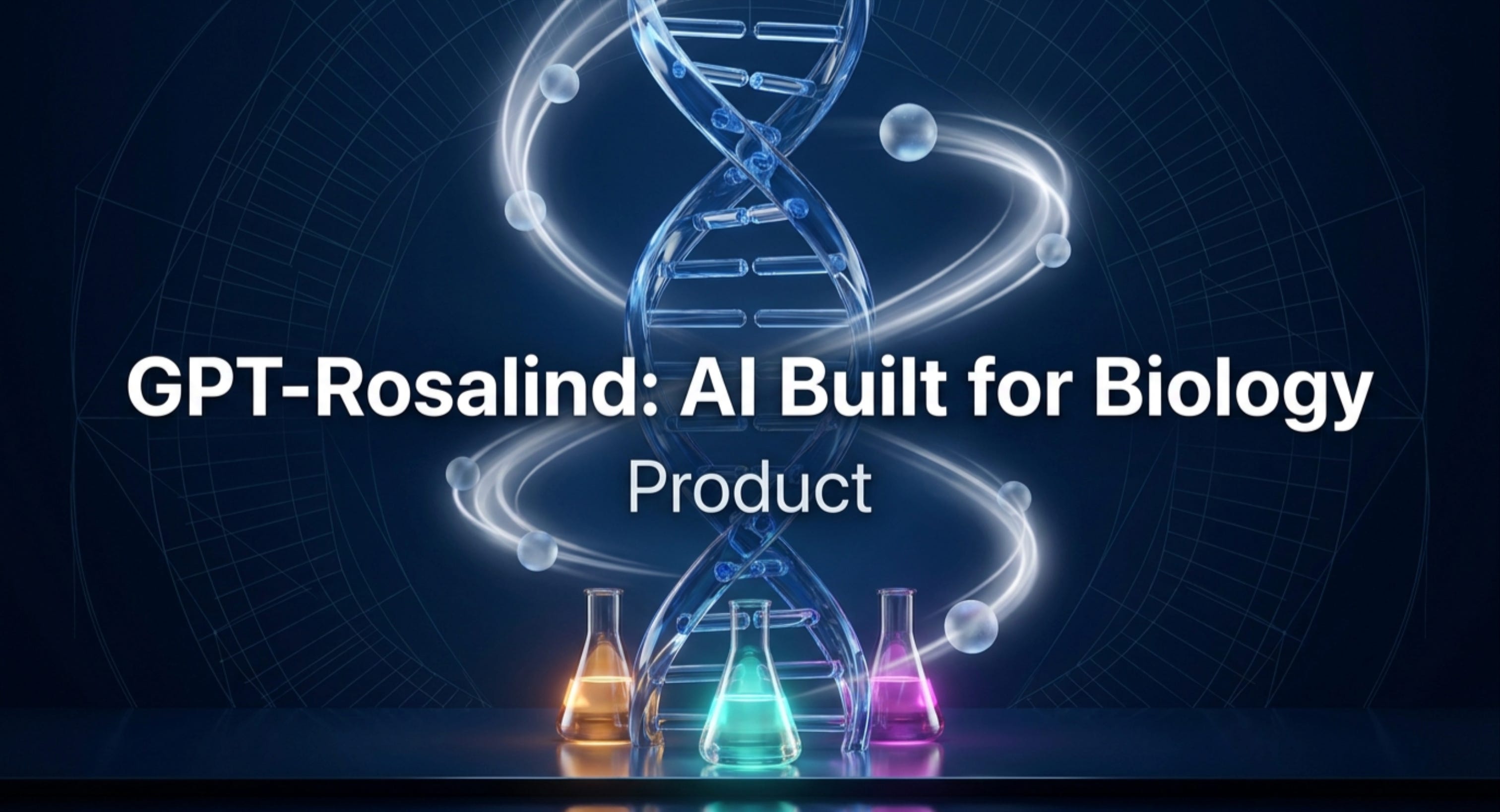
    OpenAI introduced GPT-Rosalind on Thursday, an AI model built specifically for life sciences research. Named after Rosalind Franklin, the scientist whose X-ray crystallography work was central to discovering DNA’s structure, the model is designed to help researchers with evidence synthesis, hypothesis generation, experimental planning, and other multi-step research tasks. It can query databases, read the latest scientific papers, suggest new experiments, and connect to over 50 scientific tools through a free Codex plugin.

    OpenAI said it is already working with Amgen, Moderna, and Thermo Fisher Scientific to apply GPT-Rosalind across their workflows. The model is available as a research preview through OpenAI’s trusted access deployment structure.

    Why it matters: Drug discovery typically takes over a decade and costs billions. If an AI model can meaningfully accelerate the early stages of research, even by months, the downstream impact on which drugs reach your pharmacy shelves is enormous. This is also OpenAI’s second specialized model in one week, after GPT-5.4-Cyber for cybersecurity. The company is clearly betting that the future of AI is not one model that does everything, but specialized models tuned for high-stakes fields.

    Source: Reuters


    3. This Robot Brain Can Figure Out Tasks Nobody Taught It

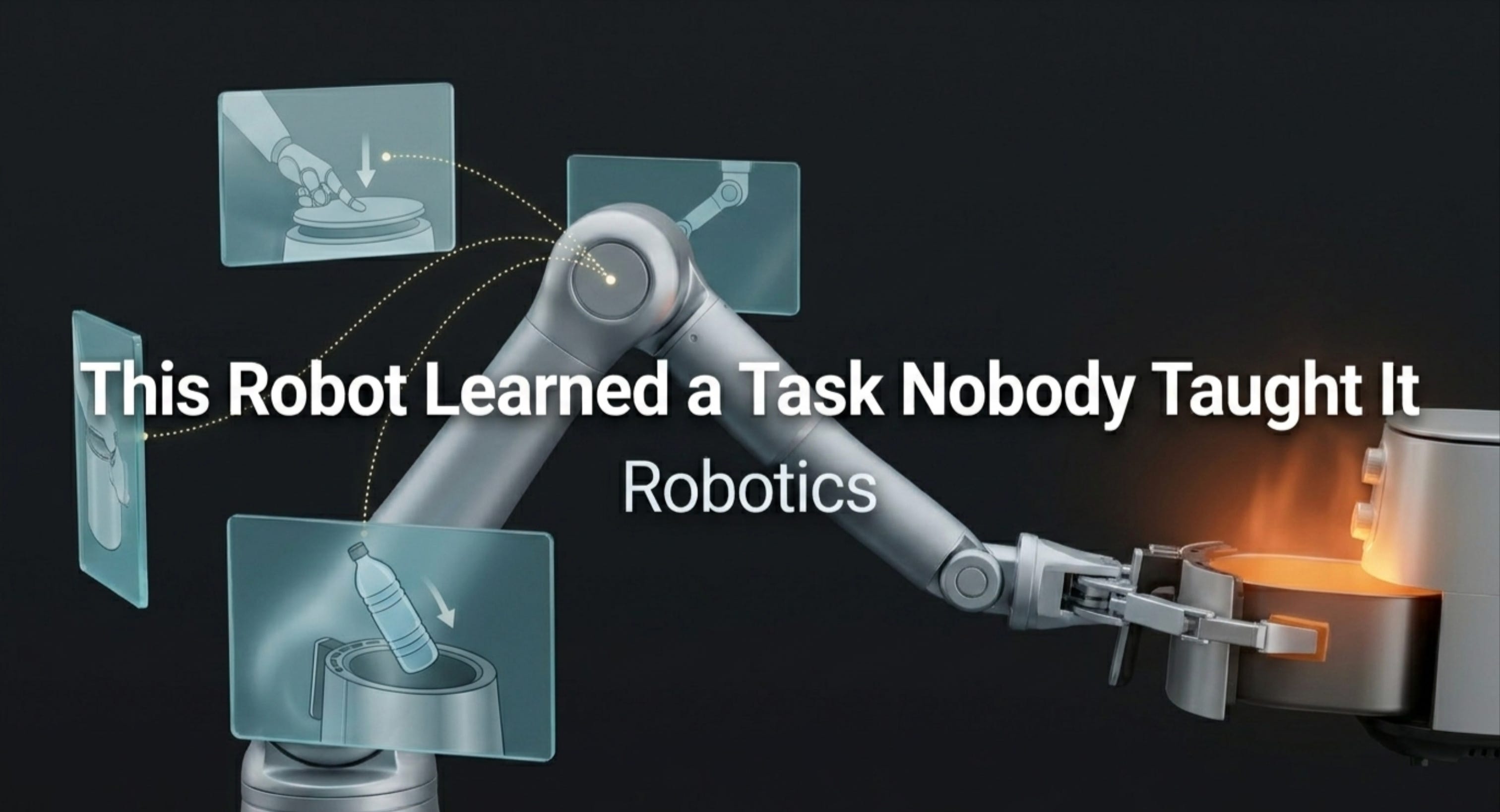
    Physical Intelligence, a San Francisco robotics startup valued at $5.6 billion, published research on Thursday showing that its latest model can direct robots to perform tasks they were never explicitly trained on. The model, called π0.7, demonstrated what researchers call “compositional generalization,” the ability to combine skills learned in different contexts to solve new problems. In one test, the robot figured out how to use an air fryer despite having only two barely relevant examples in its entire training dataset. With verbal coaching from a human walking it through the steps, it succeeded.

    The π0.7 model matched the performance of purpose-built specialist models across complex tasks including making coffee, folding laundry, and assembling boxes. The company is reportedly in talks to raise at an $11 billion valuation.

    Why it matters: Until now, training a robot meant collecting data on each specific task and building a model for that task alone. If robots can start remixing skills the way language models remix words, it changes the economics of automation entirely. A warehouse, a hospital, or a restaurant would not need a different robot for every job. They would need one that can be coached. We explained how AI systems learn from data, including the foundations that make this kind of generalization possible, in our AI Explained series → How AI Actually Learns

    Source: TechCrunch


    4. The White House Plans to Give Federal Agencies Access to Anthropic’s Mythos

    The U.S. government is preparing to make a version of Anthropic’s Mythos model available to major federal agencies, Bloomberg News reported. Gregory Barbaccia, the federal chief information officer, emailed Cabinet department officials on Tuesday that the Office of Management and Budget was setting up protections to allow agencies to begin using the model. “We’re working closely with model providers, other industry partners, and the intelligence community to ensure the appropriate guardrails and safeguards are in place,” Barbaccia said.

    Separately, Anthropic CEO Dario Amodei is scheduled to meet White House chief of staff Susie Wiles on Friday, Axios reported, signaling a possible breakthrough in Anthropic’s ongoing dispute with the Pentagon.

    Why it matters: The same model that five major financial regulators spent the past two weeks scrutinizing for cybersecurity risk is now being prepared for use by the very government agencies responsible for protecting critical infrastructure. That is not a contradiction. It is the same logic that drives every advanced weapons system: if something is this powerful, you want your own people to have it first. The Mythos saga is becoming the clearest real-world test case for how governments handle AI models that are simultaneously a defensive tool and a potential threat.

    Source: Reuters | Source: Reuters


    Quick Hits

    • AI traffic to US retail websites jumped 393% in Q1, and shoppers arriving via AI now convert 42% better than non-AI visitors, according to Adobe data. A year ago, AI traffic converted 38% worse. The turnaround is massive. Source: TechCrunch

    • Anthropic’s chief product officer left Figma’s board after reports that Anthropic plans to offer a competing design product. Source: TechCrunch

    • Mozilla launched Thunderbolt, a new AI client focused on self-hosted infrastructure, built on the open-source Haystack framework toward what it calls a “decentralized open source AI ecosystem.” Source: Ars Technica


    That’s it for today. OpenAI is spending like a company that believes compute will be the oil of the next decade, and it is not just buying chips but buying into the companies that make them. Meanwhile, the race to put AI into biology labs, robot arms, and government agencies is accelerating at a pace that makes last year’s “will AI be useful?” debate feel like ancient history.

    Forward this to someone who needs to stay in the loop.

    Subscribe now

    Leave a comment

  • What Does GPT Actually Stand For and How Does It Work?

    What Does GPT Actually Stand For and How Does It Work?

    GPT stands for Generative Pre-trained Transformer — a family of AI models built by OpenAI that powers ChatGPT and defined the modern era of AI.

    AI for Common Folks
    Apr 2026

    Hey Common Folks!

    In our last article on Foundation Models, we talked about the general-purpose brains that power modern AI — the Swiss Army Knives trained to do everything from writing code to drafting emails. Before that, we explored Generative AI, the broad category of AI that creates new content.

    Now let’s zoom in on the most famous Foundation Model family of them all: GPT.

    You see it everywhere. GPT-4, GPT-5, ChatGPT. But what do those three letters actually stand for? Is it a robot? A company? A magic spell?

    Here’s the real story: GPT is not just an acronym. It is three separate breakthroughs in AI that had never been combined at massive scale. OpenAI put them together, and that combination is why modern AI works.

    Let’s unpack each one.

    What is GPT?

    GPT stands for Generative Pre-trained Transformer.

    It is a specific type of Large Language Model (LLM) developed by OpenAI. If AI is the broad industry, GPT is a specific product line, like the “iPhone” of AI models.

    But here is the part nobody tells you: each of those three words (Generative, Pre-trained, Transformer) represents a problem that AI researchers had been stuck on for decades. GPT is the name for what happened when all three got solved at the same time.

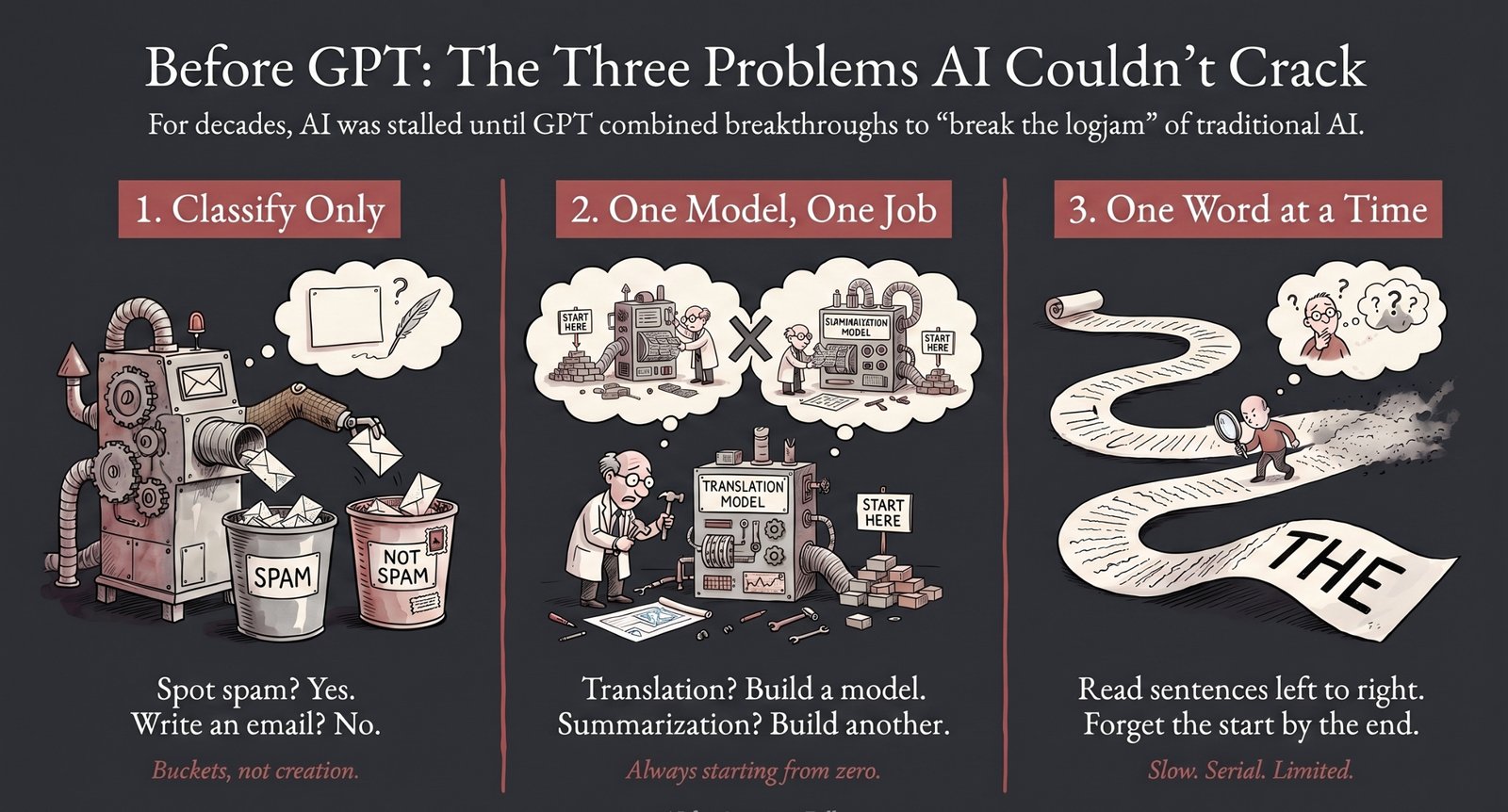
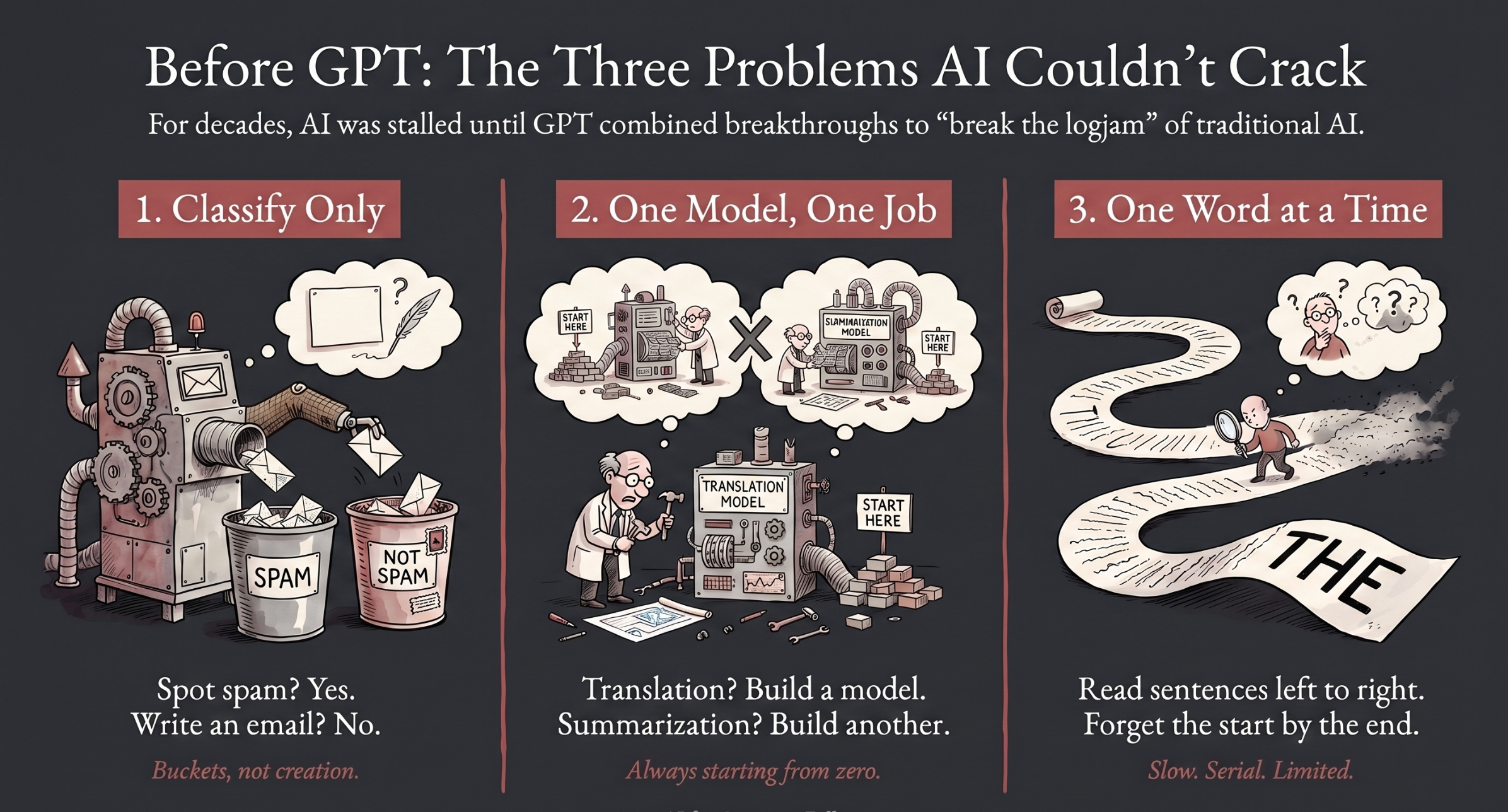
    Before GPT: Three Problems AI Couldn’t Crack

    To understand why GPT matters, you have to understand what AI looked like before it existed.

    For most of AI’s history (roughly the 1950s through the 2010s), researchers were stuck on three problems simultaneously:

    1. AI could classify, but it couldn’t create. It could tell you if an email was spam, but it couldn’t write an email.

    2. AI had to be trained from scratch for every task. Want translation? Build a translation model. Want summarization? Build a summarization model. One model, one job, always starting from zero.

    3. AI could only read one word at a time. The dominant technology of the day (called RNNs and LSTMs) processed text sequentially, like reading a book strictly left to right. It was slow, and by the end of a long sentence, it had often forgotten the beginning.

    Every single letter in “GPT” was an answer to one of these problems. Let’s take them one by one.

    1. G is for Generative: The Shift from “Classify” to “Create”

    This is the easy part to say, but the hardest to appreciate.

    What it means: GPT can create new content. Essays, code, poetry, emails. It generates output that didn’t exist before.

    Why it’s a big deal: For decades, AI was a world of “yes/no” answers. Is this spam? Is this a cat or a dog? Does this customer churn? These are classification tasks. AI looks at something and puts it in a bucket.

    Creating something new from scratch (a paragraph, a story, a working function of code) was considered nearly impossible. Language is infinite. There are more possible sentences than atoms in the universe. How would an AI pick a good one?

    The Generative approach said: don’t pick the “right” sentence. Generate it word by word, always predicting the most likely next word given what came before. Do that billions of times, and coherent writing emerges.

    That sounds simple. It is also the shift that took AI from “recognizing patterns in data” to “creating patterns that look human.”

    2. P is for Pre-trained: The Free Labels Trick

    This one is the real genius, and most explanations skip it.

    What it means: Before GPT is ever asked to do anything useful, it has already read a massive amount of text. Books, Wikipedia, websites, articles, code. That’s the “pre” in pre-trained.

    Why it’s a big deal: Traditional AI needed labeled data. To teach AI to spot spam, humans had to label millions of emails as “spam” or “not spam.” To teach it to tell cats from dogs, humans had to label millions of photos. Labeled data is expensive, slow, and limited.

    Pre-training flipped the entire problem on its head with one insight:

    If the task is “predict the next word,” the internet is already labeled. The label is just the next word.

    Read “The cat sat on the ___” and the correct answer is whatever word came next in the original sentence. No humans needed. The data labels itself. And the internet has trillions of words.

    Suddenly, AI had unlimited training data. GPT-3 was trained on roughly 570 GB of filtered text, pulled from an even larger 45 TB of raw internet data. Later models like GPT-4 and GPT-5 used dramatically more. That scale would have been unimaginable with human-labeled data.

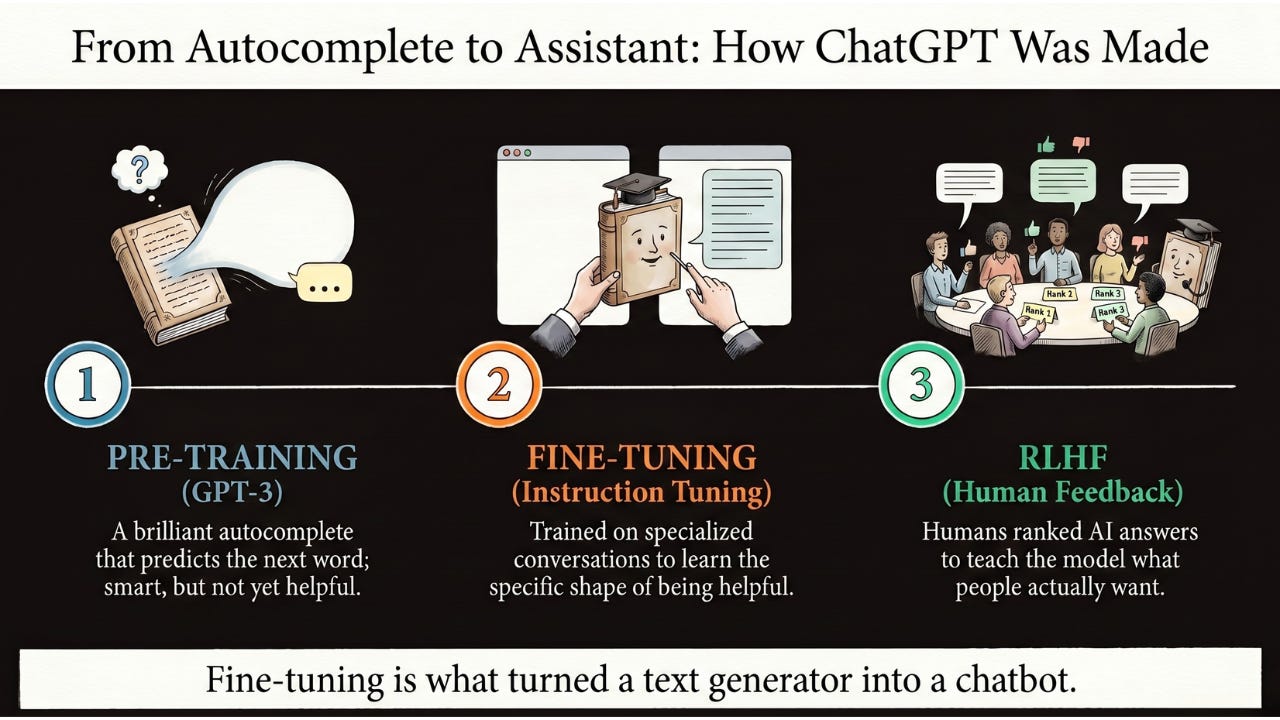
    Think of Pre-training as a student reading every book in the library to learn general knowledge. Later, this student can be Fine-tuned (specialized training for a specific job) to become a doctor, a coder, or a chatbot. But the broad education comes first, and it comes from the text itself.

    3. T is for Transformer: Seeing All the Words at Once

    What it means: The Transformer is a specific type of Neural Network architecture introduced by Google researchers in 2017, in a paper famously titled “Attention Is All You Need.”

    Why it’s a big deal: Before Transformers, AI read sentences one word at a time, sequentially. This was slow, and the model often forgot the beginning of a long sentence by the time it reached the end. It also meant you couldn’t spread the work across thousands of chips in parallel, which put a hard ceiling on how big these models could get.

    Transformers introduced two superpowers:

    1. Parallel Processing: They look at all the words in a sentence simultaneously, rather than one by one. This makes them dramatically faster and, critically, scalable to billions of parameters. Without Transformers, no amount of compute could have produced GPT-3 or GPT-4.

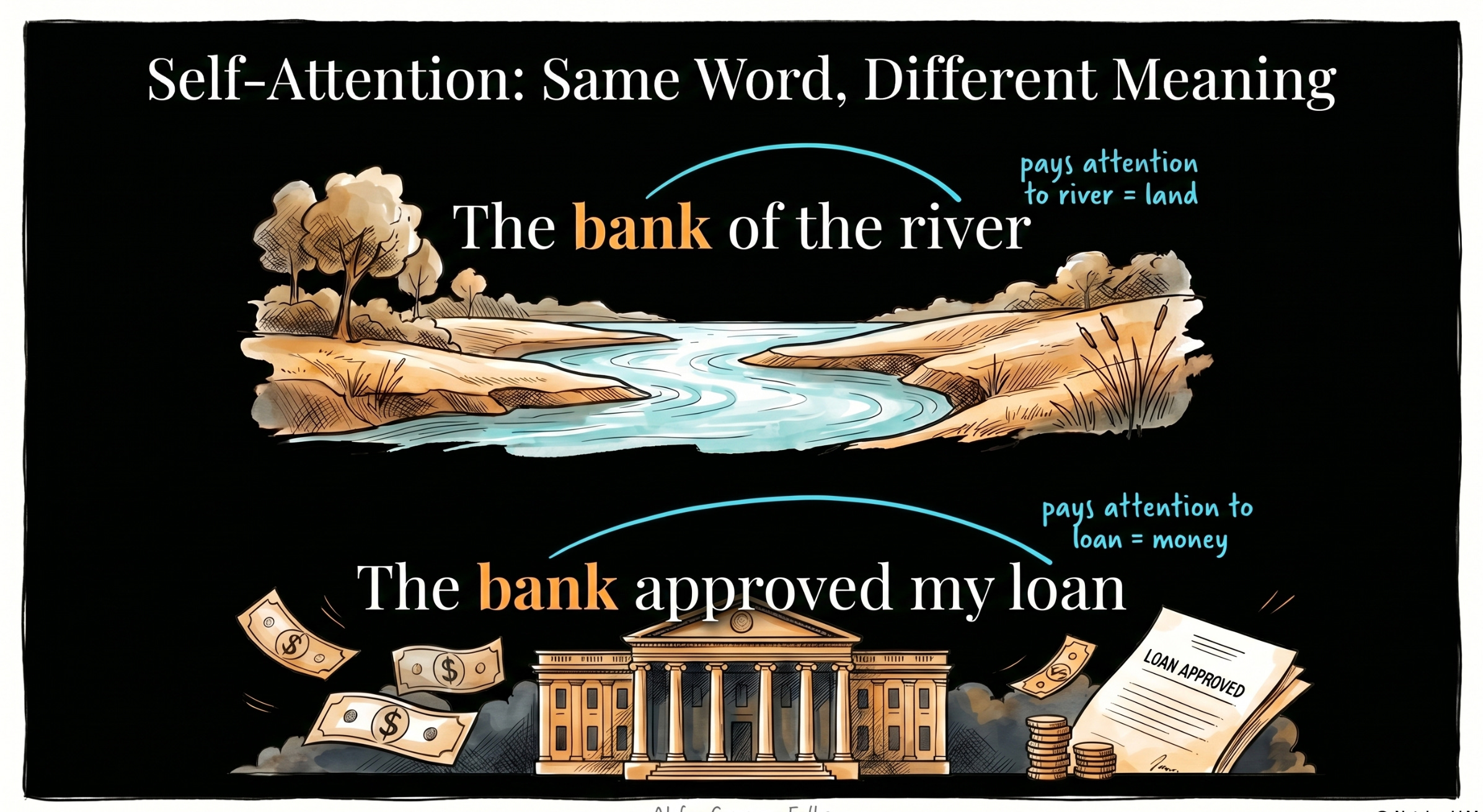
    2. Self-Attention: They figure out which words in a sentence relate to each other. In “The bank of the river,” the Transformer pays attention to “river” to know that “bank” means land. In “The bank approved my loan,” it pays attention to “loan” to know bank means the financial kind. Same word, different meaning, figured out from context.

    Self-attention is what gave AI something that looks like understanding context. It is the single architectural idea that made modern AI possible.

    Why the Combination Changed Everything

    Here’s the thing nobody emphasizes enough: each of these three ideas existed on its own before GPT.

    • Researchers had built generative models before.

    • Unsupervised pre-training had been explored in smaller forms.

    • The Transformer paper was published by Google, not OpenAI.

    What OpenAI did was combine all three at massive scale. GPT-1 in 2018 showed the recipe could work. GPT-2 in 2019 showed it could write coherently. GPT-3 in 2020 was the moment the world saw what happens when you push this recipe to billions of parameters: the model started doing things it was never explicitly trained to do. Reasoning. Translation. Summarization. Rudimentary code generation. Researchers call these emergent abilities. Capabilities that appear, seemingly out of nowhere, once the model gets big enough.

    ChatGPT in late 2022 was when the public caught on.

    So when someone says “GPT changed AI,” they are not being dramatic. The specific combination of Generative + Pre-trained + Transformer at scale is the recipe that broke a decades-long logjam.

    GPT vs. ChatGPT

    Are they the same thing? No.

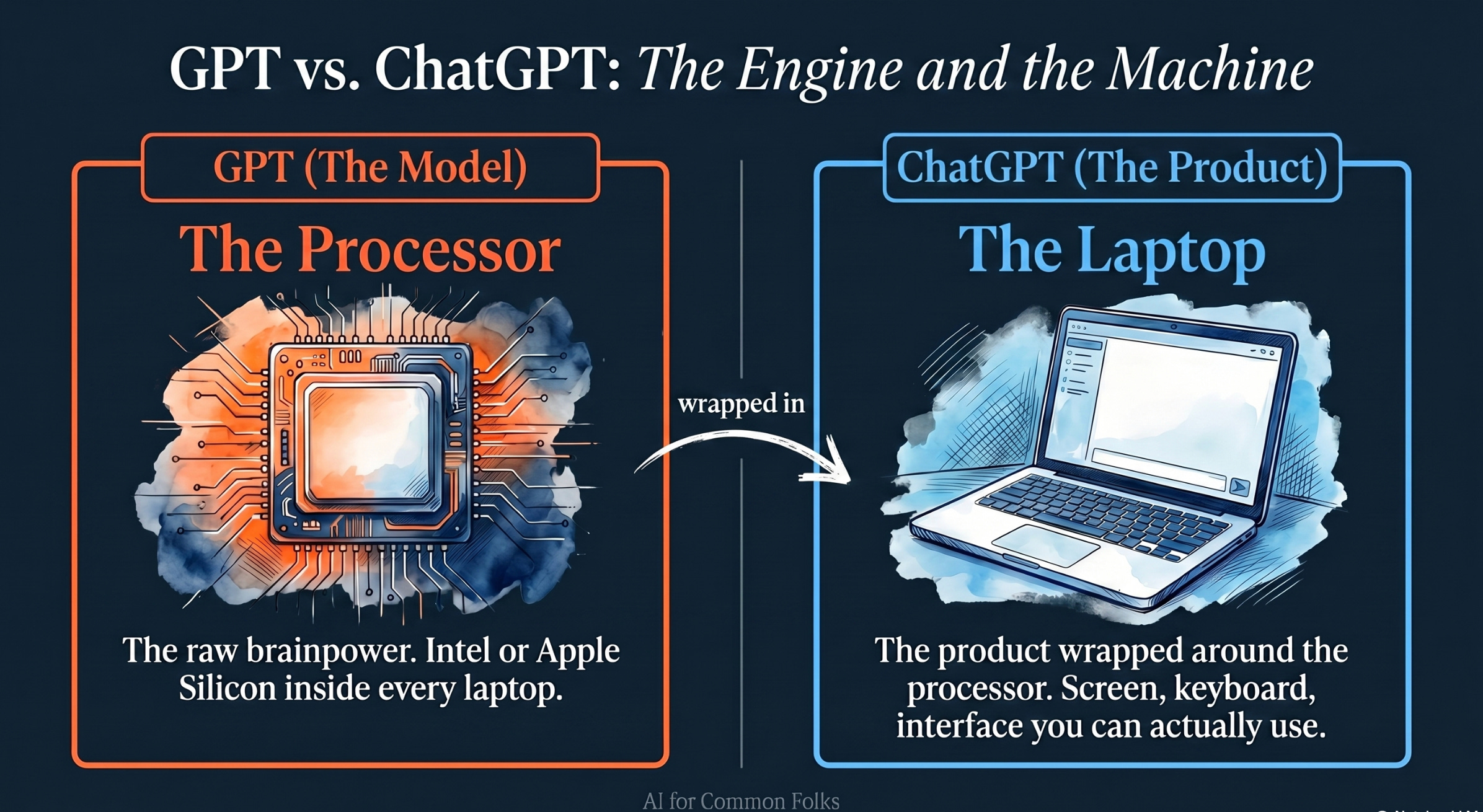
    Here is the best analogy to understand the difference:

    Think of a Laptop.

    • GPT is the Processor (like Intel or Apple Silicon): It is the raw brainpower and technology that does the thinking.

    • ChatGPT is the Laptop (like a MacBook or Dell XPS): It is the product wrapped around that processor with a screen and keyboard (an interface) that allows you to interact with it easily.

    GPT is the model; ChatGPT is the application built using the GPT model.

    The “Decoder” Secret

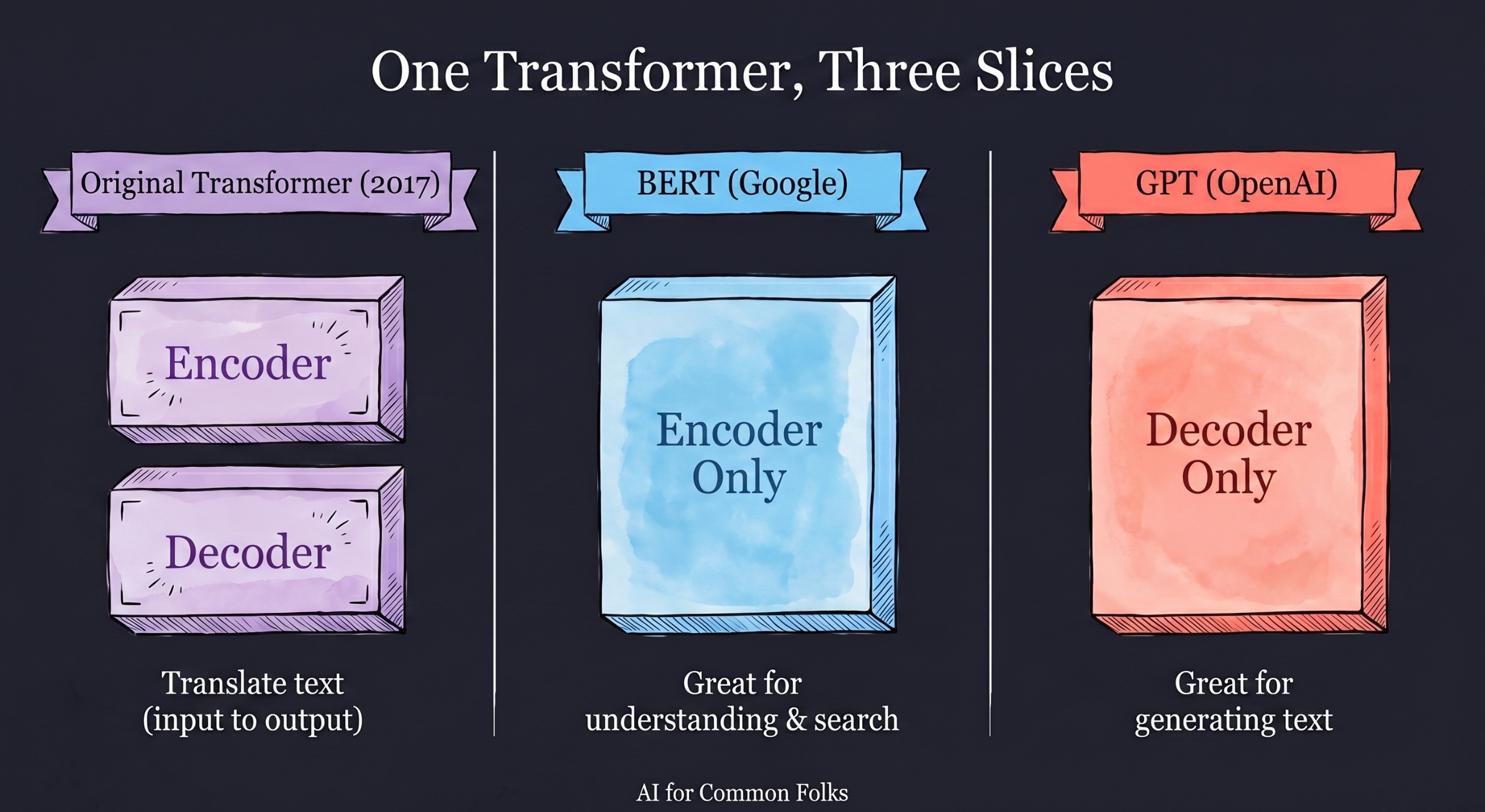
    If you want to sound extra smart, know this: the Transformer architecture originally came with two parts, an Encoder (to understand input) and a Decoder (to generate output).

    GPT models are actually Decoder-only models. They dropped the Encoder entirely. They are specialists in generating text: predict the next token, then the next, then the next, until they have built a whole sentence.

    Different AI systems use different slices of the Transformer architecture. Google’s original BERT was Encoder-only (great for understanding and search). GPT is Decoder-only (great for generating). That single design choice is a big part of why GPT models feel so fluent when they write.

    The Takeaway

    You didn’t just learn what an acronym stands for. You learned the three ingredients that made modern AI possible:

    • Generative: AI stopped classifying and started creating.

    • Pre-trained: The internet itself became the training data, no humans needed to label it.

    • Transformer: AI stopped reading one word at a time and started seeing the whole picture at once.

    Each of these had been tried separately. Combining them at scale, between 2018 and 2020, is what OpenAI did. And it is the reason “GPT” became shorthand for modern AI.

    The next time someone says “we’re in the GPT era,” you’ll know they don’t mean an acronym. They mean a recipe.

    Coming Up

    You now know what GPT stands for. But here is a subtle point we glossed over: GPT is just one example of a broader category called Large Language Models (LLMs). Claude, Gemini, Llama, and DeepSeek are LLMs too. So what exactly is an LLM, and why is it the engine behind every chatbot you use? In our next article, we’ll break down the engine behind ChatGPT, Claude, and Gemini and show you why LLMs are the defining technology of this decade.


    AI for Common Folks – Making AI understandable, one concept at a time.
    Subscribe now

    Leave a comment

  • What Are Foundation Models and Why Does Everyone Talk About Them?

    What Are Foundation Models and Why Does Everyone Talk About Them?

    A Foundation Model is a massive AI model trained on a vast amount of data — text, images, code — that can be adapted to perform a wide range of tasks, from writing emails to diagnosing diseases.

    Hey Common Folks!

    In our last article, we explored Generative AI — AI that can create brand new content like essays, images, music, and code. We saw it transforming customer support, education, content creation, and software development.

    But here’s a question that article left open: what’s actually powering all of that?

    When ChatGPT writes your email, when Claude explains your kid’s homework, when Gemini summarizes a research paper — they’re all running on the same type of technology underneath. That technology is called a Foundation Model.

    The Old Way vs. The New Way

    In traditional AI (the old way), if you wanted to translate English to French, you built a “Translation Model.” If you wanted to summarize text, you built a “Summarization Model.” If you wanted to detect spam, you built a “Spam Model.”

    One model, one job. Every new task meant starting from scratch.

    Foundation Models changed the game completely. They are like a Swiss Army Knife — one single tool that can perform hundreds of different tasks, from writing code to composing poetry to analyzing legal contracts.

    The Analogy: The “Super-Student” in the Library

    Remember from our earlier article on What is a Model — we compared an AI model to a student who finished studying and walks into the exam with knowledge in their head?

    Now imagine two types of students:

    • Traditional AI (The Specialist): This student only studied one book: “How to Repair a Bicycle.” Ask them to fix a bike? Perfect. Ask them to write an essay on history? They have no idea. They are specialized.

    • Foundation Model (The Generalist): This student has read almost every book in the library. History, math, coding, poetry, mechanics, medicine. Because they’ve seen so much, they’ve learned general patterns about how the world works.

    Now, you can ask this “Super-Student” to fix a bike, or write a poem, or solve a math problem, or draft a legal brief. They have a broad “foundation” of knowledge that allows them to adapt to almost any request.

    That’s why they’re called Foundation Models — they serve as the base upon which everything else is built. Just like you lay a concrete foundation before building a house, a hospital, or a skyscraper.

    The Framework: Builders vs. Users

    Understanding Foundation Models becomes much easier when you split the world into two groups: the people who make the engine, and the people who drive the car.

    1. The Builder Perspective (Making the Brain)

    These are the engineers at companies like OpenAI, Anthropic, Google, or Meta. They take massive amounts of raw materials — text from the internet, books, code repositories, images — and use sophisticated processes to train these models.

    • The Goal: To create a model that learns general patterns about language, logic, and the world. It’s like feeding the “student” all those books.

    • The Result: A Foundation Model (like GPT-4o, Claude, Gemini, or Llama).

    2. The User Perspective (Putting the Brain to Work)

    This is where most businesses and developers sit. They don’t need to know how to build the brain from scratch. They just need to know how to use it.

    Think of the Foundation Model as a powerful Engine:

    • One user might take that engine and put it into a Race Car (a chatbot for customer service).

    • Another user might put it into a Truck (a tool to summarize legal documents).

    • Another might put it into a Boat (an app that generates marketing copy).

    • Another might put it into an Ambulance (an AI assistant helping doctors with diagnoses).

    You don’t need to know how to build the engine. You just use its capabilities to solve your specific problem.

    This is exactly what’s happening in the real world right now. Companies like Canva, Notion, Duolingo, and Khan Academy aren’t building their own Foundation Models — they’re plugging into existing ones (GPT, Claude, Gemini) and building products on top.

    Types of Foundation Models

    While Large Language Models (LLMs) are the most famous type, Foundation Models are expanding into new territories:

    1. Large Language Models (LLMs): Trained on text. Good for writing, summarizing, reasoning, and coding. Examples: GPT-4o, Claude, Llama, Gemini.

    2. Large Multimodal Models (LMMs): These can understand not just text, but also images, audio, and video. When you upload a photo to ChatGPT and ask “what’s in this image?” — that’s a multimodal model at work. Examples: GPT-4o (handles text + images + audio), Gemini (text + images + video).

    3. Image Generation Models: Trained on images paired with descriptions. They create visuals from text prompts. Examples: DALL-E 3, Midjourney, Stable Diffusion.

    4. Code Models: Specialized for understanding and generating software code. Examples: Claude (Anthropic’s model powers Claude Code), GitHub Copilot (powered by OpenAI models).

    All of these are Foundation Models — massive, general-purpose brains that can be adapted to specific jobs.

    Why This Matters for You

    You might be thinking: “Okay, but I’m not building AI. Why should I care about Foundation Models?”

    Three reasons:

    1. It explains why AI suddenly got good at everything. Before Foundation Models, AI was narrow — good at one thing, useless at the rest. Foundation Models are why your AI assistant can write an email and explain physics and debug code and plan your vacation. One brain, many skills.

    2. It’s why the AI race is so expensive. Training a Foundation Model costs tens of millions to hundreds of millions of dollars. That’s why only a handful of companies (OpenAI, Anthropic, Google, Meta) can afford to build them. Everyone else builds on top of them.

    3. It’s the reason AI will keep getting more useful. As Foundation Models get better, every product built on top of them gets better automatically. When GPT improves, every app using GPT improves. That’s the power of a shared foundation.

    The Takeaway

    A Foundation Model is a general-purpose AI brain:

    • It is the engine inside the car.

    • It is the student who read every book in the library.

    • It is the Swiss Army Knife of the digital world.

    It shifted AI from “specialized tools that do one thing” to “general intelligence that can be adapted to almost anything.”

    And here’s the exciting part: we’re still early. The Foundation Models of 2026 are dramatically more capable than those of 2023. The ones coming in 2027 and beyond will make today’s look primitive. Understanding this technology now means you won’t be caught off guard as it transforms more of the world around you.

    Coming Up

    Now that you understand what a Foundation Model is — this massive, general-purpose brain — you’ve probably noticed we keep mentioning one name more than any other: GPT. GPT-3, GPT-4, ChatGPT. But what do those three letters actually stand for? And why did this particular approach become the dominant one? In our next article, we’ll decode the most famous acronym in AI and break down exactly how GPT works, letter by letter.


    AI for Common Folks — Making AI understandable, one concept at a time.
    Subscribe now

    Leave a comment

  • Anthropic at $800B, GPT-5.4-Cyber Debuts, Uber’s $10B Robotaxi Bet

    Anthropic at $800B, GPT-5.4-Cyber Debuts, Uber’s $10B Robotaxi Bet

    Good morning, investors are lining up to value Anthropic at $800 billion while OpenAI’s own backers question its $852 billion price tag, OpenAI just launched a cybersecurity-focused model to answer Anthropic’s Mythos, and Uber committed $10 billion to robotaxis in its biggest strategic pivot ever. Here’s what happened 👇


    1. Anthropic’s Valuation Could Double to $800 Billion as OpenAI Faces Investor Doubt

    Venture capital firms have approached Anthropic with offers to invest at valuations as high as $800 billion, more than double the $380 billion it raised at in February. Anthropic has so far resisted these overtures, according to Bloomberg. The company’s run-rate revenue now surpasses $30 billion, up from roughly $9 billion at the end of 2025, driven by surging demand for Claude and the buzz around its frontier Mythos model.

    Meanwhile, the Financial Times reported that some of OpenAI’s own backers are questioning its $852 billion valuation as the company shifts its strategy toward the enterprise market to compete with Anthropic. The contrast is striking: one company’s investors are racing to get in. The other company’s investors are asking if they overpaid.

    Why it matters: Six months ago, OpenAI was the undisputed leader in AI. Now Anthropic is growing revenue at a pace that could close the gap faster than anyone expected. If you use ChatGPT or Claude at work, you are watching a competitive shift that will directly affect the tools, pricing, and features available to you.

    Source: Reuters | Source: Reuters


    2. OpenAI Launches GPT-5.4-Cyber to Counter Anthropic’s Mythos

    OpenAI unveiled GPT-5.4-Cyber, a variant of its latest flagship model fine-tuned specifically for defensive cybersecurity work. The release comes exactly one week after Anthropic announced Mythos, which has already found “thousands” of major vulnerabilities in operating systems, browsers, and other software. GPT-5.4-Cyber will initially be available only to vetted security vendors, organizations, and researchers through OpenAI’s expanded Trusted Access for Cyber (TAC) program.

    The highest-tier TAC users will get access to the model with fewer restrictions on sensitive cybersecurity tasks like vulnerability research and analysis. OpenAI is also opening the program to thousands of individual defenders and hundreds of security teams.

    Why it matters: The cybersecurity AI race is now a two-horse competition. Both OpenAI and Anthropic are building models specifically designed to find software vulnerabilities before attackers do. For companies, this means AI-powered security tools are about to get significantly more capable. For everyone else, it means the software you use every day is about to get tested by AI systems that can find flaws humans have missed for years.

    Source: Reuters


    3. Uber Commits $10 Billion to Robotaxis, Breaks Its Own Business Model

    Uber has committed more than $10 billion to buying thousands of autonomous vehicles and taking equity stakes in their developers, according to the Financial Times. This is a fundamental break from the “gig economy” model that built the company. Uber is positioning itself as a marketplace for multiple robotaxi operators, partnering with Baidu, Rivian, and Lucid, and plans to launch robotaxi services in at least 28 cities by 2028.

    The deals include roughly $2.5 billion in equity stakes and over $7.5 billion in fleet purchases over the next few years, contingent on partners hitting deployment milestones.

    Why it matters: The company that defined ride-sharing is betting its future on removing drivers entirely. If you use Uber, you could be hailing a driverless car within two years depending on your city. This is also a signal that the robotaxi market has crossed from “maybe someday” to “we need to own this now” for the biggest players in transportation.

    Source: Reuters


    4. Snap Cuts 1,000 Jobs, Says AI Now Writes 65% of Its Code

    Snapchat’s parent company is laying off about 1,000 employees, 16% of its full-time staff, and closing over 300 open positions. The company said AI is now generating more than 65% of new code at Snap, enabling it to operate with smaller teams. CEO Evan Spiegel expects the cuts to save more than $500 million in annualized expenses by the second half of 2026.

    Snap is not alone. More than 80 tech companies have cut roughly 71,440 jobs so far this year, according to Layoffs.fyi, as AI adoption accelerates across the industry.

    Why it matters: The stat to pay attention to is not the layoff count. It is the 65% number. When a major tech company publicly says AI is writing two-thirds of its new code, that is a signal about where software development is heading across every industry. The question is no longer whether AI will change the job market. It is how fast.

    Source: Reuters


    Quick Hits

    • Maine became the first US state to pass a moratorium on large data centers, freezing approvals for facilities requiring more than 20 megawatts of power until October 2027. Eleven other states are weighing similar legislation. Source: Reuters

    • Federal agencies are quietly sidestepping Trump’s ban on Anthropic to test its Mythos model. The Commerce Department’s Center for AI Standards is actively testing Mythos’ capabilities, and staff on at least three congressional committees have held or requested briefings. Source: Reuters

    • Jane Street signed a $6 billion AI cloud computing deal with CoreWeave and boosted its equity stake in the company, one of the largest single cloud contracts announced this year. Source: Reuters


    That’s it for today. The AI industry is splitting into two clear lanes: one where the biggest companies race to build the most powerful models, and another where everyone else figures out what those models mean for their workers, their cities, and their energy bills.

    Forward this to someone who needs to stay in the loop.

    Subscribe now

    Leave a comment

  • What Is Generative AI and How Does It Create New Things?

    What Is Generative AI and How Does It Create New Things?

    Generative AI is artificial intelligence that creates brand new content that didn’t exist before, like writing an essay, drawing a picture, composing music, or writing computer code, by learning patterns from mountains of existing data and producing something new that feels like a human made it.

    Hey Common Folks!

    We break down AI so it makes sense to real people. If you’ve been following along, our last article explored Predictive Modeling, how AI uses historical data to make educated guesses about the future. That’s AI looking backward to predict forward.

    Today we’re flipping the script. What if AI could look at everything it has learned and create something entirely new?

    That’s Generative AI. And it’s the reason AI went from a behind-the-scenes tool to something your parents, your boss, and your neighbor are all talking about.

    Why This Feels Different from Everything Before

    Think about what makes humans special. Our ability to create new things, right? For decades, people said this was the one thing AI would never be able to do.

    Before Generative AI, artificial intelligence was mainly used for prediction and classification:

    • Will this customer buy our product? (prediction)

    • Is this email spam or not? (classification)

    • Which movies should we recommend? (recommendation)

    Useful, but limited. Now, Generative AI can write a poem, design a logo, generate a 3D model, compose music, or write working software. The creative barrier has been broken.

    In fact, the images you see in this article and even the majority of this writing style was created with the help of AI tools. We’re using the very technology we’re explaining.

    Four Ways Generative AI Is Already Changing the World

    1. Customer Support That Doesn’t Make You Pull Your Hair Out

    Remember the last time you needed help and had to wade through an endless phone tree or wait hours for a response?

    Companies used to need huge call centers with dozens of employees handling problems. Expensive and frustrating for everyone.

    Now, AI-powered chatbots handle the first level of support. When you contact customer service for a food delivery app or your internet provider, your initial questions are likely answered by an AI that understands what you’re asking and gives helpful responses.

    The result? Companies reduce their support staff from 10 people to 2-3, while actually improving response times. The AI handles common questions. Human agents focus on the complex issues that really need their attention.

    2. Content Creation That’s Indistinguishable from Human Work

    “AI can’t be creative” was the mantra for years. That ship has sailed.

    Today, if you read an article online, you often cannot tell if a human or an AI wrote it. The quality has improved that dramatically.

    This extends beyond writing to image creation, video editing, music composition, and more. Artists and creators aren’t being replaced, but they’re increasingly working alongside AI tools that speed up their workflow.

    For everyday people, this means you can generate professional-quality content without years of specialized training. Need a business proposal? A birthday card design? A custom bedtime story for your kids? Generative AI can help create it in minutes.

    3. Education That Adapts to How You Learn

    Generative AI is transforming education by providing 24/7 personalized learning support. Stuck on a complex topic? AI can explain concepts in multiple ways until you understand.

    Tools like ChatGPT, Claude, and Gemini are already being used by students worldwide as study partners. Universities like Northeastern and the London School of Economics have integrated AI tutoring into their programs. Some of these tools use Socratic questioning, asking you guiding questions instead of handing you the answer, helping you actually think instead of just copy.

    This newsletter itself is an example. We use AI tools every day to research, draft, and refine explanations so that complex topics reach you in plain language.

    4. Software Development That’s Accessible to Almost Everyone

    Coding used to be a highly specialized skill requiring years of training. Generative AI has dramatically lowered the barriers.

    Today’s AI tools like Claude Code, Cursor, and GitHub Copilot can:

    • Write functional code from a simple description

    • Explain complex code in plain language

    • Debug and fix errors

    • Build entire applications with minimal guidance

    Tasks that once required a team of five programmers might now be accomplished by two or three with AI assistance. More importantly, people who never thought they could create software are now building tools to solve their own problems.

    The “no-code” and “low-code” movements are being supercharged by Generative AI, making software creation accessible to people without technical backgrounds.

    Is Generative AI Just Another Tech Bubble?

    Before investing your time in learning any technology, it’s smart to ask whether it has staying power. We evaluated Generative AI against five questions:

    1. Does it solve real-world problems?
    Yes. As we just saw, it’s already making a real difference in customer service, education, content creation, and software development. These aren’t trivial applications.

    2. Is it useful in everyday life?
    Yes. Unlike some technologies that only benefit specialized industries, Generative AI tools are immediately useful to almost everyone. Writing emails, learning new skills, creating content, understanding complex information. Daily value.

    3. Is it creating economic impact?
    Absolutely. Private AI investment hit $285 billion in the US alone in 2025, growing over 127% in a single year. Generative AI captures nearly half of all private AI funding globally. Major companies are restructuring entire divisions around AI capabilities.

    4. Is it creating new job opportunities?
    Yes. While there are legitimate concerns about job displacement, Generative AI is also creating entirely new career paths. The role of “AI Engineer” barely existed a few years ago. Now it’s one of the fastest-growing job categories.

    New roles are emerging in prompt engineering, AI ethics, AI training and education, and specialized AI application development across industries.

    5. Is it accessible to ordinary people?
    Yes. This might be the most important part. Unlike previous waves of technology that required specialized knowledge, today’s Generative AI tools are designed to be used through natural language.

    You don’t need to code or understand complex math. You simply talk to them in English, Hindi, Urdu, or whatever language you prefer. The technology is accessible to almost everyone, regardless of technical background.

    All five answered yes. Generative AI is following the trajectory of truly transformative technologies like the internet, not temporary hype cycles.

    Why This Matters Now

    The Generative AI shift isn’t coming. It’s already here. But we’re still in the early days, comparable to where the internet was in the mid-90s. The most significant impacts and opportunities are still ahead.

    By understanding these tools now, you position yourself to benefit from them rather than being caught off guard as they transform more aspects of work and life.

    The good news? These tools are designed to be intuitive. You don’t need to understand everything about how they work to start benefiting from them today.

    Coming Up

    Now that you know what Generative AI is and why it matters, the natural next question is: what’s actually powering these tools? In our next article, we’ll break down Foundation Models, the massive pre-trained systems that make ChatGPT, Claude, and Gemini possible. If you’ve ever wondered why some AI tools are smarter than others, that one’s for you.


    Inspired in part by CampusX’s Hindi-language AI education content.

    AI for Common Folks — Making AI understandable, one concept at a time.
    Subscribe now

    Leave a comment

  • Altman’s Home Attacked, Mythos Goes Global, OpenAI Hit by Hackers

    Altman’s Home Attacked, Mythos Goes Global, OpenAI Hit by Hackers

    Good morning, someone threw a Molotov cocktail at Sam Altman’s San Francisco home and he responded with a blog post calling for de-escalation, the US government is now encouraging Wall Street banks to test Anthropic’s Mythos model while UK regulators scramble to assess its risks, and North Korean hackers compromised a widely used developer tool that exposed OpenAI’s macOS app signing certificates. Here’s what happened 👇


    1. Someone Threw a Molotov Cocktail at Sam Altman’s Home

    Someone allegedly threw a Molotov cocktail at OpenAI CEO Sam Altman’s San Francisco home early Friday morning. No one was hurt. Police later arrested a suspect at OpenAI headquarters, where he was threatening to burn down the building. The incident came days after a lengthy New Yorker profile by Ronan Farrow and Andrew Marantz that questioned Altman’s trustworthiness, with sources describing “a relentless will to power” and “a sociopathic lack of concern for the consequences” of deceiving people. Altman published a blog post Friday night, acknowledging mistakes and a tendency toward being “conflict-averse.” He called the New Yorker piece “incendiary” and said he had “underestimated the power of words and narratives.” He also invoked a Lord of the Rings metaphor, arguing that no one should try to “control AGI” and that the technology should be shared broadly.

    Why it matters: The physical attack on a tech CEO’s home is a crossing of a line. AI anxiety is real and growing, and no matter what you think of Altman or OpenAI, Molotov cocktails are not criticism. But the deeper story is the New Yorker profile itself. More than 100 sources raised questions about whether the person steering the most ambitious AI company in the world can be trusted with that responsibility. That question is not going away.

    Source: TechCrunch


    2. US Pushes Banks to Test Mythos While UK Regulators Scramble

    The Anthropic Mythos saga escalated on two fronts this weekend. Bloomberg reported that Treasury Secretary Bessent and Fed Chair Powell did not just warn bank executives about Mythos at their emergency meeting. They encouraged the banks to test it for defensive cybersecurity purposes. Goldman Sachs, Citigroup, Bank of America, and Morgan Stanley are now reportedly testing the model alongside JPMorgan Chase, which was one of the original 40 partner organizations. Separately, the Financial Times reported that UK financial regulators, including the Bank of England and the Financial Conduct Authority, are holding urgent talks with the National Cyber Security Centre to assess Mythos risks. British banks, insurers, and exchanges are expected to be briefed on those risks within two weeks.

    Why it matters: The US government is now actively pushing banks to use a model from a company that the Pentagon blacklisted as a supply chain risk. That contradiction tells you everything about how fast AI cybersecurity is moving. Governments are not choosing between fear and adoption. They are doing both at the same time. The UK response shows this is not just an American problem. If a model can find vulnerabilities in every major operating system, every financial regulator on earth needs a plan for it.
    Source: TechCrunch | Source: Reuters


    3. North Korean Hackers Hit OpenAI Through Axios Supply Chain Attack

    OpenAI disclosed Friday that a widely used developer library called Axios was compromised on March 31 as part of a broader software supply chain attack believed to be linked to North Korea. The attack caused a GitHub Actions workflow used by OpenAI to download and execute a malicious version of Axios. That workflow had access to a certificate and notarization material used for signing macOS applications, including ChatGPT Desktop, Codex, Codex-cli, and Atlas. OpenAI said its analysis concluded the signing certificate was likely not successfully stolen, and no user data was accessed. But as a precaution, the company is updating all security certifications and requiring macOS users to update their apps. Older versions of OpenAI’s macOS desktop apps will stop receiving updates or support after May 8 and may stop working entirely.

    Why it matters: Supply chain attacks are the hardest kind of cybersecurity threat to defend against because you are not being attacked directly. You are being attacked through a tool you trust. Axios is one of the most widely used JavaScript libraries in the world. If North Korean hackers can compromise it, they can reach thousands of companies at once. OpenAI caught this one, but the broader lesson is that every company building AI is a target, and the tools they depend on are the weakest link.

    Source: Reuters


    Quick Hits

    • Apple is testing four designs for AI-powered smart glasses it plans to sell in 2027, with a possible unveiling later this year, Bloomberg’s Mark Gurman reported. The glasses will not have displays but will support photos, video, phone calls, music, and Siri. Source: TechCrunch

    • Claude dominated the conversation at the HumanX AI conference in San Francisco this week, with vendors and panelists repeatedly naming Anthropic’s chatbot as their tool of choice over ChatGPT. TechCrunch reported that the perception OpenAI has “fallen off” is becoming widespread among enterprise users. Source: TechCrunch

    • South Africa unveiled a draft national AI policy seeking public comment on sweeping proposals to regulate and accelerate AI adoption, including new institutions and incentive programs. Source: Reuters


    That’s it for today. The week ended with a physical attack on a tech CEO, two governments racing to figure out the same AI model, and a reminder that the software supply chain is only as strong as its weakest dependency. AI is no longer a technology story. It is a security story, a political story, and now, a personal safety story.

    Forward this to someone who needs to stay in the loop.

    Subscribe now

  • Mythos Spooks Wall Street, Anthropic Eyes Custom Chips, TSMC Surges

    Mythos Spooks Wall Street, Anthropic Eyes Custom Chips, TSMC Surges

    Good morning, the Treasury Secretary and Fed Chair held an emergency meeting with Wall Street’s top bankers over the cyber risks posed by Anthropic’s new Mythos model, Anthropic is quietly exploring whether to design its own AI chips as its revenue triples, and TSMC just posted record first-quarter revenue on the back of insatiable AI demand. Here’s what happened 👇


    1. Treasury and Fed Warn Wall Street CEOs About Anthropic Mythos Risks

    U.S. Treasury Secretary Scott Bessent and Federal Reserve Chair Jerome Powell convened an urgent meeting with bank CEOs this week to warn them about cybersecurity risks posed by Anthropic’s newly launched Mythos model. Anthropic has said the model is capable of identifying and exploiting weaknesses across “every major operating system and every major web browser.” Access to Mythos is limited to about 40 technology companies, including Microsoft and Google. CEOs from Citigroup, Morgan Stanley, Bank of America, Wells Fargo, and Goldman Sachs attended the Washington meeting. JPMorgan’s Jamie Dimon could not join. Anthropic proactively briefed senior U.S. government officials on the model’s capabilities before release.

    Why it matters: This is the first time the Treasury Secretary and the Fed Chair have jointly called in bank CEOs over the capabilities of a single AI model. It signals that AI cybersecurity is no longer a tech problem. It is a financial stability problem. If a model can find zero-day vulnerabilities at scale, the institutions that hold the most money are the most obvious targets. The meeting was not about regulating Anthropic. It was about making sure the banks are ready for what comes next.

    Source: Reuters


    2. Anthropic Explores Designing Its Own AI Chips as Revenue Hits $30 Billion

    Anthropic is in the early stages of exploring whether to design its own custom AI chips, Reuters reported, citing three sources. The plans are preliminary, no dedicated chip team has been assembled, and the company may ultimately decide to keep buying chips from others. Anthropic currently relies on Google’s TPUs, Amazon’s Trainium chips, and now CoreWeave’s Nvidia-based infrastructure. Its annualized revenue has surged to over $30 billion, up from roughly $9 billion at the end of 2025. Earlier this week, Anthropic signed a long-term compute deal with Google and Broadcom, and on Friday it added a new multi-year agreement with CoreWeave for cloud capacity to run its Claude models.

    Why it matters: Designing a cutting-edge AI chip costs around half a billion dollars just to get started, so this is not a decision any company makes lightly. But the math is changing. When your revenue triples in four months and your biggest bottleneck is chip supply, building your own starts to look less like a vanity project and more like a survival strategy. Anthropic would join Meta and OpenAI in the custom chip race, and it would reduce its dependence on any single supplier at a time when every chip in the world has a waiting list.

    Source: Reuters


    3. TSMC Q1 Revenue Surges 35% to $35.7 Billion on AI Demand

    TSMC, the world’s largest contract chipmaker, reported first-quarter revenue of T$1.134 trillion ($35.7 billion), a 35% jump year-over-year that beat market forecasts. The company said the growth was driven by unabated demand for AI applications. TSMC’s shares have gained 29% this year. Analysts expect the next quarter to be even stronger, with revenue forecasts rising to a record T$1.2 trillion. The results come as Middle East conflict is raising energy costs and could disrupt semiconductor supply chains, but demand for advanced AI chip production has so far overwhelmed those headwinds. TSMC’s customer Foxconn, Nvidia’s biggest server maker, also reported 30% first-quarter revenue growth.

    Why it matters: TSMC makes the chips that make AI possible. When its revenue surges 35% and analysts expect the next quarter to be bigger, it tells you one thing: the companies building AI are not slowing down their spending. Every dollar that Meta, Amazon, Anthropic, and others commit to AI infrastructure eventually flows through TSMC’s fabs. The chip shortage is not easing. It is getting more expensive.

    Source: Reuters


    Quick Hits

    • CoreWeave signed a multi-year cloud deal with Anthropic to supply compute capacity for Claude models. Financial terms were not disclosed. CoreWeave shares rose more than 5% in premarket trading, adding to a 29% gain this year. Source: Reuters

    • The EU is set to classify ChatGPT as a “very large search engine” under the Digital Services Act, according to Germany’s Handelsblatt. The designation would subject OpenAI to stricter regulation in Europe, including content moderation and transparency requirements. Source: Reuters

    • Elon Musk’s xAI sued Colorado to block the state’s new AI law from taking effect on June 30, arguing it violates the First Amendment and would force changes to Grok. The lawsuit intensifies the fight over whether AI regulation should be handled by states or Washington. Source: Reuters

    • Canada’s Cohere and Germany’s Aleph Alpha are in merger talks, Handelsblatt reported, with Berlin backing the potential deal. If completed, it would create one of the largest non-U.S. AI companies. Source: Reuters


    That’s it for today. The federal government called Wall Street into a room to talk about one AI model. Anthropic’s revenue tripled in four months and it still cannot get enough chips. TSMC’s record quarter proves that every company making these bets is making them bigger, not smaller. The AI arms race is now a financial infrastructure problem, and the people who regulate banks just admitted it.

    Forward this to someone who needs to stay in the loop.

    Subscribe now

    Leave a comment

  • Meta’s $21B CoreWeave Deal, Amazon’s $15B AI Revenue, Musk v OpenAI

    Meta’s $21B CoreWeave Deal, Amazon’s $15B AI Revenue, Musk v OpenAI

    Good morning, Meta just signed a $21 billion compute deal that gives it early access to Nvidia’s next-generation chips, Amazon disclosed for the first time that its AI business is pulling in $15 billion a year, and Elon Musk dropped his $134 billion claim against OpenAI and offered to give everything to the nonprofit instead. Here’s what happened 👇


    1. Meta Signs $21 Billion CoreWeave Deal, Gets Early Access to Nvidia’s Next-Gen Chips

    Meta deepened its partnership with CoreWeave on Thursday with a fresh $21 billion cloud computing deal that extends through 2032. This comes on top of the $14.2 billion agreement the two companies signed in September. As part of the deal, Meta gets early access to Nvidia’s next-generation Vera Rubin chips, which are reportedly twice as fast as the current Blackwell platform. Meta plans to spend up to $135 billion on its AI buildout this year, the largest capital commitment of any tech company in history. CoreWeave, which went public last year and counts Microsoft as its biggest customer, said Meta is now among its largest clients. The deal landed one day after Meta unveiled Muse Spark, the first model from Meta Superintelligence Labs, an expensive team it assembled last year after the poor performance of its Llama 4 model.

    Why it matters: The total value of Meta’s CoreWeave commitments is now north of $35 billion, locked in through the end of the decade. These are not research budgets. This is a company that makes its money from ads committing more capital to AI compute than most countries spend on their militaries. The Vera Rubin access is the strategic prize: it means Meta will be training on chips that competitors cannot buy yet. When a social media company is spending more on chips than Boeing spends on planes, the AI arms race is no longer a metaphor.

    Source: Reuters


    2. Amazon Reveals AWS AI Revenue Is $15 Billion a Year, Custom Chips Hit $20 Billion

    Amazon CEO Andy Jassy disclosed for the first time that AWS AI services are generating annualized revenue of more than $15 billion, roughly 10 percent of AWS’s total $142 billion revenue run rate. In his annual shareholder letter, Jassy also revealed that Amazon’s custom chip business, including Graviton processors, Trainium AI chips, and Nitro networking cards, has doubled its annualized revenue to over $20 billion, up from $10 billion just one quarter earlier. Jassy hinted that demand for Amazon’s custom chips is so strong the company may start selling them directly to outside customers. “There’s so much demand for our chips that it’s quite possible we’ll sell racks of them to third parties in the future,” he wrote. Amazon is planning $200 billion in capital spending this year, mostly on AI.

    Why it matters: This is the first time Amazon has put a dollar figure on its AI revenue, and it answers the question investors have been asking for two years: is this spending paying off? At $15 billion and growing, the answer is clearly yes. But the custom chip number is the more interesting signal. At $20 billion in annualized revenue, Amazon’s homegrown chip business is already larger than many standalone semiconductor companies. If Amazon starts selling those chips to third parties, it becomes a direct competitor to Nvidia in the data center, not just a customer.

    Source: Reuters


    3. Musk Drops $134 Billion Claim, Offers to Give All OpenAI Damages to the Nonprofit

    Elon Musk amended his lawsuit against OpenAI and Sam Altman on Tuesday, dropping his demand for up to $134 billion in personal damages and instead asking the court to return all recovered funds to OpenAI’s original nonprofit charity. Musk’s lawyer said he is “not seeking a single dollar for himself.” The pivot came after US District Judge Yvonne Gonzalez Rogers denied Musk’s request for punitive damages and ruled that his expert’s calculations did not support his arguments for pocketing the money. Musk is still suing to unseat Altman from the board, unwind OpenAI’s for-profit conversion, and permanently restore the company to its original nonprofit structure. OpenAI called the filing “nothing more than a harassment campaign driven by ego, jealousy, and a desire to slow down a competitor.” The trial is expected to begin later this month.

    Why it matters: This is not a change of heart. It is a legal strategy forced by a judge who was about to gut his case. Musk had been trying to pocket the damages himself, and the judge said no. Now he is reframing the entire suit as a public interest case, not a financial one. The question the jury will face is whether OpenAI’s pivot from nonprofit to for-profit was a breach of charitable trust. If Musk wins on that argument, it would not just cost Altman the company. It could set a precedent that constrains every future AI lab that starts as a nonprofit and converts.

    Source: Ars Technica


    Quick Hits

    • Florida’s Attorney General launched an investigation into OpenAI and ChatGPT on Thursday. The state joins a growing list of regulators taking a closer look at the company’s practices ahead of its planned IPO. Source: Reuters

    • OpenAI paused its UK data center project over concerns about regulation and costs, according to Reuters. The company had been planning a major buildout in Britain but is now reconsidering. Source: Reuters

    • OpenAI projects $2.5 billion in advertising revenue this year and $100 billion by 2030, according to Axios. The company is betting that ads inside ChatGPT and its other products will become a major revenue stream alongside subscriptions. Source: Reuters

    • Meta’s Superintelligence Lab unveiled its first public model, Muse Spark, with strong benchmarks but admitted “performance gaps” in agentic and coding tasks. The model is the first output from the costly team Meta built after Llama 4 underperformed. Source: Ars Technica


    That’s it for today. Meta is writing $35 billion in checks to one cloud company. Amazon is revealing that its homegrown chips are a $20 billion business. And the trial that could decide whether OpenAI stays a for-profit company is about to begin. The money flowing into AI infrastructure is now so large it is reshaping the companies that spend it as much as the technology they are building.

    Forward this to someone who needs to stay in the loop.

    Subscribe now

    Leave a comment

  • From Idea to Working Product in 48 Hours, Without Writing a Line of Code

    From Idea to Working Product in 48 Hours, Without Writing a Line of Code


    The Reality

    A team member had an idea on Tuesday. By Thursday, it was a working product. She doesn’t know how to code. Not a single line.

    That’s not a hypothetical. That’s what’s happening right now with what’s being called “vibe coding,” describing what you want to build in plain language and having AI write the actual code for you.

    36% of new companies are now solo-founded. One person. No co-founder, no team. Five years ago, that number was 23%. The reason isn’t that founders got smarter. It’s that the tools caught up to their ambition.

    Google’s research team has been working on something they call “generative UI.” You describe what you want, and in about a minute, you get a fully interactive application: buttons, logic, interface, all working. Yasi Matias, who leads Google Research, has watched this evolve firsthand. “People can now actually say what they want to be developed,” he said. “You can already develop an application that previously required a team.”


    The Shift

    The Old Way: Have an idea. Write a spec. Hire a developer. Wait weeks. Review. Iterate. Ship months later. Most ideas die in that gap between “I thought of something” and “someone built it.”

    The New Reality: Describe what you want. Watch it get built. Test it. Ship it. The gap between idea and prototype collapsed from months to hours.

    This changes who gets to build things. It’s not just developers anymore. The person who runs your social media, the operations lead who sees a workflow problem, the sales rep who wants a better tracking tool. They can all build now. The bottleneck shifted from “can you code?” to “do you have a clear enough vision of what you want?”

    That’s a fundamentally different barrier. Technical skill was expensive and scarce. Clarity of vision is free and abundant, if you practice it.

    The companies that understand this are going to look very different in two years. Instead of waiting for the engineering team’s backlog to clear, anyone with a problem and a clear description of the solution can ship a prototype the same week.


    What To Do Next

    If you have an idea you’ve been sitting on, whether it’s a tool, a workflow, a product, stop waiting for someone to build it. Open Claude, ChatGPT, or Cursor and describe what you want. Start with something small. A dashboard. A calculator. A form that automates something you do manually.

    You’ll be surprised how far you can get without writing a single line of code. The worst case is you learn what’s possible. The best case is you ship something real.

    And if you’re a manager, start asking your team: “What would you build if you could?” The answers might be worth more than your next engineering hire.


    The One Thing to Remember

    The barrier between “I have an idea” and “I built it” is gone. The new competitive advantage isn’t coding ability. It’s the clarity to describe exactly what you want and the judgment to know if what you got back is good enough.


    This insight comes from “Google VP: The AI Shift Is Done and the Gap Between People Is Growing” featuring Yasi Matias, head of Google Research. The AI Shift curates wisdom from AI leaders for busy professionals navigating the AI era. What’s one thing you’d build if the technical barrier didn’t exist?

    Subscribe now

    Leave a comment