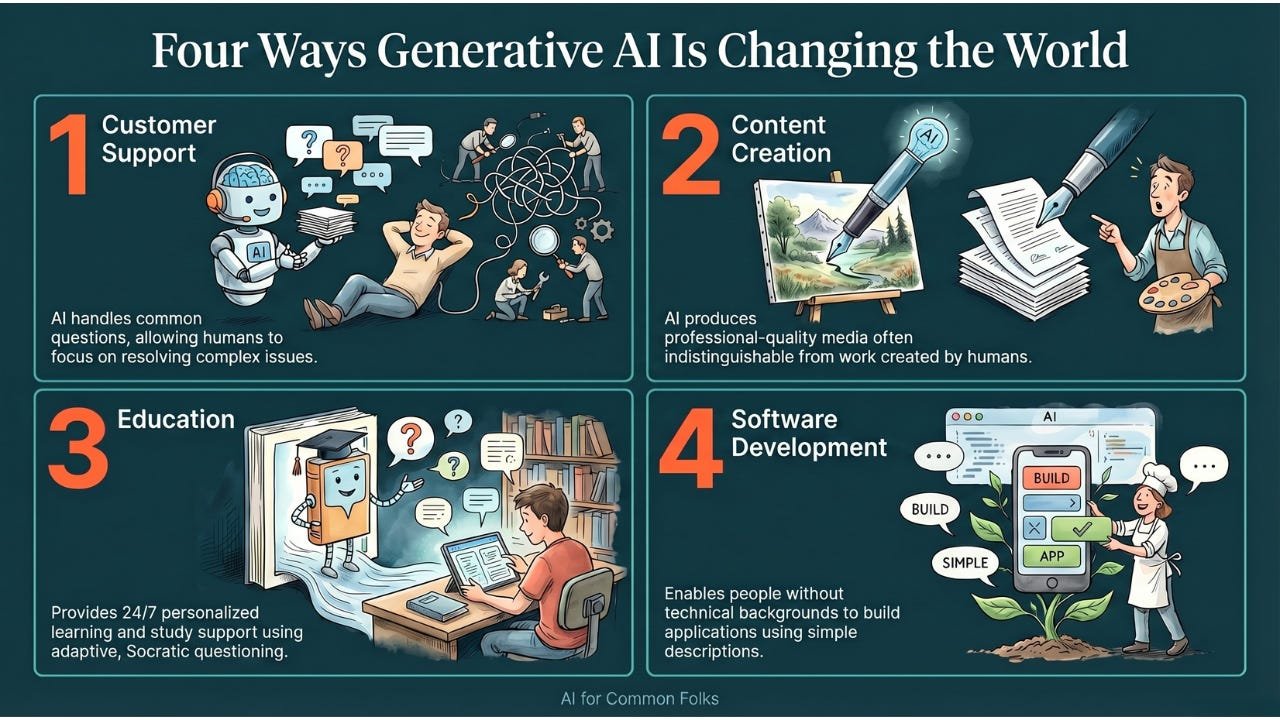
Generative AI is artificial intelligence that creates brand new content that didn’t exist before, like writing an essay, drawing a picture, composing music, or writing computer code, by learning patterns from mountains of existing data and producing something new that feels like a human made it.
Hey Common Folks!
We break down AI so it makes sense to real people. If you’ve been following along, our last article explored Predictive Modeling, how AI uses historical data to make educated guesses about the future. That’s AI looking backward to predict forward.
Today we’re flipping the script. What if AI could look at everything it has learned and create something entirely new?
That’s Generative AI. And it’s the reason AI went from a behind-the-scenes tool to something your parents, your boss, and your neighbor are all talking about.
Why This Feels Different from Everything Before
Think about what makes humans special. Our ability to create new things, right? For decades, people said this was the one thing AI would never be able to do.
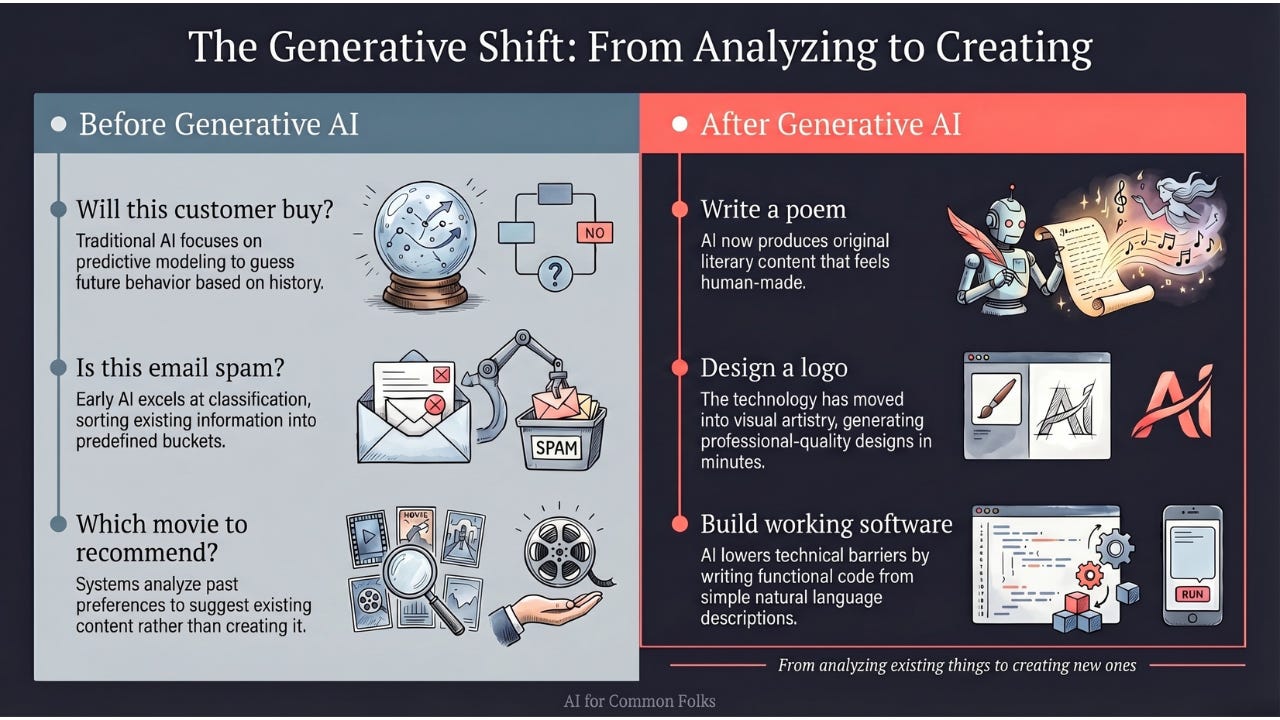
Before Generative AI, artificial intelligence was mainly used for prediction and classification:
-
Will this customer buy our product? (prediction)
-
Is this email spam or not? (classification)
-
Which movies should we recommend? (recommendation)
Useful, but limited. Now, Generative AI can write a poem, design a logo, generate a 3D model, compose music, or write working software. The creative barrier has been broken.
In fact, the images you see in this article and even the majority of this writing style was created with the help of AI tools. We’re using the very technology we’re explaining.
Four Ways Generative AI Is Already Changing the World
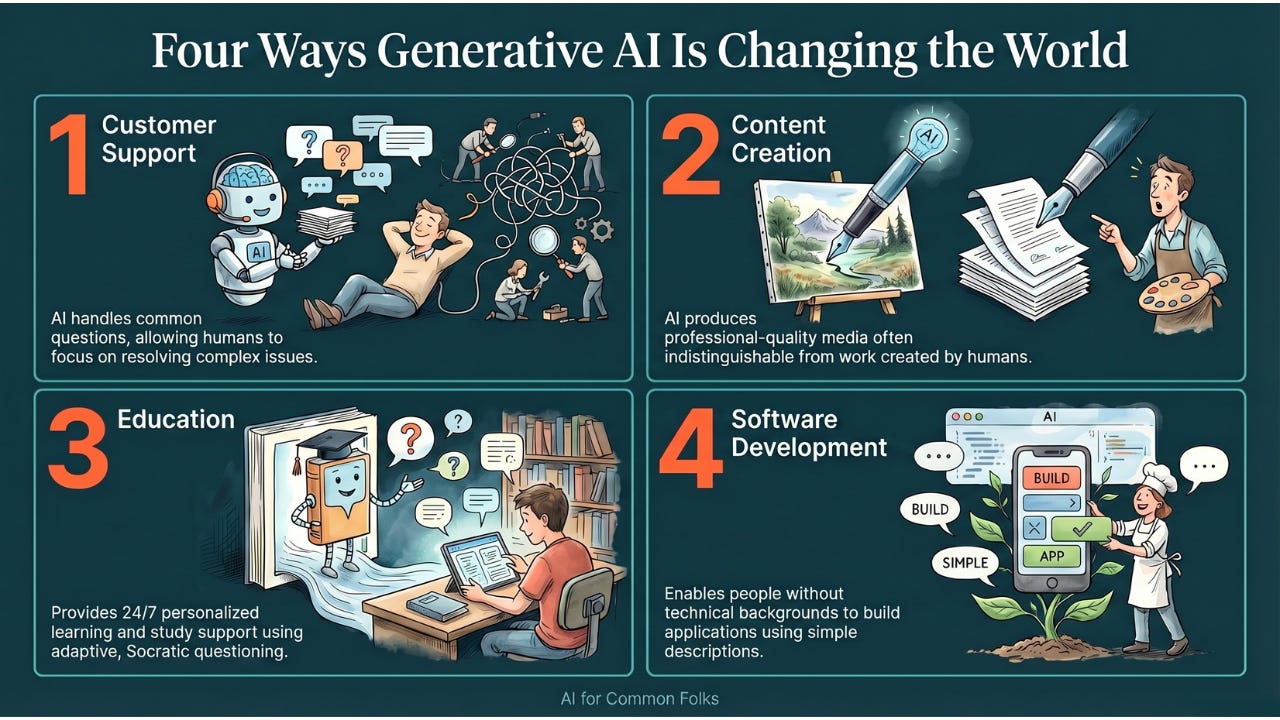
1. Customer Support That Doesn’t Make You Pull Your Hair Out
Remember the last time you needed help and had to wade through an endless phone tree or wait hours for a response?
Companies used to need huge call centers with dozens of employees handling problems. Expensive and frustrating for everyone.
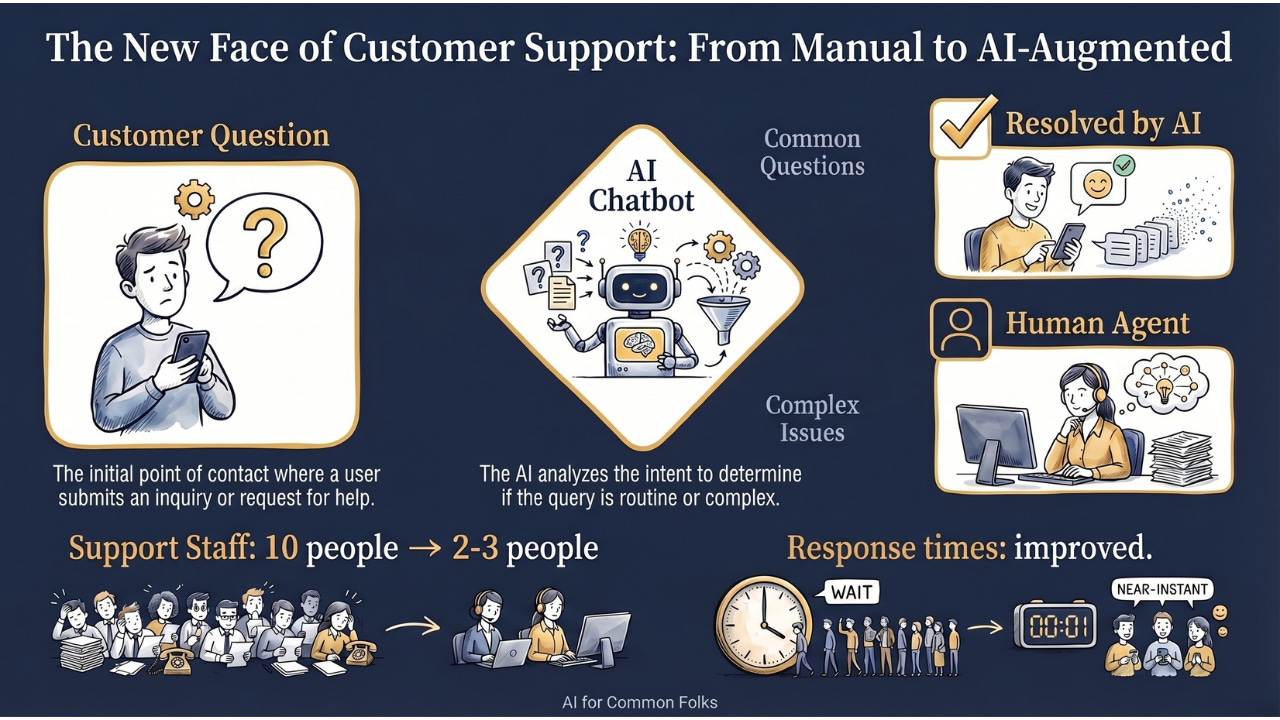
Now, AI-powered chatbots handle the first level of support. When you contact customer service for a food delivery app or your internet provider, your initial questions are likely answered by an AI that understands what you’re asking and gives helpful responses.
The result? Companies reduce their support staff from 10 people to 2-3, while actually improving response times. The AI handles common questions. Human agents focus on the complex issues that really need their attention.
2. Content Creation That’s Indistinguishable from Human Work
“AI can’t be creative” was the mantra for years. That ship has sailed.
Today, if you read an article online, you often cannot tell if a human or an AI wrote it. The quality has improved that dramatically.
This extends beyond writing to image creation, video editing, music composition, and more. Artists and creators aren’t being replaced, but they’re increasingly working alongside AI tools that speed up their workflow.
For everyday people, this means you can generate professional-quality content without years of specialized training. Need a business proposal? A birthday card design? A custom bedtime story for your kids? Generative AI can help create it in minutes.
3. Education That Adapts to How You Learn
Generative AI is transforming education by providing 24/7 personalized learning support. Stuck on a complex topic? AI can explain concepts in multiple ways until you understand.
Tools like ChatGPT, Claude, and Gemini are already being used by students worldwide as study partners. Universities like Northeastern and the London School of Economics have integrated AI tutoring into their programs. Some of these tools use Socratic questioning, asking you guiding questions instead of handing you the answer, helping you actually think instead of just copy.
This newsletter itself is an example. We use AI tools every day to research, draft, and refine explanations so that complex topics reach you in plain language.
4. Software Development That’s Accessible to Almost Everyone
Coding used to be a highly specialized skill requiring years of training. Generative AI has dramatically lowered the barriers.
Today’s AI tools like Claude Code, Cursor, and GitHub Copilot can:
-
Write functional code from a simple description
-
Explain complex code in plain language
-
Debug and fix errors
-
Build entire applications with minimal guidance
Tasks that once required a team of five programmers might now be accomplished by two or three with AI assistance. More importantly, people who never thought they could create software are now building tools to solve their own problems.
The “no-code” and “low-code” movements are being supercharged by Generative AI, making software creation accessible to people without technical backgrounds.
Is Generative AI Just Another Tech Bubble?
Before investing your time in learning any technology, it’s smart to ask whether it has staying power. We evaluated Generative AI against five questions:
1. Does it solve real-world problems?
Yes. As we just saw, it’s already making a real difference in customer service, education, content creation, and software development. These aren’t trivial applications.
2. Is it useful in everyday life?
Yes. Unlike some technologies that only benefit specialized industries, Generative AI tools are immediately useful to almost everyone. Writing emails, learning new skills, creating content, understanding complex information. Daily value.
3. Is it creating economic impact?
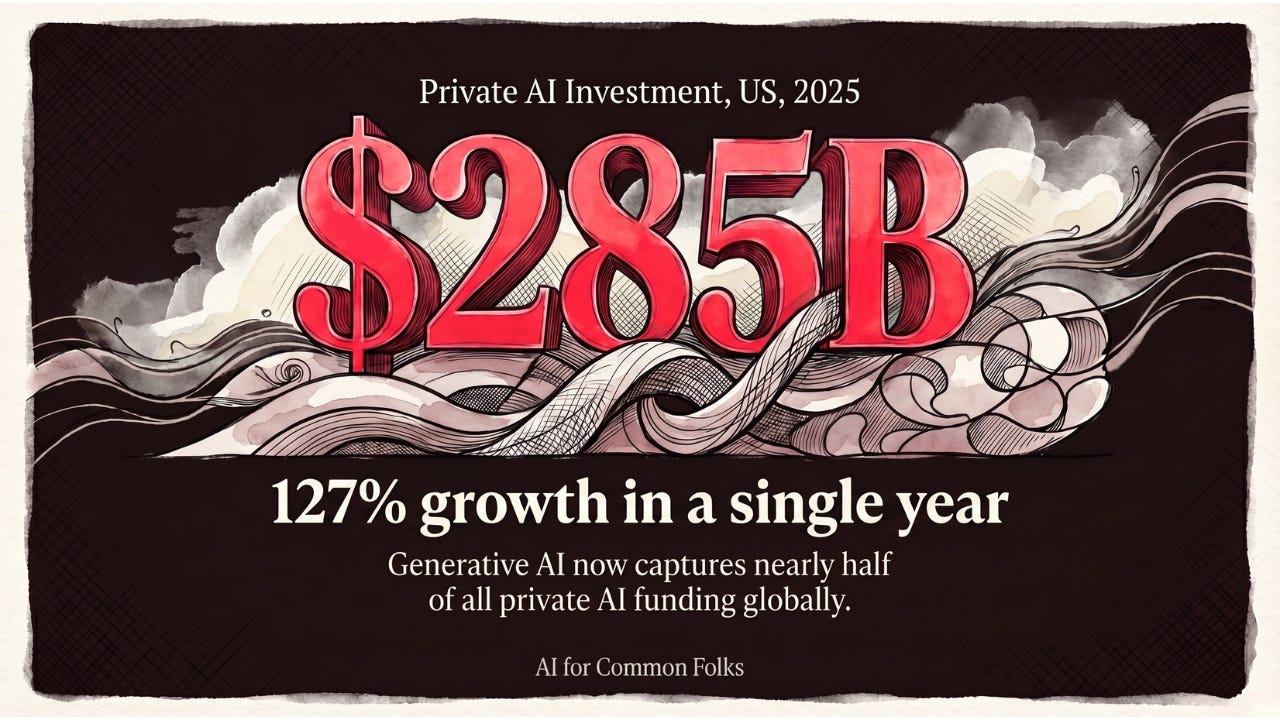
Absolutely. Private AI investment hit $285 billion in the US alone in 2025, growing over 127% in a single year. Generative AI captures nearly half of all private AI funding globally. Major companies are restructuring entire divisions around AI capabilities.
4. Is it creating new job opportunities?
Yes. While there are legitimate concerns about job displacement, Generative AI is also creating entirely new career paths. The role of “AI Engineer” barely existed a few years ago. Now it’s one of the fastest-growing job categories.
New roles are emerging in prompt engineering, AI ethics, AI training and education, and specialized AI application development across industries.
5. Is it accessible to ordinary people?
Yes. This might be the most important part. Unlike previous waves of technology that required specialized knowledge, today’s Generative AI tools are designed to be used through natural language.
You don’t need to code or understand complex math. You simply talk to them in English, Hindi, Urdu, or whatever language you prefer. The technology is accessible to almost everyone, regardless of technical background.
All five answered yes. Generative AI is following the trajectory of truly transformative technologies like the internet, not temporary hype cycles.
Why This Matters Now
The Generative AI shift isn’t coming. It’s already here. But we’re still in the early days, comparable to where the internet was in the mid-90s. The most significant impacts and opportunities are still ahead.
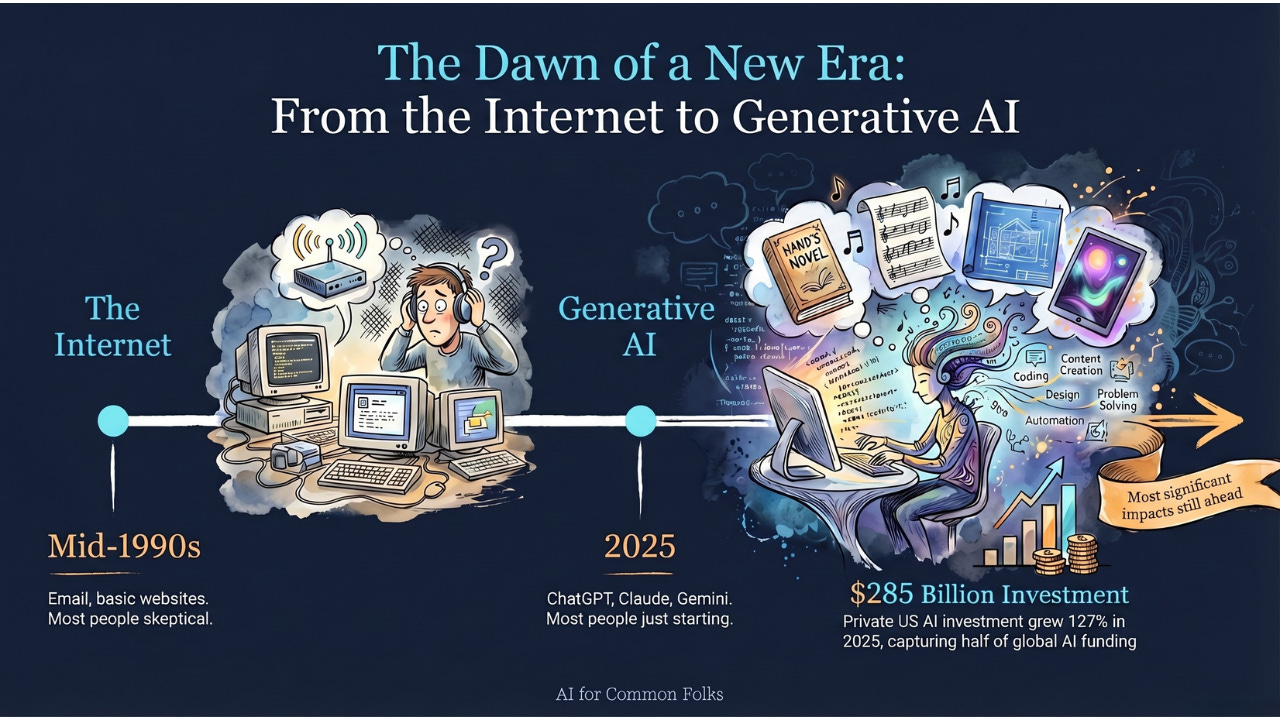
By understanding these tools now, you position yourself to benefit from them rather than being caught off guard as they transform more aspects of work and life.
The good news? These tools are designed to be intuitive. You don’t need to understand everything about how they work to start benefiting from them today.
Coming Up
Now that you know what Generative AI is and why it matters, the natural next question is: what’s actually powering these tools? In our next article, we’ll break down Foundation Models, the massive pre-trained systems that make ChatGPT, Claude, and Gemini possible. If you’ve ever wondered why some AI tools are smarter than others, that one’s for you.
Inspired in part by CampusX’s Hindi-language AI education content.
AI for Common Folks — Making AI understandable, one concept at a time.
Leave a Reply