Machine Learning is teaching computers to learn from data, rather than following a list of strict rules. Instead of programming every possible scenario, we show machines examples, and they figure out the patterns themselves—like a child learning to recognize dogs by seeing hundreds of different breeds.
If AI is the destination, Machine Learning is the vehicle that gets us there. And you’re already using it dozens of times a day without realizing it.
Hey Common Folks!
In our last edition, we learned that Artificial Intelligence (AI) is the big umbrella term for machines acting smartly. But how exactly do they get smart? They don’t just wake up one day knowing how to drive a car or recommend your next Netflix binge.
They have to learn.
Today, we’re zooming in on the most important circle inside that AI umbrella: Machine Learning (ML).
Machine Learning vs Traditional Programming: The Big Shift
To understand why Machine Learning is revolutionary, we need to look at how we used to talk to computers versus how we talk to them now.
The Old Way: Traditional Programming (The Recipe)
For decades, if we wanted a computer to do something, we had to give it a specific “recipe.”
We gave the computer the Input (ingredients) and the Rules (recipe), and the computer gave us the Output (the cake).
Example: If you wanted to write a program to add two numbers, you had to write the rule: If user gives 2 and 2, perform addition. Result is 4.
The problem? You have to write code for every single scenario. If you want a computer to recognize a dog, you have to write rules for tail length, ear shape, and fur color. But what happens when you show it a Poodle after you wrote rules for a German Shepherd? The program fails. You can’t write enough rules to cover the real world.
The New Way: Machine Learning (The Detective)
Machine Learning flips the script. Instead of giving the computer the rules, we give it the Input and the Output (the answers), and we ask the computer to figure out the Rules itself.
The Analogy:
Imagine teaching a child to identify a “dog.” You don’t hand the child a dictionary definition of a canine.
You point to a Golden Retriever and say, “Dog.” You point to a Pug and say, “Dog.” You point to a cat and say, “No, not dog.”
Eventually, the child’s brain spots the patterns—the snout, the paws, the bark—and learns to recognize a dog they’ve never seen before.
This is Machine Learning. We feed the computer thousands of photos (Data) and tell it which ones are dogs (Answers). The machine acts like a detective, finding the hidden patterns that make a dog a dog.
The Three Types of Machine Learning
Not all learning happens the same way. In the world of ML, there are three main ways machines learn. Think of them as different teaching styles:
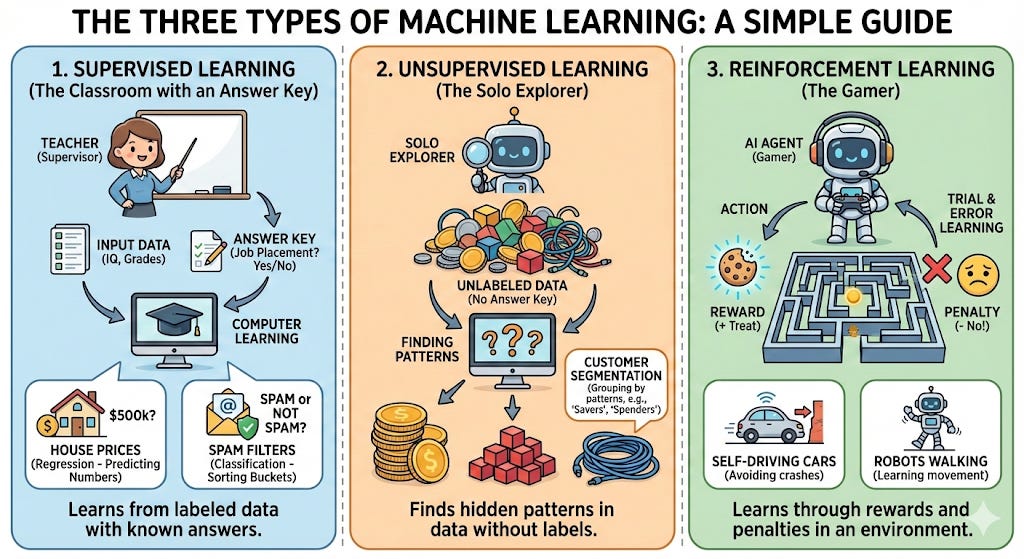
1. Supervised Learning (The Classroom with an Answer Key)
This is the most common type. We act as the “supervisor” or teacher. We give the computer data that includes the right answers.
How it works: We show the computer data about students—their IQ and their Grades (Input)—and tell it who got a job placement and who didn’t (Output/Answer Key). The computer learns the relationship between grades and getting a job.
Real Life Examples:
-
House Prices: Predicting if a house will sell for $500k based on its size and location (This is called Regression—predicting a number).
-
Spam Filters: Predicting if an email is “Spam” or “Not Spam” (This is called Classification—sorting things into buckets).
2. Unsupervised Learning (The Solo Explorer)
Here, we throw the computer into the deep end without an answer key. We give it data, but no labels. We say, “Here’s a pile of data. Find the patterns yourself.”
How it works: Imagine you dump a bucket of mixed coins on a table. You don’t need to know the names of the coins to sort them. You can group them by size or color. That’s Unsupervised Learning.
Real Life Example:
-
Customer Segmentation: A bank looks at millions of transactions and groups customers into “Savers,” “Spenders,” and “Investors” without being told those groups exist beforehand.
3. Reinforcement Learning (The Gamer)
This is learning by trial and error. The AI is an “agent” placed in an environment. If it does something good, we give it a reward (like a digital cookie). If it messes up, it gets a penalty.
The Analogy: It’s exactly like training a dog. If the dog sits, it gets a treat. If it jumps on the couch, it gets a “No!” Eventually, it learns what to do to get the most treats.
Real Life Examples: Self-driving cars learning not to crash, or robots learning how to walk.
How Machine Learning Actually Works: The Math Behind It
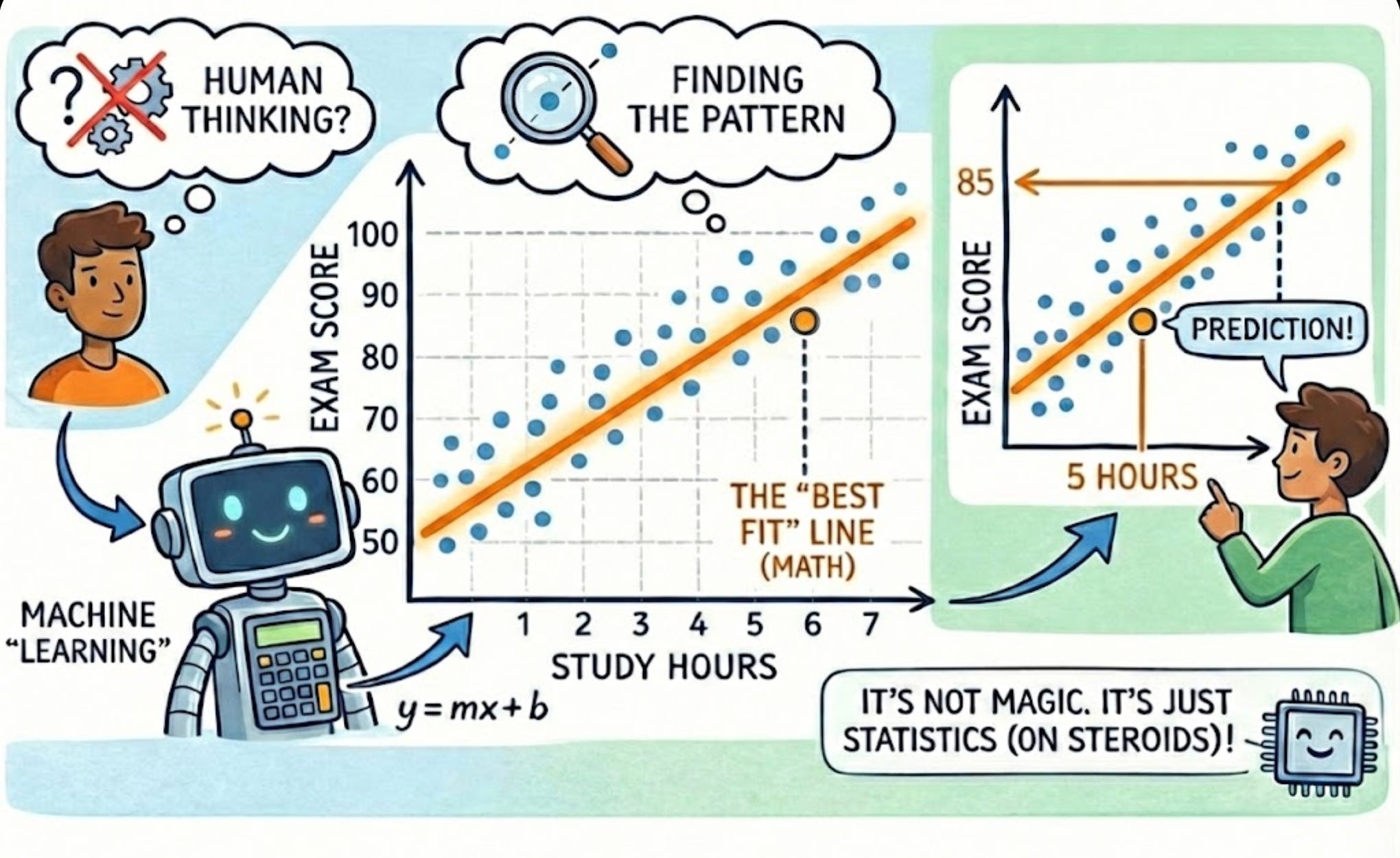
When we say the machine “learns,” it isn’t thinking like a human. It’s using math to draw a line through data.
If you plot points on a graph—say, “Study Hours” vs. “Exam Score”—Machine Learning is essentially trying to draw the best possible line that passes through those points.
Once that line is drawn, if you tell the machine you studied for 5 hours, it looks at the line and predicts your score.
That’s it. It’s not magic; it’s statistics on steroids.
Where You’re Already Using Machine Learning
You interact with Machine Learning every single day:
-
Netflix recommendations → Supervised Learning predicting what you’ll watch next
-
Spam filters → Classification sorting emails into spam or not spam
-
Voice assistants (Siri, Alexa) → Learning to understand your speech patterns
-
Amazon product suggestions → Unsupervised Learning finding patterns in shopping behavior
-
Self-driving cars → Reinforcement Learning improving through millions of practice miles
The Takeaway
Machine Learning is the shift from telling computers what to do to teaching computers how to figure it out.
-
It’s Supervised when we give it the answers.
-
It’s Unsupervised when it finds patterns on its own.
-
It’s Reinforcement when it learns by trial and error.
Next time Netflix suggests a movie you end up loving, you’ll know: that wasn’t a lucky guess. That was a Machine Learning model acting like a detective, analyzing your history to predict your future.
Coming Up:
We’ve covered the engine (ML), but what happens when we upgrade that engine to mimic the human brain? Next, we dive into the “Deep” end with Deep Learning and Neural Networks.
Leave a Reply