Deep Learning is a technique where we build complex, layered structures (called Neural Networks) that allow computers to learn from vast amounts of data without us having to tell them what to look for. It’s the technology behind self-driving cars, FaceID, ChatGPT, and voice assistants—allowing machines to see, hear, and create like humans.
Hey Common Folks!
We’ve covered the umbrella (AI) and the engine (Machine Learning). Now, we’re going to talk about the rocket fuel that has made AI the hottest topic on the planet for the last decade: Deep Learning (DL).
If Machine Learning is about teaching computers to find patterns, Deep Learning is about building a “brain” that can find patterns so complex that humans can’t even describe them.
When you hear about a computer beating a world champion at the game Go, or your phone unlocking by scanning your face, or Siri understanding your accent—that isn’t just generic AI. That’s Deep Learning.
Deep Learning vs Machine Learning: What’s the Difference?
The most critical difference comes down to one thing: Features.
Imagine you want to build a system to tell the difference between a Car and a Bus.
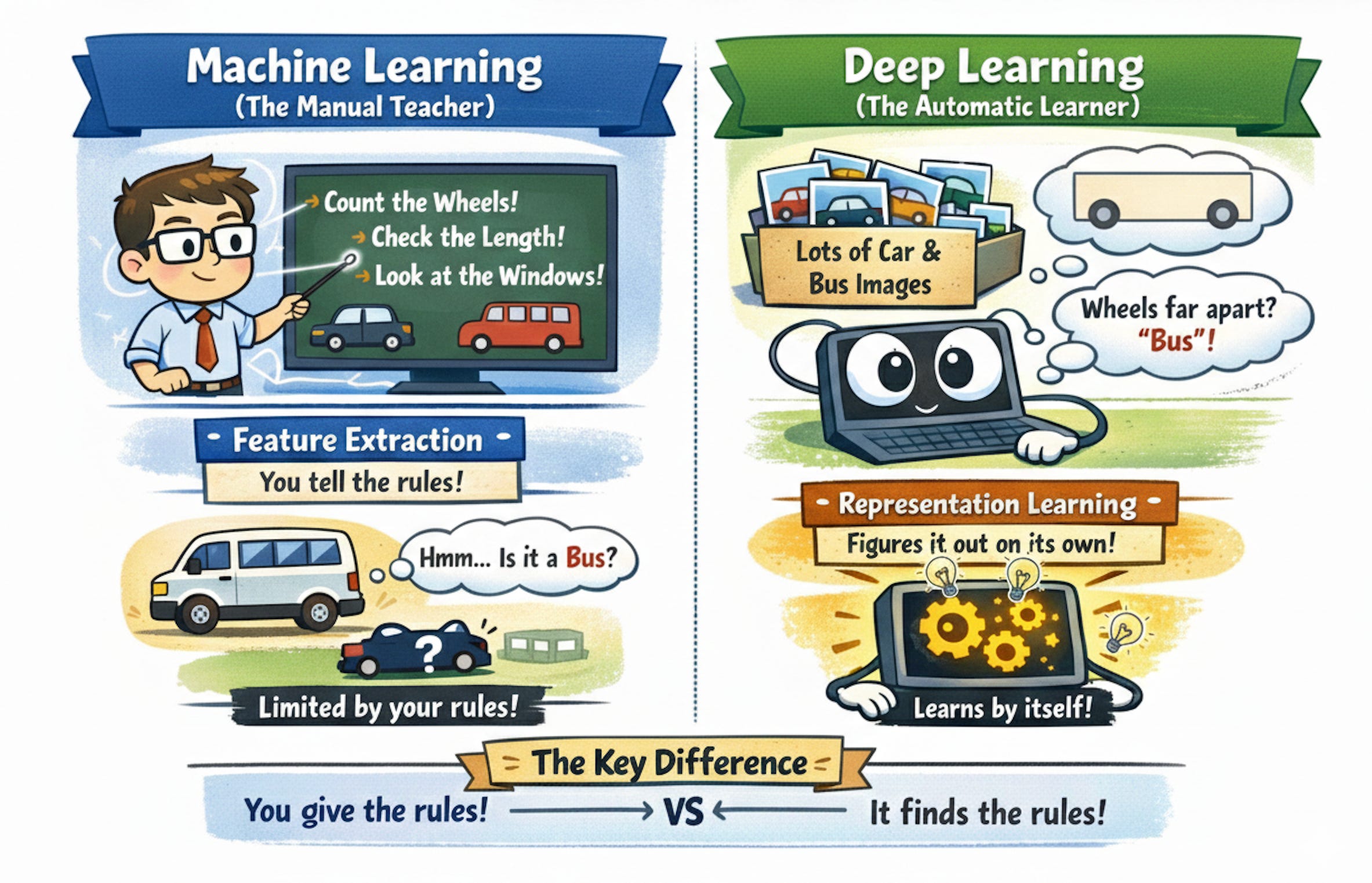
Machine Learning (The Manual Teacher)
In traditional Machine Learning, you (the human) have to be the expert. You have to tell the computer specific rules or “features” to look for.
-
You tell it: “Look for the number of wheels.”
-
You tell it: “Look at the length of the vehicle.”
-
You tell it: “Look for the number of windows.”
This is called Feature Extraction. The computer learns the math to separate cars from buses based on the features you gave it. But if you forget to tell it about “height,” it might confuse a tall van with a bus. The computer is limited by your ability to describe the object.
Deep Learning (The Automatic Learner)
In Deep Learning, you don’t define the features. You just throw thousands of pictures of cars and buses at the system.
The system looks at the raw pixels and figures it out on its own.
-
It figures out: “Hey, this long rectangular shape usually goes with the label ‘Bus’.”
-
It figures out: “These two circular patterns (wheels) spaced far apart mean ‘Bus’.”
It performs Representation Learning. It automatically extracts the features without human intervention.
The Key Difference: In Machine Learning, you tell the computer what to look at. In Deep Learning, the computer figures out what’s important on its own.
How Deep Learning Works: Neural Networks Explained
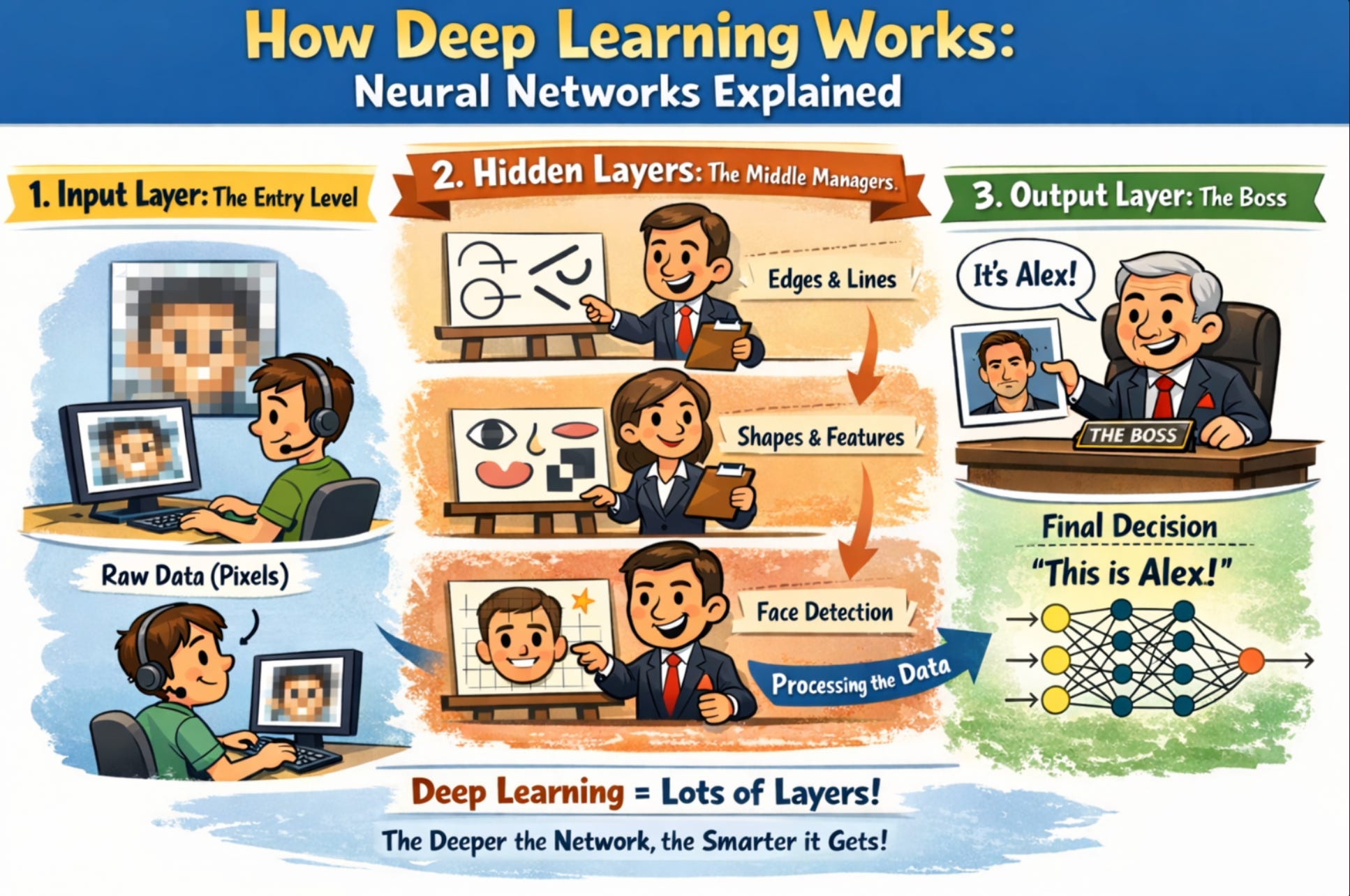
Deep Learning uses something called an Artificial Neural Network (ANN).
Imagine a corporate hierarchy or an assembly line.
1. The Input Layer (The Entry Level):
This is where the data comes in. If it’s a picture of a face, these are the raw pixels.
2. The Hidden Layers (The Middle Managers):
This is where the magic happens. The data passes through multiple layers of “neurons.”
-
The first layer might just detect lines and edges (curves, straight lines).
-
The next layer combines those lines to identify shapes (circles, squares, eyes, noses).
-
The deeper layers combine those shapes to identify complex objects (a human face).
3. The Output Layer (The Boss):
This layer gives the final decision: “This is a photo of Alex.”
We call it “Deep” Learning simply because we stack many, many of these hidden layers on top of each other. The deeper the network, the more complex patterns it can recognize.
How Does It Actually Learn? The Training Process
Here’s the key thing most people get confused about: Deep Learning still needs a teacher during training.
Think of it like teaching a child to recognize animals using flashcards.
Training Phase (You’re the Teacher):
1. Show the flashcard
You hold up a picture of a dog.
2. Tell them the answer
You say “DOG” out loud. (This is the correct label you provide.)
3. They make a guess
The child looks at the picture and says “Cat!” (Wrong!)
4. Measure how wrong they are (Loss Function)
You say, “No, that’s wrong. The right answer is DOG, not CAT.” The child’s brain calculates how wrong they were. Were they completely off, or kind of close?
5. They adjust their thinking (Backpropagation)
The child’s brain tweaks itself slightly. It thinks: “Okay, pictures with floppy ears and wagging tails are more likely to be dogs, not cats.” Next time they see similar features, they’ll guess differently.
6. Repeat thousands of times
You keep showing flashcard after flashcard. Dog, cat, dog, bird, dog, dog, cat… After seeing thousands of examples WITH your corrections, the child gets really good at recognizing animals.
Testing Phase (They Work Alone):
Now you show them a picture of a dog they’ve NEVER seen before—no label, no help.
The child confidently says “DOG!” ✓
The Deep Learning Process Works the Same Way:
During Training:
-
We show it 10,000 pictures of dogs (labeled “DOG”)
-
We show it 10,000 pictures of cats (labeled “CAT”)
-
The network looks at each picture one by one, makes a guess, gets corrected, and adjusts
-
Then it goes through ALL 20,000 pictures again… and again… and again
-
Each complete pass through all the data is called an Epoch
-
Models typically train for 10-100+ Epochs until they get really accurate
After Training:
-
We show it a NEW picture it’s never seen
-
It correctly identifies “DOG” on its own
-
We don’t give it the answer anymore—it learned the pattern
The Three Steps Happening Inside (For Each Picture):
Step 1: The Guess (Forward Propagation)
The neural network looks at a picture and makes a guess based on its current “knowledge” (the connections between neurons).
Step 2: The Grade (Loss Function)
The system compares what it guessed to the correct answer we provided:
-
What it guessed: “CAT”
-
What we told it: “DOG”
The Loss Function measures how wrong it was. Think of it like grading a test:
-
Totally wrong answer → Big red X → High error score
-
Close but not quite → Partial credit → Medium error score
-
Perfect answer → Gold star → Zero error
Step 3: The Correction (Backpropagation)
The network takes that error score and works backward through all its layers, slightly adjusting the connections (called weights) between neurons to make a better guess next time.
This loop—Guess, Grade, Correct—happens for every single picture in the dataset.
The Magic Part:
Yes, during training we give it Input (pictures) AND Output (correct labels). The network learns to find the patterns that connect them.
The “automatic feature learning” means we don’t tell it “look for floppy ears” or “look for wet noses”—it figures out THOSE details on its own by examining millions of pixels. But we absolutely DO tell it “this picture = dog, this picture = cat” during training.
Once trained, it can identify dogs in brand new photos without any help.
The Three Types of Neural Networks
Just like there are different types of vehicles for different jobs (trucks for hauling, Ferraris for speed), there are different neural networks for different data:
1. ANN (Artificial Neural Networks):
The basic version. Good for simple data like spreadsheets or numbers.
2. CNN (Convolutional Neural Networks):
The “Eyes” of AI. These are designed specifically for images and videos. They’re brilliant at scanning a photo to find patterns, like identifying a tumor in an X-ray or a stop sign for a self-driving car.
3. RNN (Recurrent Neural Networks):
The “Ears” and “Memory” of AI. These are designed for sequential data like text, audio, or time. They remember what happened previously to understand what’s happening now (like predicting the next word in a sentence).
Where You’re Already Using Deep Learning
You interact with Deep Learning technology every day:
-
Face ID / Face Unlock → CNNs recognizing your unique facial features
-
Voice Assistants (Siri, Alexa, Google Assistant) → RNNs understanding speech patterns
-
ChatGPT and AI Chatbots → Deep neural networks generating human-like text
-
Self-driving cars → Multiple neural networks processing camera feeds in real-time
The Takeaway
Deep Learning is the technology that allows computers to perform tasks that we used to think only humans could do—seeing, hearing, and creating.
It’s powerful, it’s complex, and it requires massive amounts of data. But at its core, it’s just a system of layers trying to minimize its own mistakes.
Was this helpful? Reply and let us know what AI term confuses you the most!
AI for Common Folks,
Understand AI in plain English.
Leave a Reply