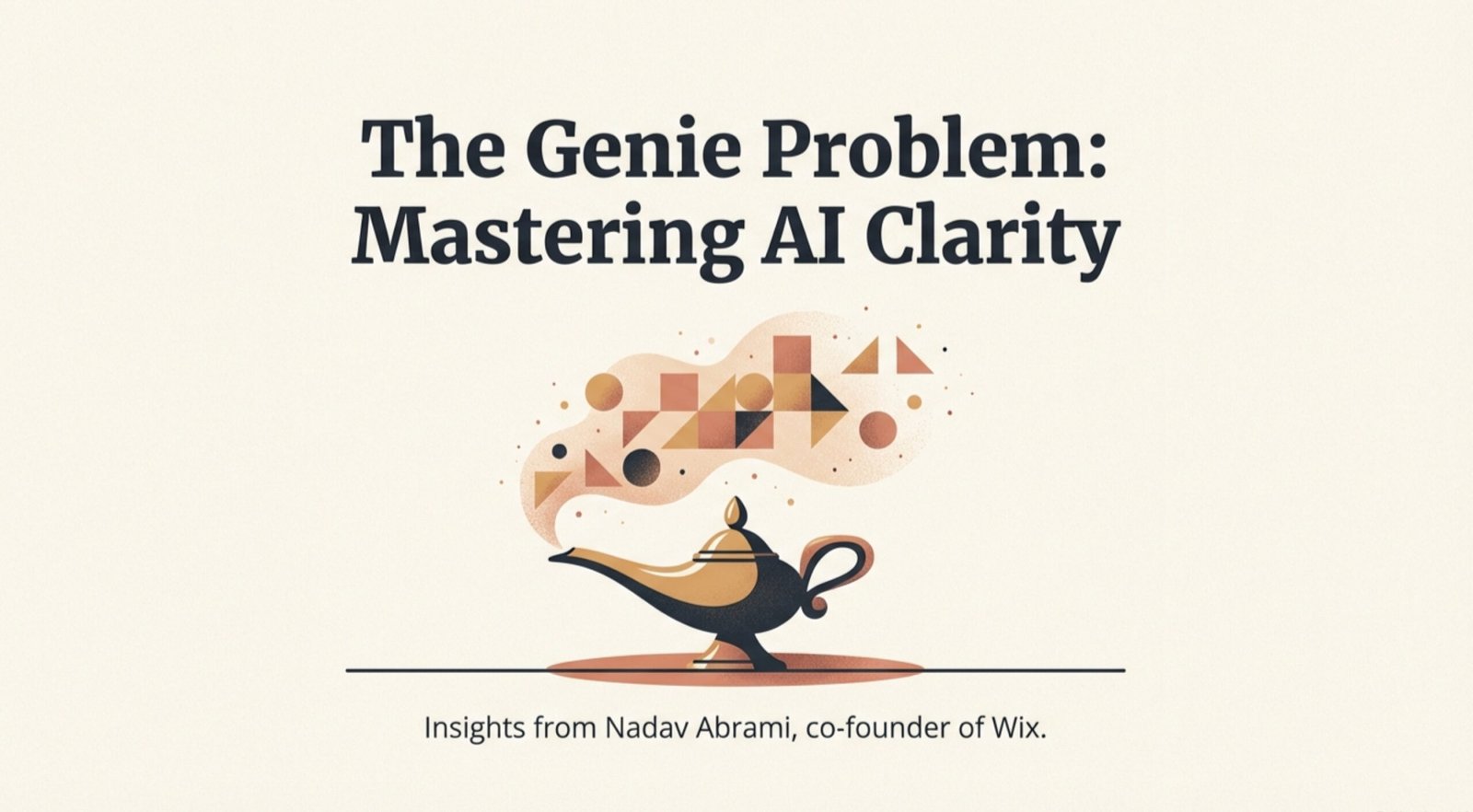
Everyone’s racing to learn AI tools. But the co-founder of a $5.5 billion company says the real skill has nothing to do with technology.
The Reality
You’ve heard it a hundred times: “Learn AI or get left behind.”
So people sign up for prompt engineering courses. They memorize frameworks. They learn to speak in chains and tokens and temperature settings.
And then they sit down with an AI tool and get garbage output.
Not because the tool is broken. Because they didn’t know what they actually wanted.
Nadav Abrami, co-founder of Wix — the $5.5 billion website building platform — has watched thousands of people use AI coding and prototyping tools. He’s seen the pattern clearly. The people who fail with AI aren’t the non-technical ones. They’re the unclear thinkers.
“It’s like talking to a genie,” he says. “95% of the time it will do what you want. But 5% of the time the genie will find everything you said that is flawed and will do the exact opposite of what you wanted.”
Here’s the critical difference between AI and a human colleague: a developer would push back when something you said doesn’t make sense. They’d ask clarifying questions. They’d tell you when your instructions contradict each other.
AI doesn’t do that. AI takes your instructions — correct or not — and executes them perfectly.
Which means every ambiguity in your thinking becomes a bug in your output.
The Shift
Abrami’s insight cuts against the entire “learn AI skills” narrative:
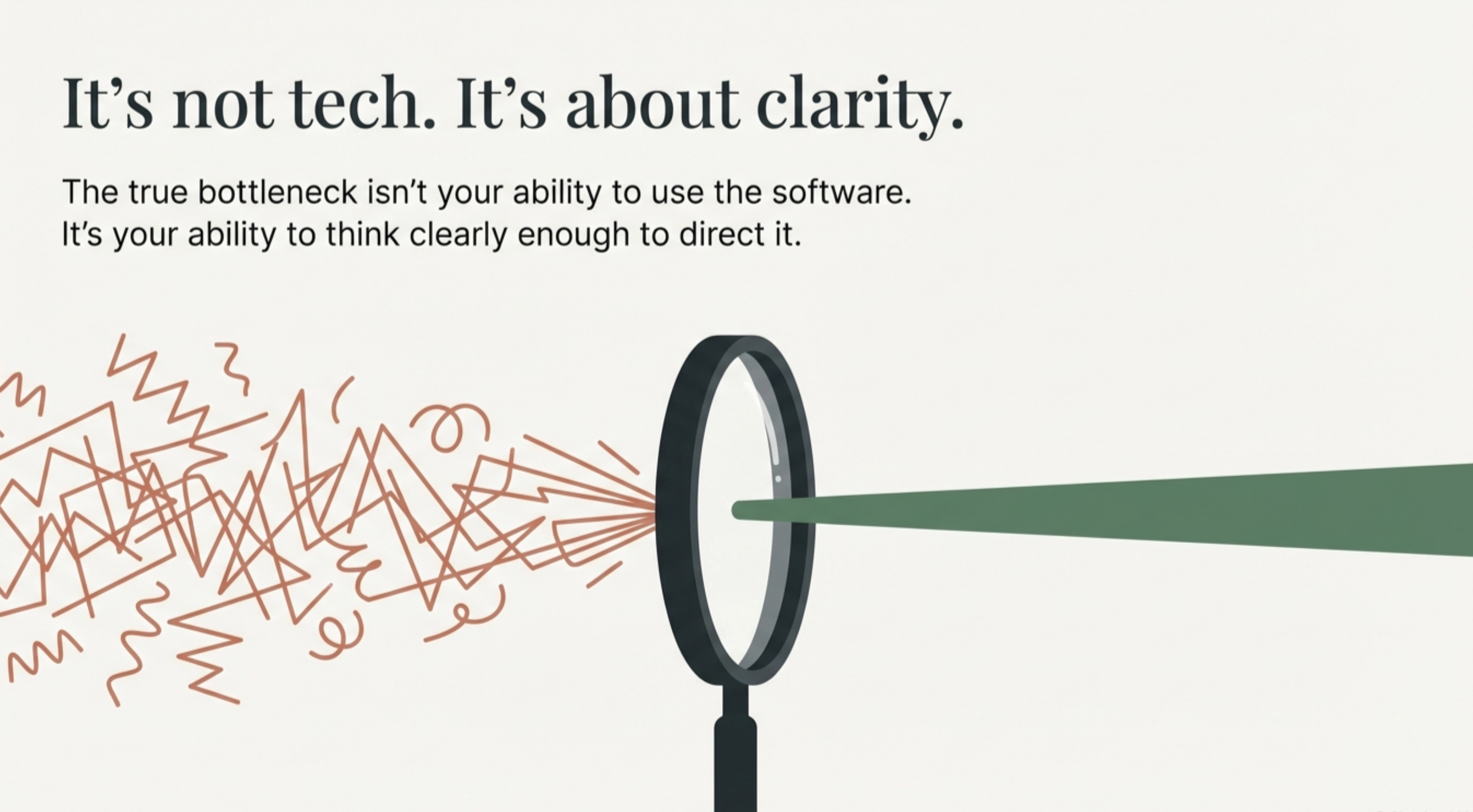
“It’s not about going technical. It’s about going clarity.”
Think about that. The bottleneck isn’t your ability to use the tool. It’s your ability to think clearly enough to direct it.
He puts it bluntly: “Anything that can be misinterpreted will statistically be misinterpreted.”
This isn’t Murphy’s Law for pessimists. It’s a mathematical reality when you’re working with systems that process language probabilistically. A human might catch your intent despite sloppy instructions. AI catches your words and ignores your intent.
The Old Way: Technical skills were the gateway. You needed to learn the tool’s language — its syntax, its quirks, its frameworks. Mastery meant knowing the tool better.
The New Reality: Clarity of communication is the meta-skill. You don’t need to tell AI how to build something. You need to know exactly what you want. The people who thrive with AI aren’t the most technical. They’re the most precise in their thinking.
Abrami recommends a simple practice that most people skip: Before you execute anything with AI, take your prompt and ask another AI to review it.
“What are the contradictions? What’s unclear? How could this be misinterpreted?”
It sounds almost too simple. But this is exactly what good developers do when they review a spec — they look for ambiguity. Now you can do it in ten seconds.
He also recommends what he calls “discuss mode” — before letting AI build anything, have a conversation with it first. Tell it your plan. Ask it: “How do you understand me? What do you think I’m saying?” Like you would with a developer before they start coding.
The difference between directing AI and understanding what AI did is the difference between someone who gives orders and someone who actually knows what they’re building.
What To Do Next
This week, before you use any AI tool for something important, try the “clarity check.”
Write your instructions. Then paste them into a fresh AI chat and ask: “What are the contradictions, ambiguities, or things that could be misinterpreted in this?”
You’ll be stunned at how many you find.
Then rewrite your instructions and try again. You’ll notice something: the output quality jumps — not because you used a better prompt template, but because you thought more clearly.
Make this a habit. Every important AI interaction gets a clarity check first. Over time, you’ll start catching the ambiguities in your own head before they even reach the screen.
That’s the real skill. Not prompting. Thinking.
The One Thing to Remember
AI doesn’t reward the most technical user. It rewards the clearest thinker. A genie grants what you say, not what you mean — so learn to say exactly what you mean.
This insight comes from Nadav Abrami, co-founder of Wix, on the Aakash Gupta podcast. The AI Shift curates wisdom from AI leaders for busy professionals navigating the AI era. When was the last time AI gave you something completely wrong — and was it really the AI’s fault, or yours?
Leave a Reply