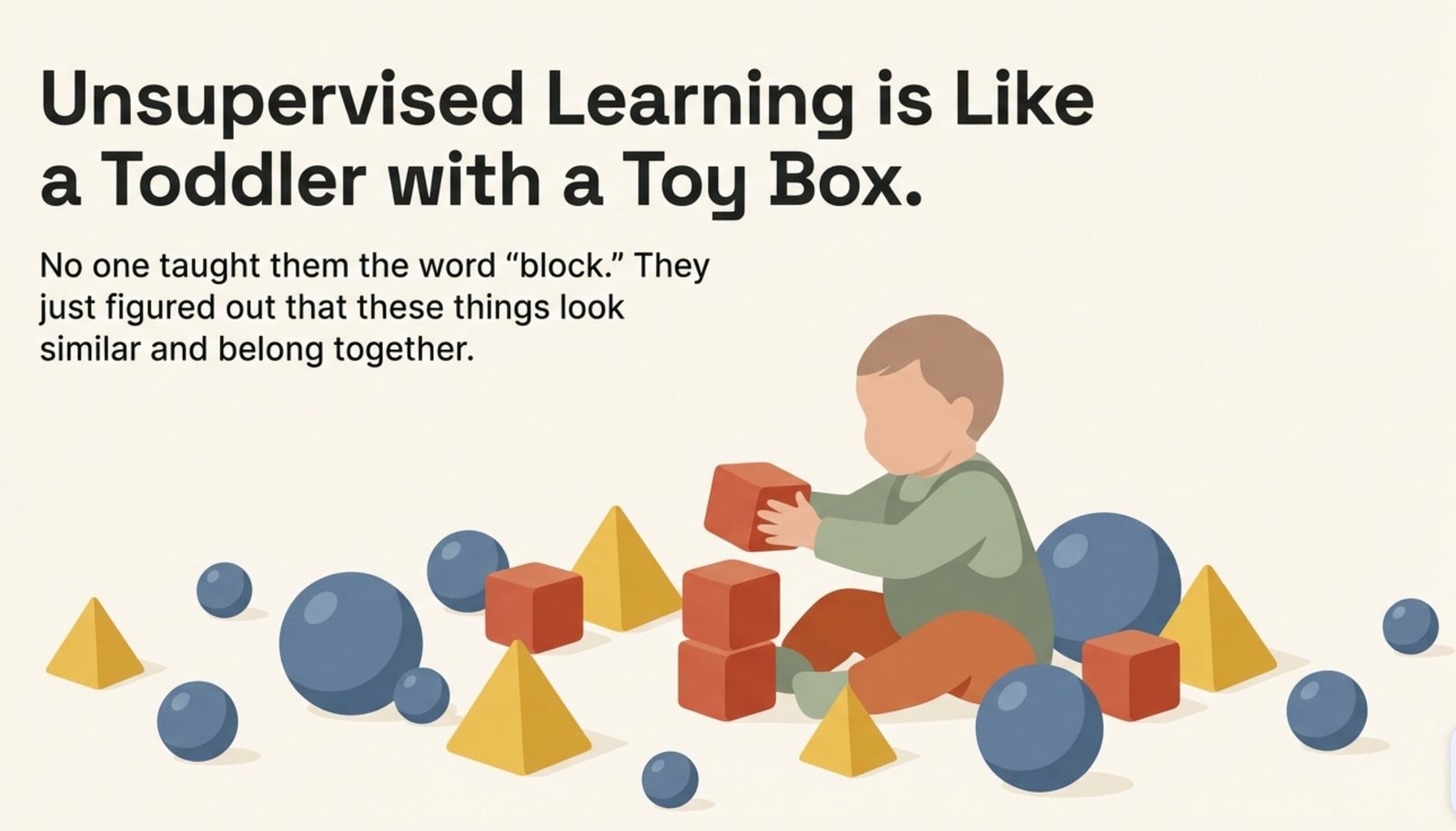
Unsupervised Learning is teaching computers to find hidden patterns in data without any labeled answers—like a detective solving a mystery with no clues, just raw evidence. While Supervised Learning needs a teacher with an answer key, Unsupervised Learning figures things out completely on its own.
Hey Common Folks!
Last week we talked about Supervised Learning—the kind where we hold the computer’s hand and show it the right answers. Today we’re going somewhere more mysterious.
What happens when you don’t have an answer key? What if you have mountains of data but no one has labeled any of it? What if you don’t even know what questions to ask?
That’s where Unsupervised Learning comes in.
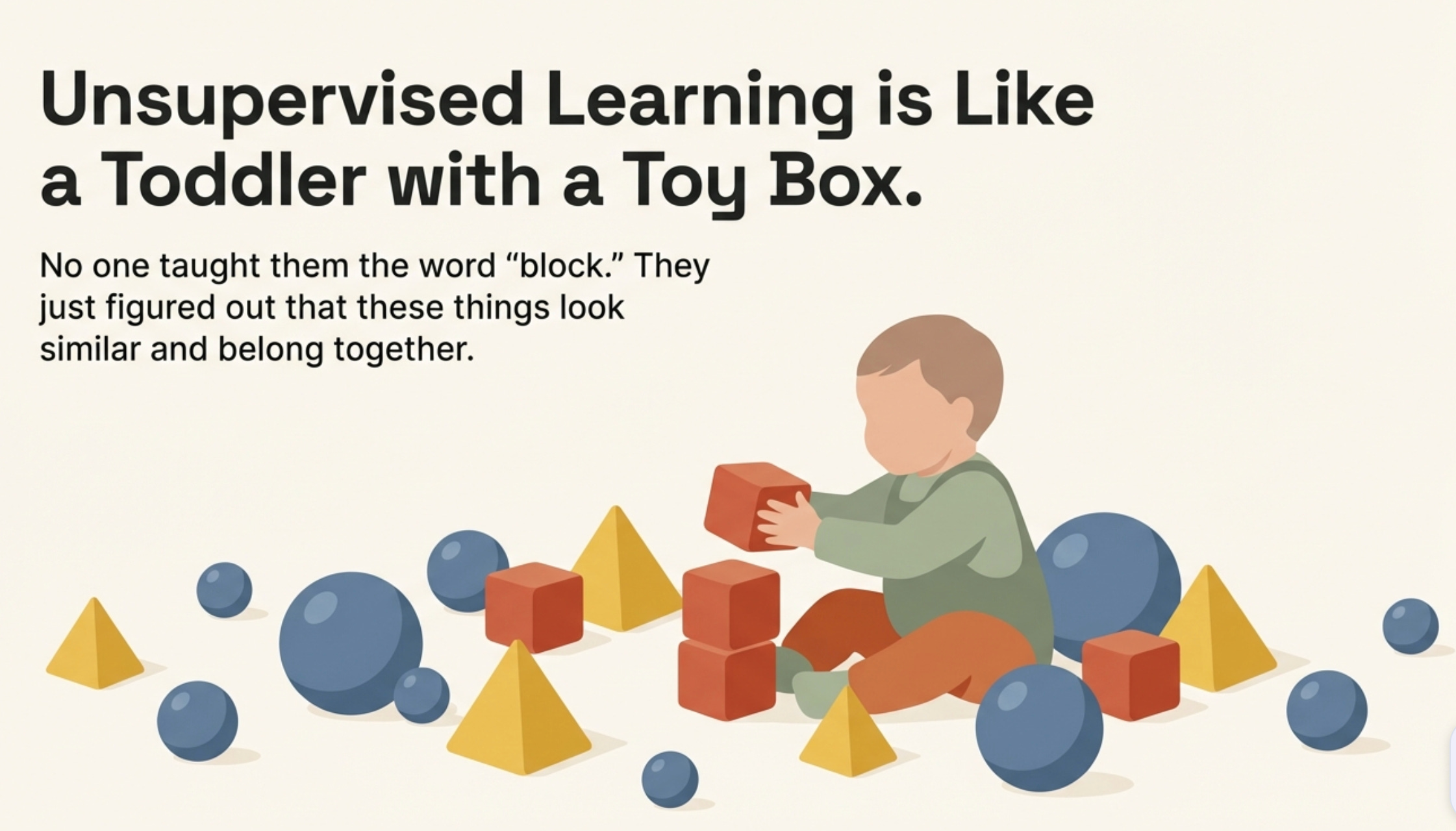
The Toy Box Analogy
Imagine dumping a bucket of toys in front of a toddler: red blocks, blue balls, yellow cars, green stuffed animals. You don’t tell them the names. You don’t explain what goes with what. You just watch.
What happens?
The toddler starts sorting. Maybe all the round things go in one pile. Maybe all the red things go together. Maybe the soft toys get separated from the hard ones.
The child doesn’t know the words “ball” or “block,” but they’ve discovered something profound: these things are similar to each other, and those things are different.
That’s Unsupervised Learning. The machine groups data based on similarities it discovers, without anyone telling it what the categories should be.
The Key Difference: No Labels, No Answers
In Supervised Learning, we showed the computer 10,000 emails and told it “this is spam” or “this is not spam.” We provided the answers.
In Unsupervised Learning, we just dump 10,000 emails on the computer and say “find the patterns.” We don’t tell it what spam looks like. We don’t even tell it to look for spam.
The computer might discover: “Aha, there’s a group of emails with similar characteristics—they all have words like FREE MONEY, they come from weird addresses, they have lots of exclamation points!!!”
It found the pattern. We just didn’t tell it what to call it.
The Three Superpowers of Unsupervised Learning
Since we’re not predicting specific answers, Unsupervised Learning typically does one of three jobs:
1. Clustering: The Automatic Organizer
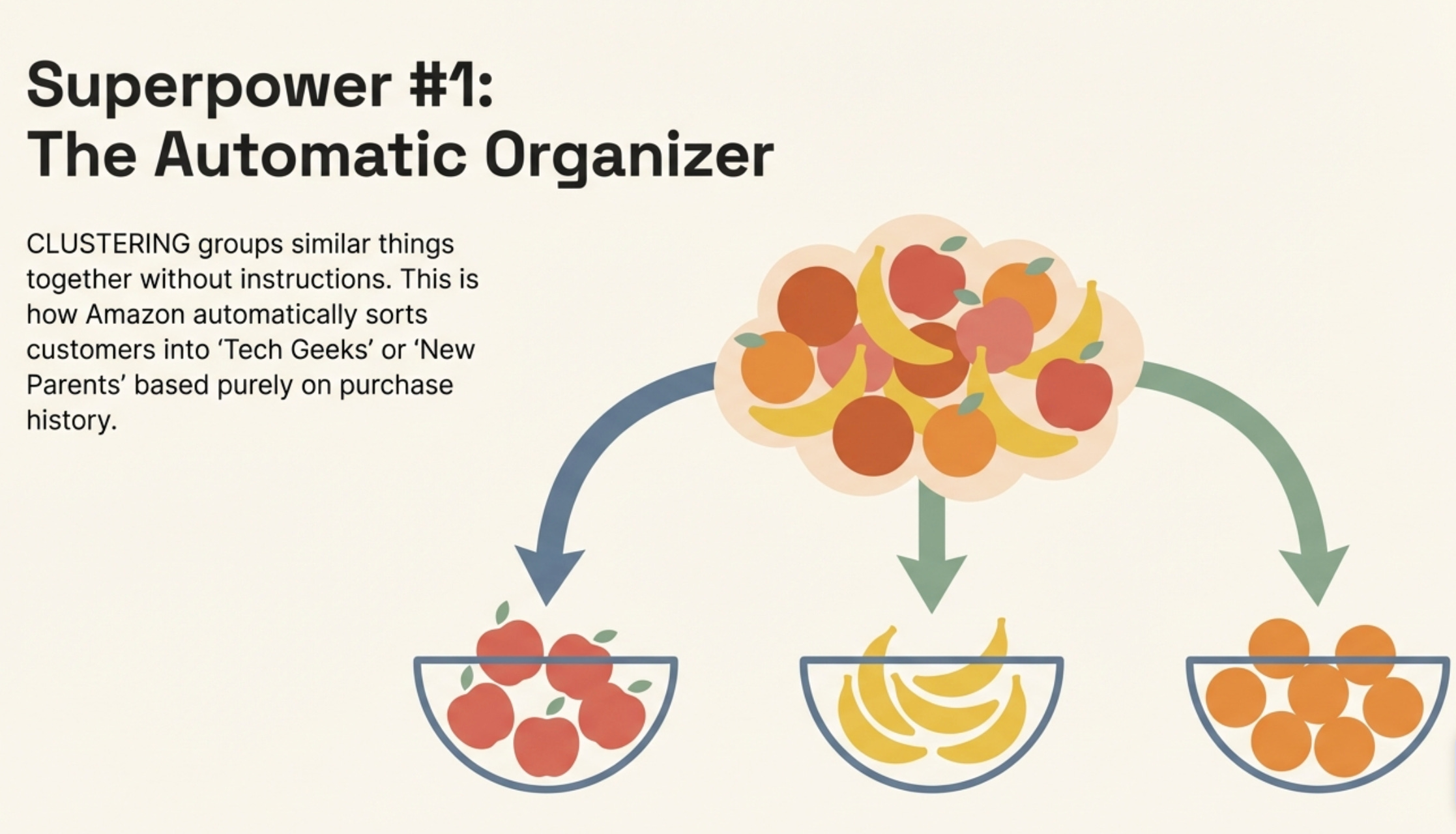
This is the most common use. The AI looks at your data and automatically groups similar items together.
The Student Example: Imagine plotting 1,000 college students by their grades and attendance. You don’t label anyone as “high achiever” or “struggling.” But when you look at the chart, you see natural clusters: one group with high grades and high attendance, another with low grades and spotty attendance, and a middle group coasting along.
The AI draws circles around these groups automatically. It discovered three types of students without anyone teaching it the categories.
Real-World Use—Amazon’s Recommendations: Amazon doesn’t manually sort you into “tech enthusiast” or “new parent.” Instead, their AI notices you buy the same types of products as certain other customers, groups you with them, and recommends what that group typically buys next. You’re in an invisible club you didn’t know existed.
2. Anomaly Detection: The Digital Security Guard
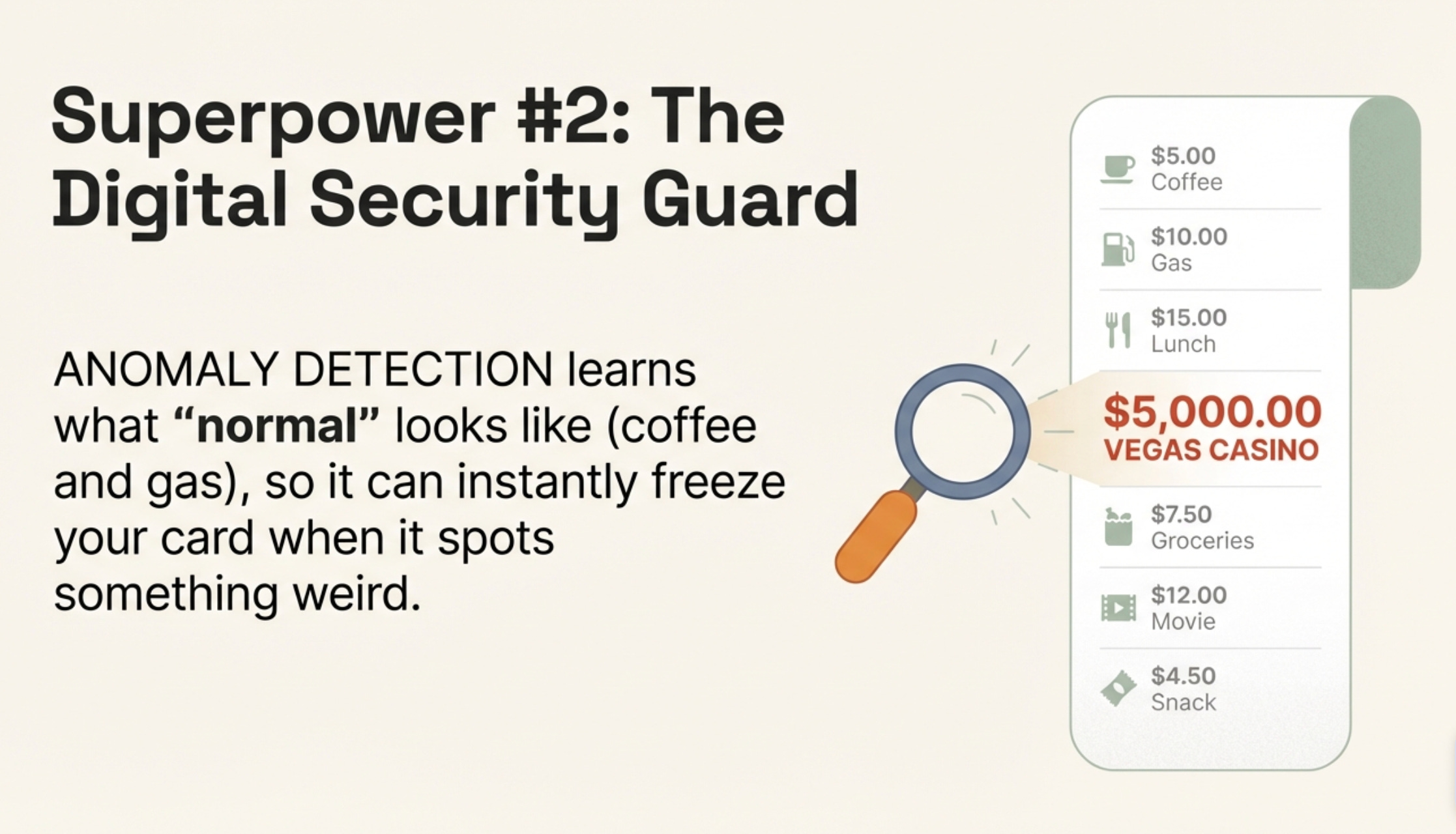
Instead of finding what’s similar, the AI hunts for what’s weird. It learns what “normal” looks like, then flags anything that doesn’t fit.
The Credit Card Example: Your bank doesn’t have a list of “fraud transactions” to train on. Instead, it learns your normal pattern: $50 at the grocery store in Indiana, $30 for gas, $15 at Starbucks.
Then one day, boom—a $5,000 charge in Las Vegas.
The AI sees this as an outlier, way outside your normal pattern. It doesn’t need to be told “this is fraud.” It just knows “this is weird,” and freezes your card.
3. Association: The “People Who Bought This Also Bought” Engine
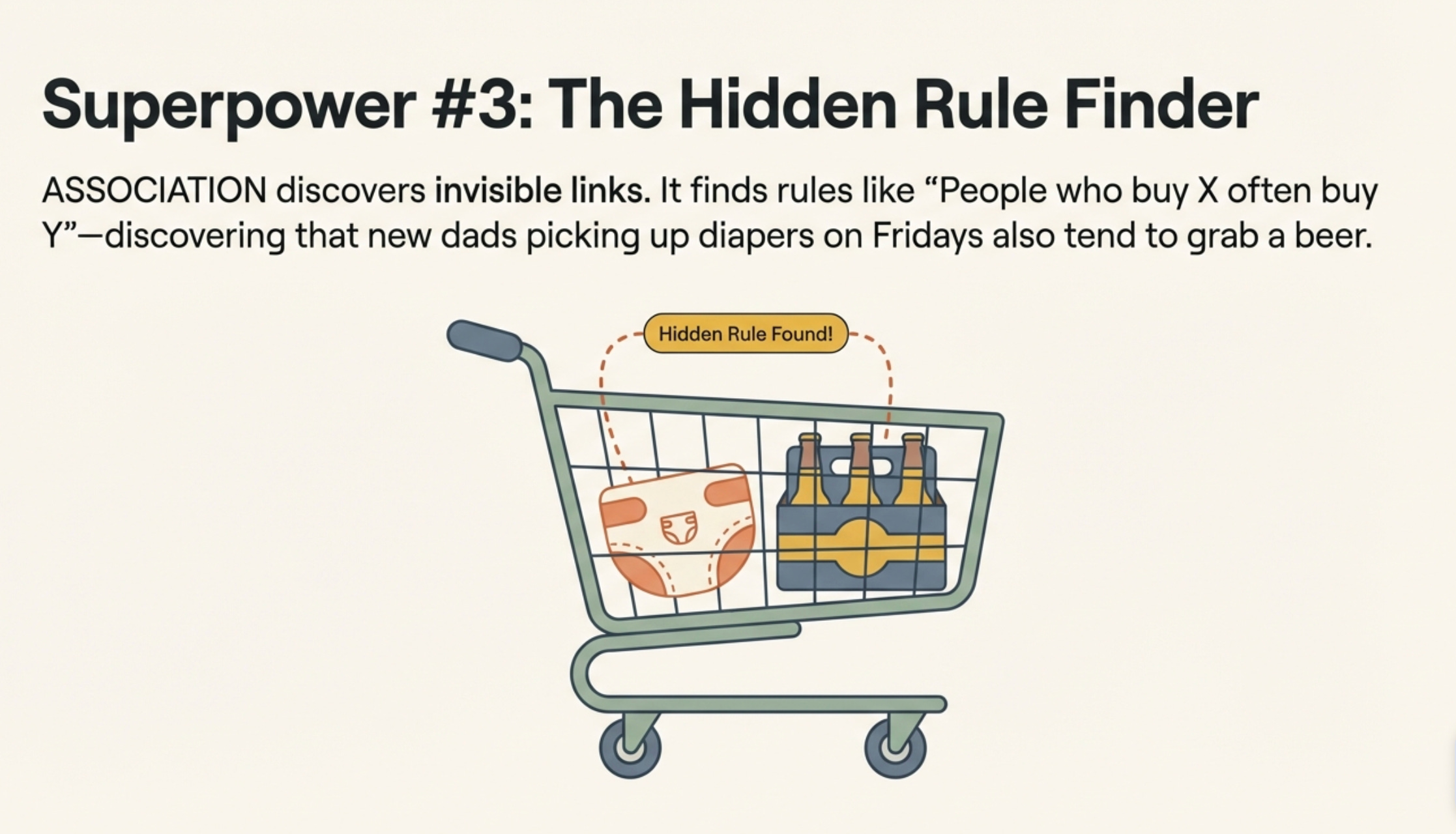
This finds rules hidden in your data. It discovers that when X happens, Y tends to happen too.
The Famous Example: Walmart’s data team discovered something bizarre in their transaction data. Men who bought diapers on Friday evenings also tended to buy beer.
No one programmed this rule. The algorithm discovered the pattern: new dads stopping for diapers were also grabbing beer for the weekend.
Netflix’s Secret: When you finish watching Inception, Netflix suggests Interstellar. Not because someone manually linked these movies, but because the algorithm noticed people who watched one usually watched the other. It associated the two based purely on viewing patterns.
The Big Challenge: How Do You Know It’s Right?
Here’s the uncomfortable truth about Unsupervised Learning: you can’t always tell if it’s right.
In Supervised Learning, if the AI calls a cat a dog, we correct it immediately. Wrong answer.
In Unsupervised Learning, the AI might group your customers by shoe size instead of spending habits. Is that wrong? Technically no—it found a pattern. But is it useful? Probably not.
This is why human expertise still matters. The AI finds patterns we never knew existed, but humans have to interpret whether those patterns actually mean something valuable.
Where You’re Already Using It
You interact with Unsupervised Learning more than you realize:
Netflix and Spotify recommendations work by clustering users with similar tastes and suggesting what others in your cluster enjoyed.
Google Photos automatically groups pictures of the same person together, even though you never labeled anyone. It learned to recognize faces and found the pattern: “these 50 photos all contain the same face.”
Credit card fraud detection flags unusual purchases based on your personal spending patterns, not a pre-labeled list of “fraud types.”
Spam filters got their start with Supervised Learning, but many now use Unsupervised Learning to catch new spam tactics no one has labeled yet.
The Takeaway
Unsupervised Learning unlocks the value hidden in raw, unlabeled data. It finds patterns we didn’t know to look for.
While Supervised Learning needs a teacher, Unsupervised Learning is the self-starter—the algorithm that explores data on its own and surfaces insights humans might never have discovered.
It clusters similar things. It spots weird outliers. It discovers associations we didn’t see coming.
Coming Up: We’ve covered learning with a teacher (Supervised) and learning alone (Unsupervised). But what about learning through trial and error—getting rewards for good choices and penalties for bad ones? That’s Reinforcement Learning, the technique teaching robots to walk and AI to master video games. We’ll explore it next.
AI for Common Folks — Making AI understandable, one concept at a time.
Leave a Reply