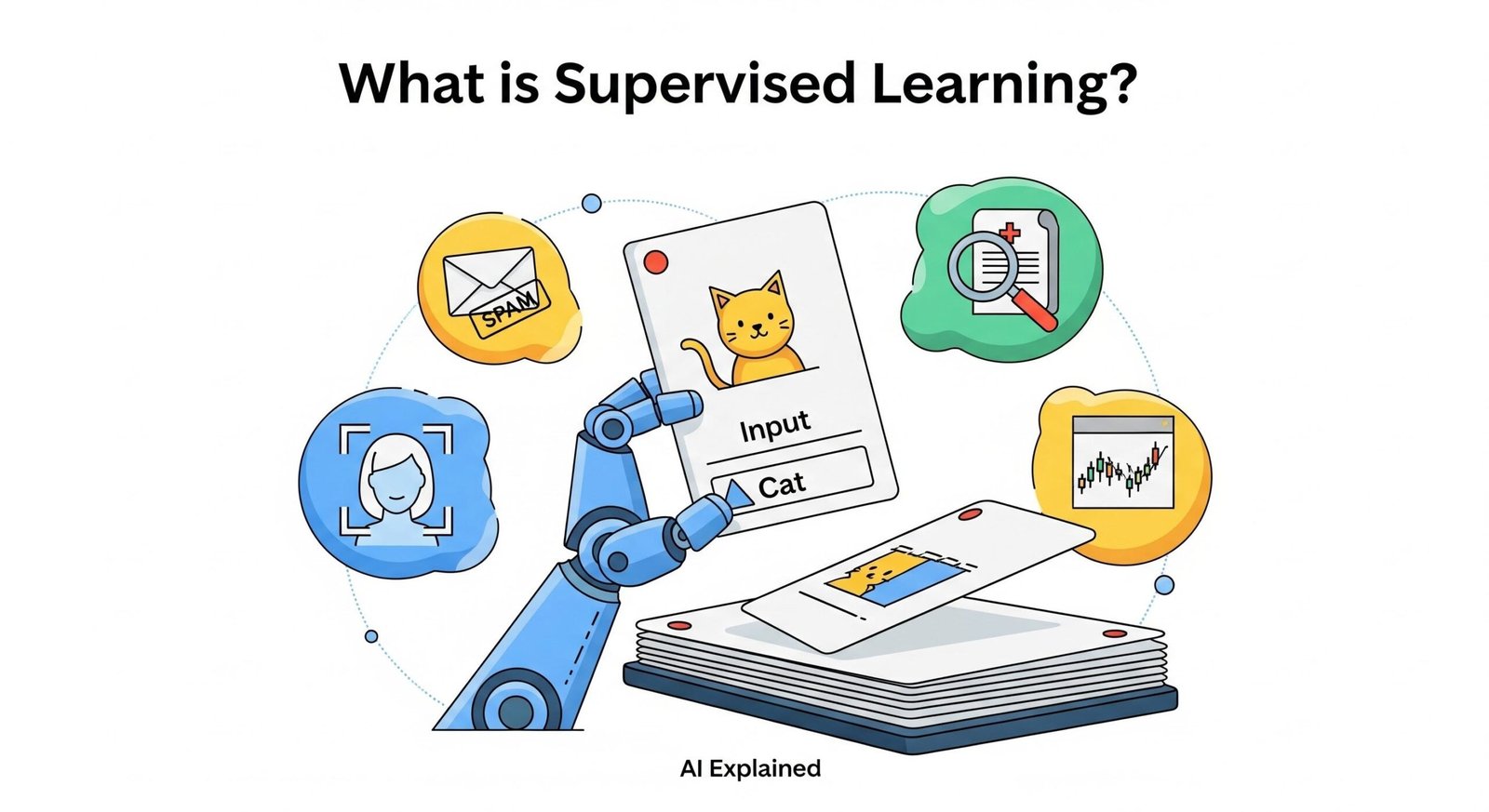
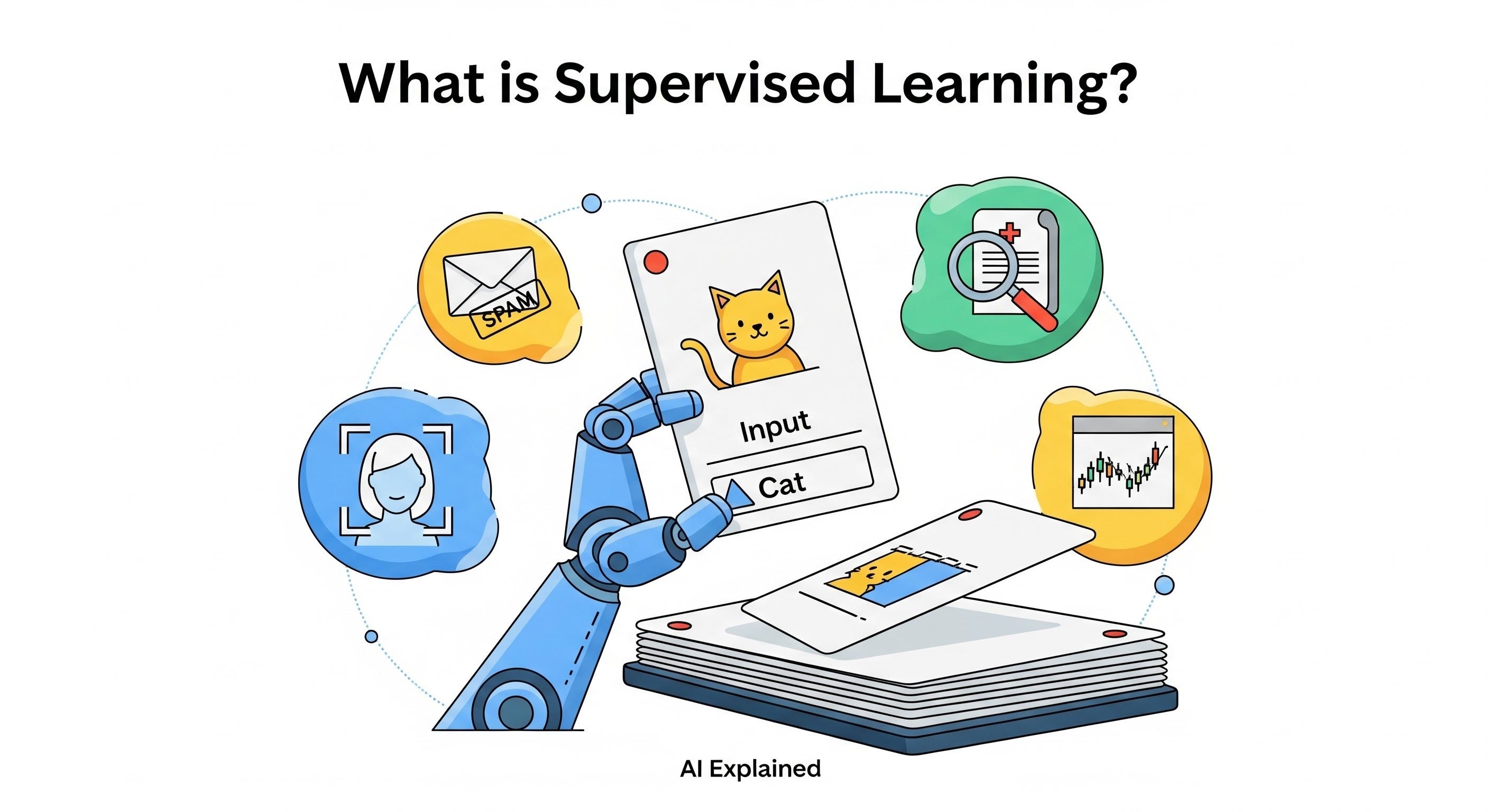
Supervised Learning is teaching computers by showing them examples with the correct answers already provided—like learning with a flashcard deck where every card has the answer on the back. It’s the most common type of Machine Learning and powers everything from spam filters to medical diagnosis tools.
Hey Common Folks!
We’ve covered the umbrella (AI) and the engine (Machine Learning). Now we’re zooming into the most popular way machines actually learn: Supervised Learning.
If Machine Learning is the school, Supervised Learning is the class where the teacher gives you the answer key before the exam.
Think about it: when you learned to read as a child, someone didn’t just hand you a pile of books and say “figure it out.” They pointed at an apple and said “Apple.” They pointed at a banana and said “Banana.” They supervised your learning by giving you the correct answers.
That’s exactly how Supervised Learning works.
What Makes It “Supervised”?
The word “supervised” means there’s a teacher involved. In technical terms, we train the computer using labeled data:
Data = The question (a picture, an email, a patient’s symptoms)
Label = The correct answer (cat, spam, cancer)
We show the computer thousands of examples where we already know the right answer. The computer’s job is to find the pattern connecting the input to the output.
Example: We show a computer 10,000 emails. For each one, we’ve already marked it as “Spam” or “Not Spam.” The computer studies these examples and learns: “Aha! Emails with words like ‘FREE MONEY’ and ‘CLICK NOW’ tend to be spam.”
After training, we can show it a brand new email it’s never seen, and it correctly predicts: Spam.
The Training Process: How It Actually Learns
Let’s say we want to predict whether students will get job placements based on their grades and IQ scores. Here’s how Supervised Learning works:
Step 1: Gather Labeled Data
We collect data on 1,000 students: their CGPA, IQ scores, and whether they got placed (Yes/No). The “Yes/No” is our label—the correct answer.
Step 2: Split the Data
We divide our 1,000 students into two groups:
Training Set (800 students): The computer studies these examples WITH the answers. It learns the mathematical relationship between good grades and job placement.
Test Set (200 students): We hide the answers. The computer makes predictions, and we check how many it got right. This tells us if it actually learned or just memorized.
Step 3: Learn and Adjust
The computer makes a prediction, checks if it was right or wrong, and adjusts its internal “thinking.” It repeats this millions of times until it gets really accurate.
The Two Flavors of Supervised Learning
Supervised Learning solves two types of problems. Think of them as two different subjects in school:
1. Classification (Sorting into Buckets)
This is when the answer is a category—Yes or No, Cat or Dog, Spam or Not Spam.
The question: “Which bucket does this belong in?”
Example: Is this email spam? Is this tumor malignant or benign? Will this customer cancel their subscription?
The answer is always one of a limited set of options. There’s no “half-spam.”
2. Regression (Predicting a Number)
This is when the answer is a continuous number—not a category.
The question: “What number should this be?”
Example: What will this house sell for? What temperature will it be tomorrow? How much revenue will we make next quarter?
The answer could be any number: $450,000, 72 degrees, $1.2 million.
Quick way to remember: Classification = Categories (this OR that) Regression = Real numbers (how much, how many)
Where You’re Already Using Supervised Learning
You interact with Supervised Learning dozens of times a day:
-
Email spam filters → Classification (spam or not spam)
-
Credit card fraud detection → Classification (fraudulent or legitimate)
-
House price estimates on Zillow → Regression (predicting dollar amounts)
-
Medical diagnosis tools → Classification (disease present or not)
-
Weather forecasts → Regression (predicting temperature, rainfall amounts)
The Catch: The Labeling Bottleneck
Supervised Learning is powerful, but it has one big limitation: someone has to label all that data first.
That spam filter? Someone had to manually mark thousands of emails as “Spam” or “Not Spam” before the computer could learn.
That medical AI? Doctors had to review thousands of X-rays and mark which ones showed tumors.
This is expensive, time-consuming, and if humans make labeling mistakes, the AI learns those mistakes too. Garbage in, garbage out.
The Takeaway
Supervised Learning is the most common and reliable form of Machine Learning because we define what “correct” looks like. We’re the supervisor, providing the answer key.
If the AI is predicting a category (Yes/No, Cat/Dog), it’s Classification.
If the AI is predicting a number (price, temperature, score), it’s Regression.
Next time your email app catches a phishing attempt or Google Maps predicts your arrival time, you’ll know: that’s Supervised Learning doing its job—pattern recognition trained on millions of labeled examples.
Coming Up:
But what happens when we don’t have the answer key? What if we just dump a pile of data on the computer and say “find the patterns yourself”? That’s the world of Unsupervised Learning, and we’ll explore it next.
Was this helpful? Reply and let us know what AI/ML/Data Science concept confuses you the most!
AI for Common Folks — Understand AI in plain English
Leave a Reply