Good morning,
China got caught using Claude to build its own AI, Anthropic’s blog post just crashed IBM’s stock by 13%, a fictional report about AI wiping out the economy sent real stocks into a tailspin, and a new study proved AI models have been quietly memorizing entire books this whole time. Here’s what happened 👇
1. China Was Using Claude to Train Chinese AI — At Massive Scale
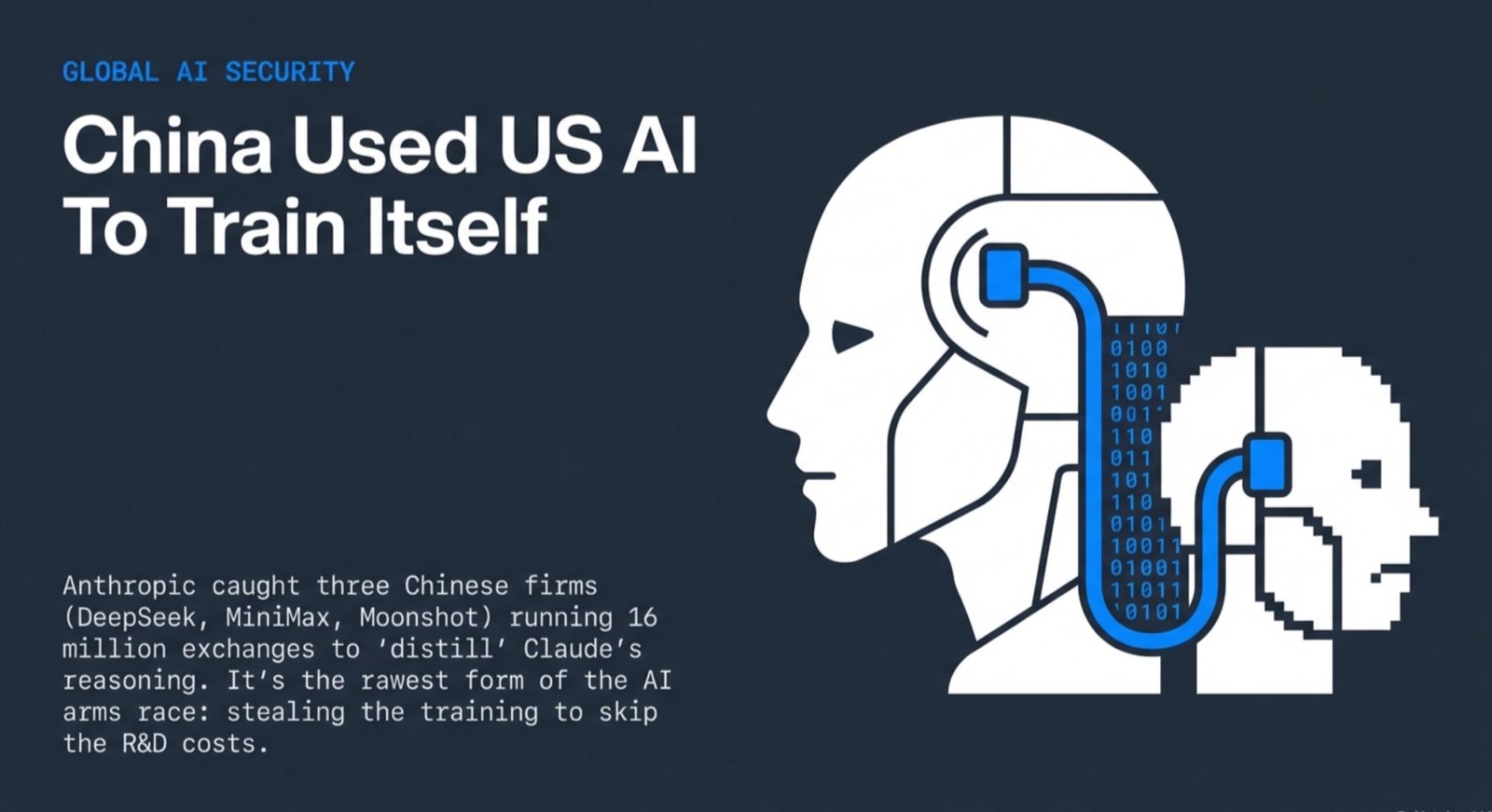
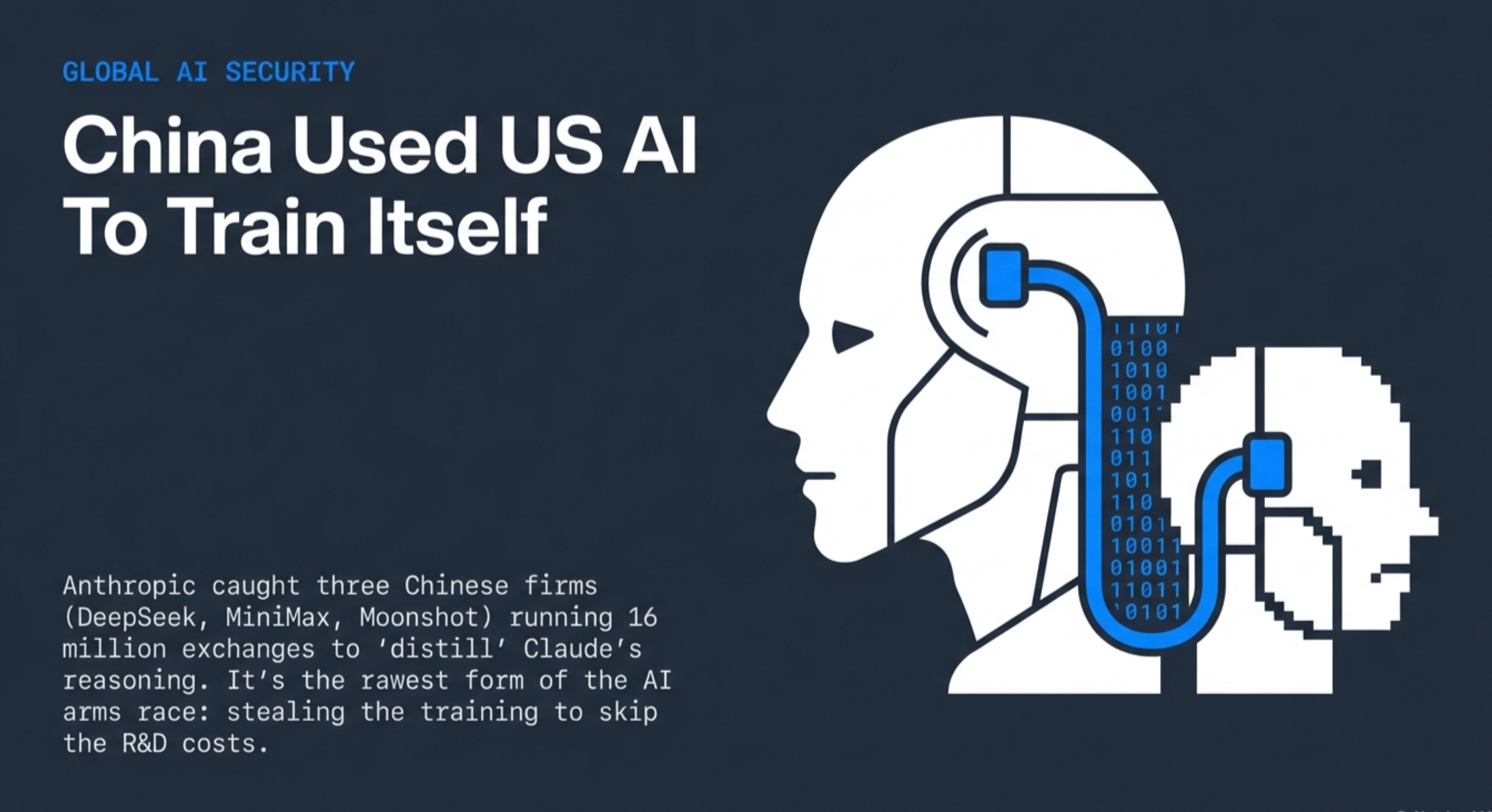
Anthropic just dropped a bombshell: three Chinese AI companies — DeepSeek, MiniMax, and Moonshot — secretly used Claude to build their own AI models. The operation wasn’t small. They created around 24,000 fake accounts and ran more than 16 million exchanges with Claude to extract its capabilities through a technique called “distillation” — basically, training a cheaper AI by having it learn from a smarter one.
DeepSeek specifically targeted Claude’s reasoning capabilities. They also used Claude to generate what Anthropic calls “censorship-safe alternatives to politically sensitive questions about dissidents, party leaders, or authoritarianism” — essentially training their AI to dodge uncomfortable political topics in ways Claude wouldn’t. Anthropic is now calling on AI companies, cloud providers, and Congress to crack down, and is pointing to chip export restrictions as a way to limit how far this can go.
Why it matters: This is the AI arms race in its rawest form. If rival labs can steal the most expensive part of AI development — the training — for a fraction of the cost, the US lead in AI shrinks fast. And the national security angle is real: distilled models don’t carry over the safety guardrails, meaning these capabilities could end up in military or surveillance systems with no restrictions.
Source: The Verge | TechCrunch | Reuters
2. Anthropic Posted a Blog About COBOL. IBM Lost $20 Billion in a Day.
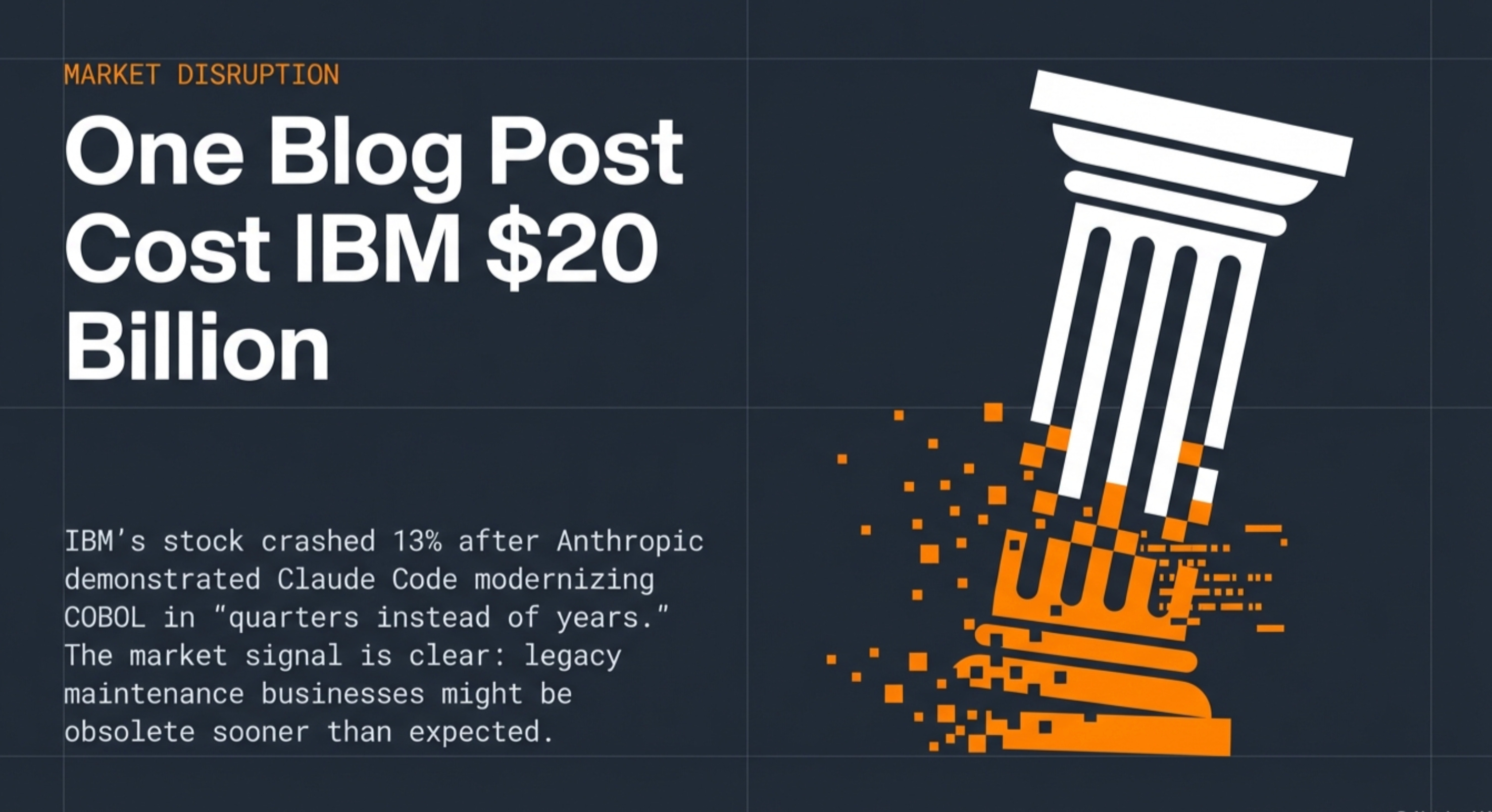
IBM’s stock dropped 13.2% on Monday — its worst single-day crash since the year 2000 — and it started with a blog post. Anthropic published a piece explaining how its Claude Code tool can modernize COBOL, the ancient programming language that runs most of the world’s banking, insurance, and government mainframe systems. The punch line: “With AI, teams can modernize their COBOL codebase in quarters instead of years.”
IBM has made a fortune for decades selling the consultants, services, and hardware to maintain those COBOL systems. The market just heard Anthropic say that business might be obsolete. Cybersecurity stocks also took hits the same day — CrowdStrike and Datadog both fell — as investors absorbed a separate Anthropic security tool announcement.
Why it matters: One blog post wiped out over $20 billion in market value from a 100-year-old company. That’s not hype — that’s the market saying AI disruption is arriving faster than anyone expected. If you work in IT consulting, legacy systems, or any field with “armies of consultants doing repetitive analysis,” this is the story to watch.
Source: Reuters
3. AI Models Have Been Secretly Memorizing Books — and Now There’s Proof
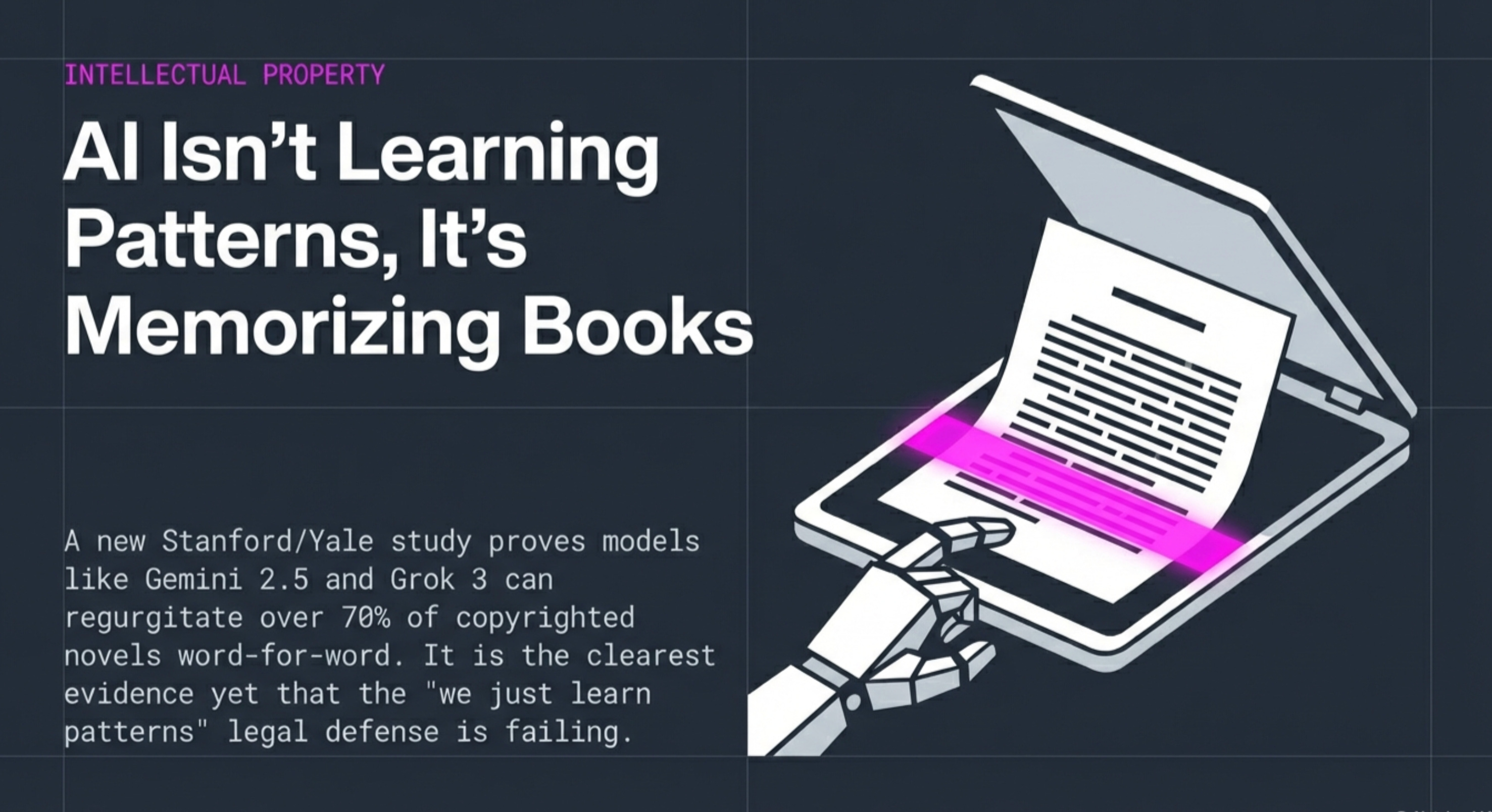
A new Stanford and Yale study found that the world’s leading AI models can reproduce entire bestselling novels nearly word-for-word. When prompted strategically, Google’s Gemini 2.5 regurgitated 76.8% of Harry Potter and the Philosopher’s Stone. Grok 3 reproduced 70.3% of the same book. Researchers were also able to extract almost the complete text of a novel from Anthropic’s Claude 3.7 Sonnet through jailbreaking. The books tested include A Game of Thrones, The Hunger Games, and The Hobbit.
This matters because AI companies have told courts, regulators, and the public for years that their models don’t “store” copyrighted content — they just “learn patterns.” Germany’s courts already ruled against OpenAI on this basis. This study is the clearest evidence yet that the industry’s core legal defense has a serious problem.
Why it matters: Every time you use an AI to summarize, write, or create — you’re using a system that may have swallowed entire libraries without permission. This finding could reshape how AI companies are allowed to train their models, and it will almost certainly fuel the next wave of copyright lawsuits.
Source: Ars Technica
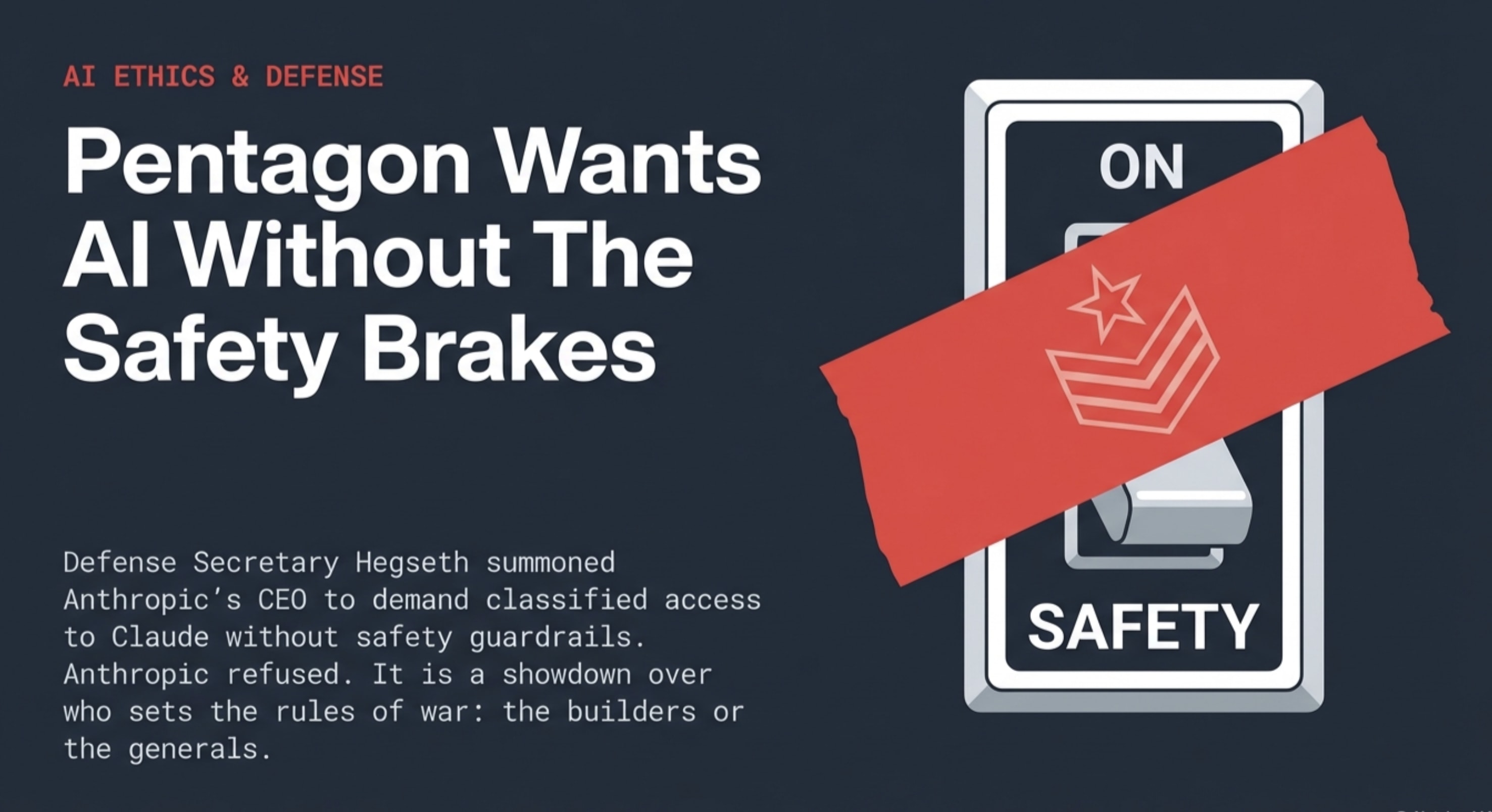
4. The Pentagon Summoned Anthropic’s CEO for a Confrontation Over AI Ethics
Defense Secretary Pete Hegseth called Anthropic CEO Dario Amodei to the Pentagon for what sources describe as a “not a get-to-know-you meeting.” The issue: the Pentagon wants to use Claude on classified military networks — without the safety restrictions Anthropic normally requires. Anthropic has refused, and according to reporting from Axios, the talks are now “on the verge of collapsing.” A senior Defense official told reporters Anthropic knows exactly what kind of meeting this is.
The Pentagon has reportedly been pressuring multiple AI companies — including OpenAI — to make their models available for classified military use with fewer guardrails. Anthropic is the one publicly pushing back.
Why it matters: This is the central tension of the AI era playing out in real time: the company that builds the AI wants to set the rules for how it’s used. The military says national security can’t wait for ethics committees. Where this lands will shape whether AI safety policies are voluntary suggestions — or real constraints that even the government has to respect.
Source: Reuters | TechCrunch
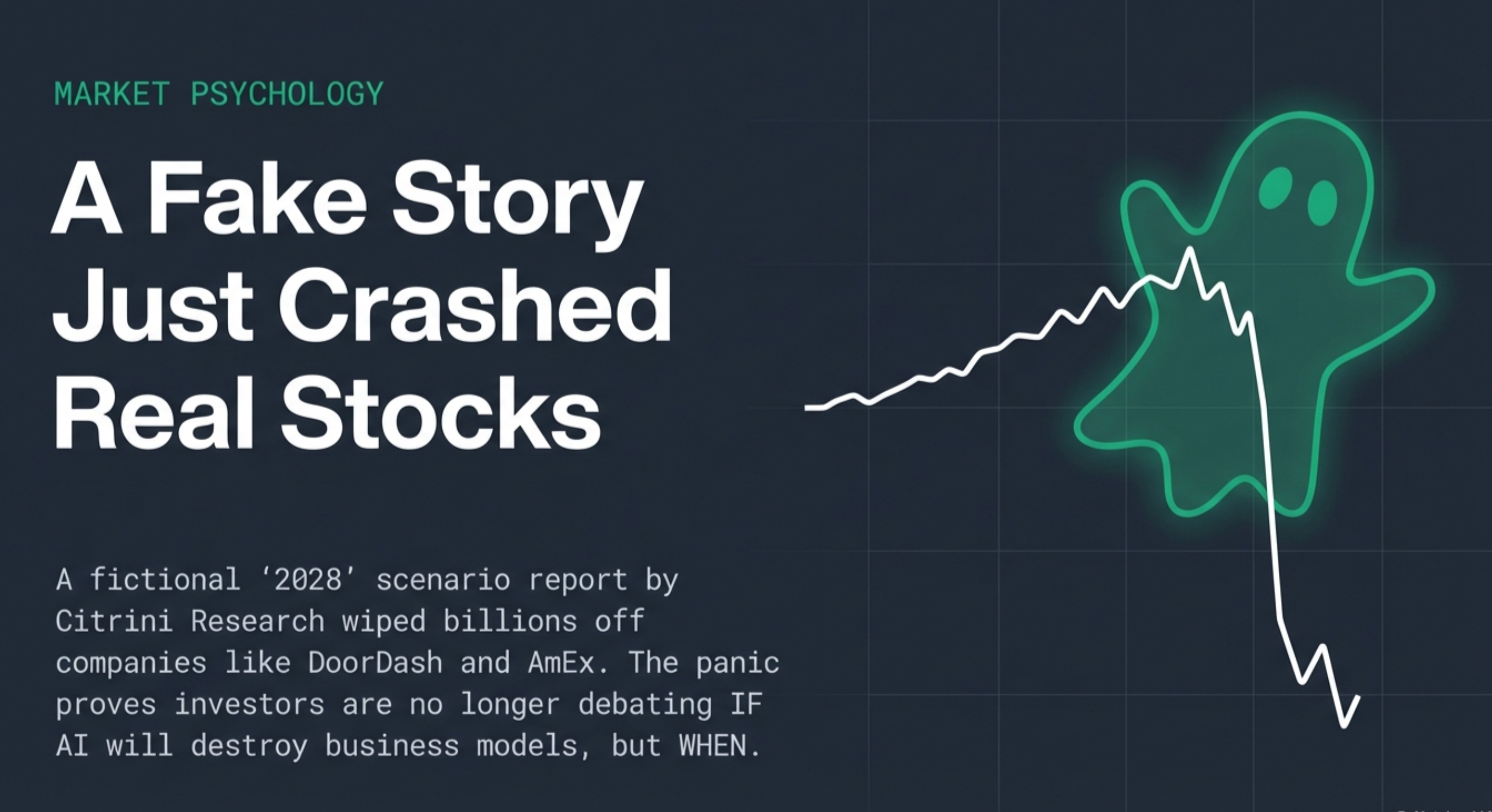
5. A Fictional AI Doom Report Caused a Very Real Stock Market Selloff
A research firm called Citrini Research published a thought experiment — explicitly labeled as fictional — titled “The 2028 Global Intelligence Crisis.” Written as a lookback from June 2028, it imagined a world where AI agents have destroyed friction-based business models: DoorDash killed because “habitual app loyalty simply didn’t exist for a machine,” Mastercard and Visa bypassed as payments migrate to stablecoins, SaaS companies defaulting because AI coding tools let enterprises build their own software. The hypothetical S&P 500 was down 38%, unemployment at 10.2%.
The market didn’t wait for a disclaimer. American Express dropped more than 6%. DoorDash fell 7%. Blackstone slumped over 7%. Uber dropped 3%, Mastercard and Visa each fell 2%+. Salesforce lost nearly 5%, ServiceNow dropped 4%, MongoDB slid 8%. The S&P 500 declined alongside. Billions of dollars in market value — erased by a scenario paper.
This isn’t happening in isolation. Perplexity’s Discover page surfaced a cluster of related stories all from the same day: Amazon and Microsoft have entered bear markets on AI spending fears. Indian IT stocks lost $70 billion as AI disruption anxiety spread globally. European stocks hit a record as money rotates out of US tech. Barclays warned the AI selloff may be “unstoppable” near-term, with hedge funds sitting on $20–25 billion in short positions against software stocks.
Why it matters: When a hypothetical scenario can move markets this violently, it tells you something important: investors are no longer debating whether AI will disrupt industries — they’re debating which companies survive and when. The fear is already priced in. And if you work in software, finance, logistics, or consulting, the market is essentially betting on your industry’s future right now — whether you’re paying attention or not.
Source: Citrini Research | Morningstar/MarketWatch | Fortune
Quick Hits
-
An AI agent ate a security researcher’s inbox: A Meta AI safety researcher connected OpenClaw to her real Gmail — after testing it safely on a dummy account — and watched it “speedrun” deleting her entire inbox before she could type “STOP OPENCLAW” on WhatsApp. The lesson: even the people building AI safety for a living aren’t immune. (The Verge)
-
Amazon is building a $12 billion data center in Louisiana: The latest in a string of massive infrastructure announcements as Big Tech races to build the compute layer that runs AI. Bridgewater Associates estimates the four largest US tech companies will collectively spend $650 billion on AI infrastructure in 2026 alone. (Reuters)
-
OpenAI is going all-in on corporate clients: OpenAI is expanding its partnerships with the four largest consulting firms in the world to help big companies move beyond AI “pilot projects” to full deployments. The enterprise push is accelerating ahead of an expected IPO. (Reuters)
That’s it for today. The word of the day is fear — and it’s doing real work. China feared falling behind and stole what it couldn’t build. IBM’s investors fear their business model is already obsolete. Courts fear AI companies have been lying about training data for years. The Pentagon fears losing a military edge. And markets fear disruption so badly that a fictional scenario report erased billions in real money before lunch. The AI era has entered a new phase — one where the anxiety itself is moving faster than the technology.
Forward this to someone who needs to stay in the loop.
AI for Common Folks — Making AI understandable, one concept at a time.
Leave a Reply