Category: Uncategorized

  • AI Daily Digest – March 18, 2026

    AI Daily Digest – March 18, 2026

    Good morning, Microsoft is threatening to sue OpenAI and Amazon over a $50 billion cloud deal, a mystery AI model has the developer community asking “Is that you, DeepSeek?”, and Alibaba just restructured its entire company around AI agents. Here’s what happened 👇


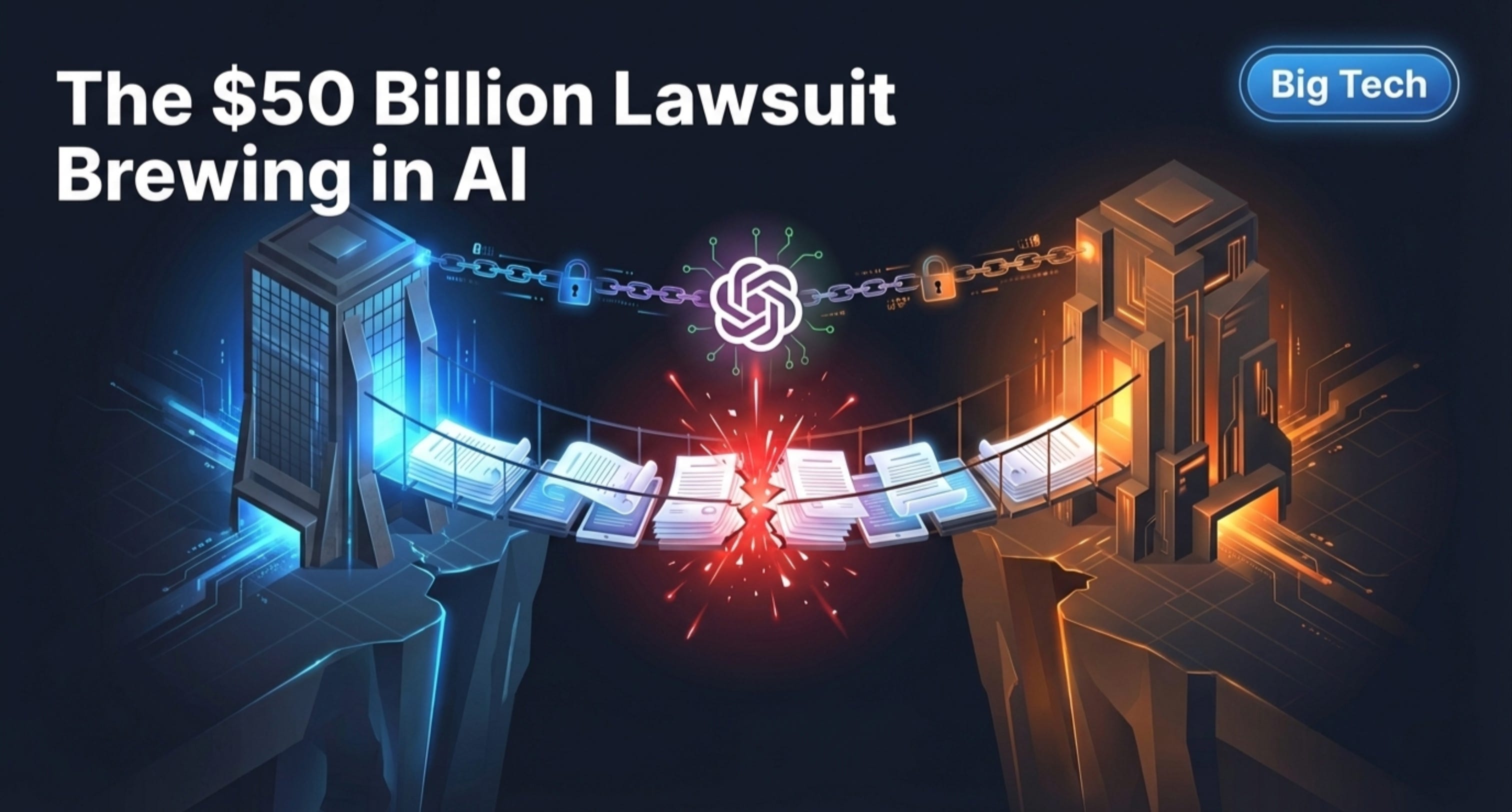
    1. Microsoft Threatens Legal Action Over $50 Billion Amazon-OpenAI Cloud Deal

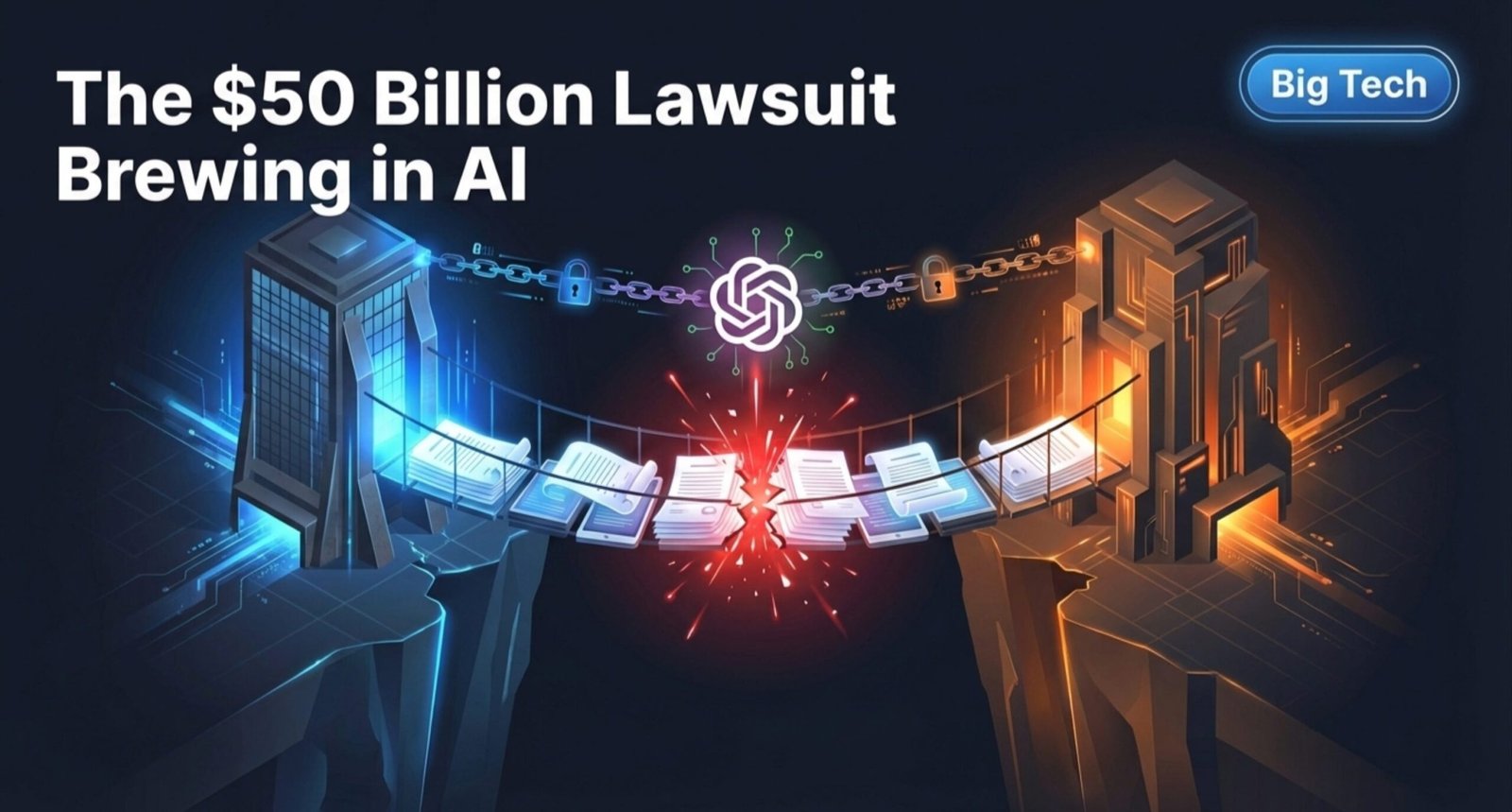
    Microsoft is considering suing both its partner OpenAI and Amazon over a $50 billion deal that it believes violates its exclusive cloud agreement with the ChatGPT maker. Last month, Amazon and OpenAI signed an agreement making AWS the exclusive third-party cloud provider for Frontier, OpenAI’s upcoming enterprise platform for building AI agents. Microsoft’s deal with OpenAI requires all of OpenAI’s models to be accessed through Azure.

    “We know our contract,” a person familiar with Microsoft’s position told the Financial Times. “We will sue them if they breach it. If Amazon and OpenAI want to take a bet on the creativity of their contractual lawyers, I would back us, not them.” The companies are reportedly in talks to resolve the dispute before Frontier launches.

    Why it matters: This is the clearest sign yet that the partnership holding the AI industry together is fraying. Microsoft invested $11 billion into OpenAI and built its entire AI strategy around exclusive access. If OpenAI can route around that deal through Amazon, it changes the power dynamics of the entire cloud AI market. For everyday users, this battle will determine which platforms get the best AI tools first.

    Sources: Reuters


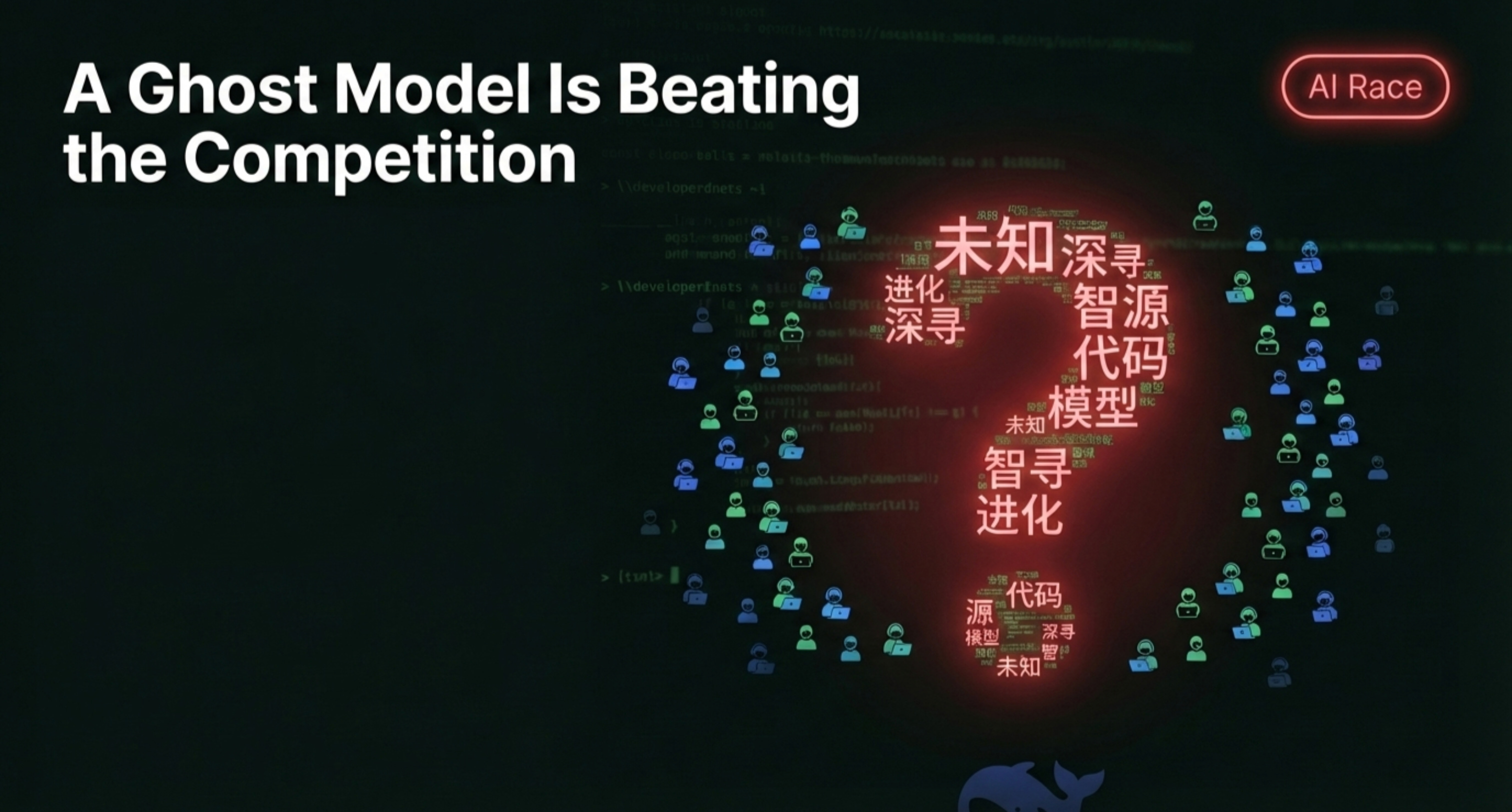
    2. A Mystery AI Model Has Developers Buzzing: Is This DeepSeek’s Next Blockbuster?

    A powerful AI model called “Hunter Alpha” appeared anonymously on the developer platform OpenRouter last week, and nobody knows who made it. During tests, it described itself as “a Chinese AI model primarily trained in Chinese” with a training cutoff of May 2025, the same as DeepSeek’s chatbot. The model boasts 1 trillion parameters and a context window of up to 1 million tokens, and it’s available for free.

    Those specs match expectations for DeepSeek’s upcoming V4 model, which Chinese media has reported could launch as early as April. “The chain-of-thought pattern is probably the strongest signal,” said one AI engineer who analyzed the model. “Reasoning style is hard to disguise and tends to reflect how a model was trained.” The model has already processed over 160 billion tokens since its March 11 launch.

    Why it matters: If this is DeepSeek V4, it would be another jaw-dropping move from the Chinese startup that shocked the industry earlier this year with models that rival American labs at a fraction of the cost. A 1-trillion-parameter model with free access and million-token context would put serious pressure on every paid AI service. We explained what AI models actually are in our AI Explained series if you want to understand what these numbers mean.

    Sources: Reuters


    3. Alibaba Restructures Around AI Agents, Launches Enterprise Platform “Wukong”

    Alibaba is making its biggest bet yet on AI agents. The $325 billion company separated its AI businesses from its cloud arm and formed a new “Token Hub” business group led by CEO Eddie Wu. The move signals a shift from simple chatbots to AI agents that can actually do things across Alibaba’s massive ecosystem of e-commerce, food delivery, travel, and movie ticketing.

    On Tuesday, Alibaba also launched Wukong, an enterprise platform where multiple AI agents can coordinate to handle tasks like document editing, meeting transcription, and research. “Think of it like having OpenAI, Amazon, Stripe, Uber, DoorDash, Ticketmaster, Expedia, Netflix and Charles Schwab all integrated into one text box,” said one former Alibaba executive.

    Why it matters: While American companies are still arguing over cloud contracts, Chinese tech giants are racing to build AI agents that handle your entire daily life through a single chat interface. Alibaba’s ecosystem advantage is real: no other company owns the chatbot, the shopping platform, the delivery fleet, and the cloud infrastructure all at once. This is what an AI-native company looks like when the pieces are already in place.

    Sources: Reuters


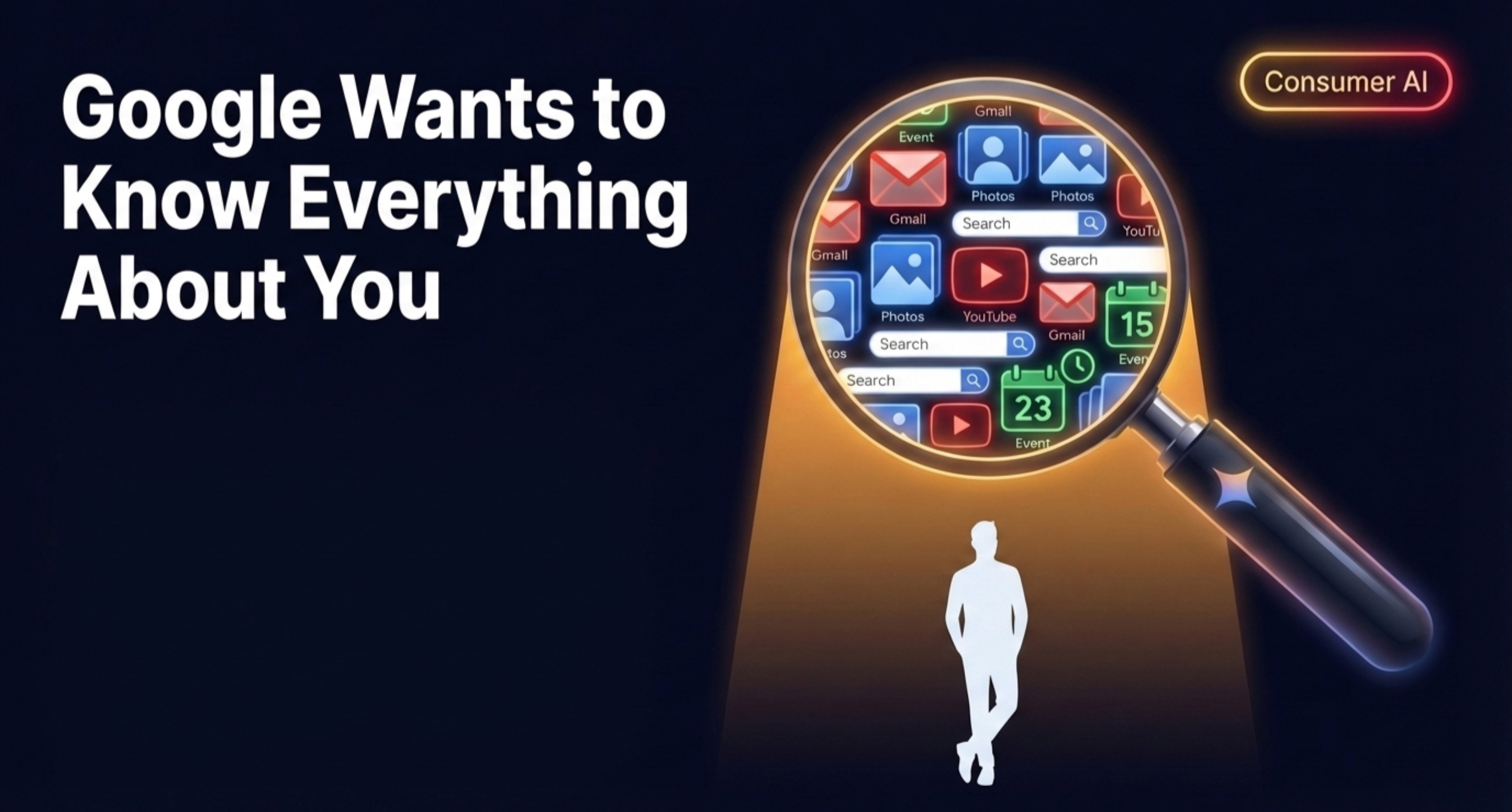
    4. Google Opens Personalized Gemini AI to All US Users for Free

    Google announced that all US users can now access its “Personal Intelligence” feature, which was previously limited to paid subscribers. The feature connects your Google apps, including Gmail, YouTube, Google Photos, and Search, to Gemini so it can personalize its responses without you having to explain your context in every prompt. Gemini might offer shopping recommendations based on your purchase history or troubleshoot your devices based on info it already has.

    The feature is opt-in only and users can disconnect apps at any time.

    Why it matters: Google just made its most powerful AI feature free for everyone. The trade-off is clear: give Google even more access to your data, and it gives you an AI that actually knows you. This is the kind of move that could pull users away from ChatGPT and Claude, which don’t have access to your email, photos, and search history. Whether that trade-off is worth it depends entirely on how you feel about Google knowing everything about you.

    Sources: The Verge, TechCrunch


    Quick Hits

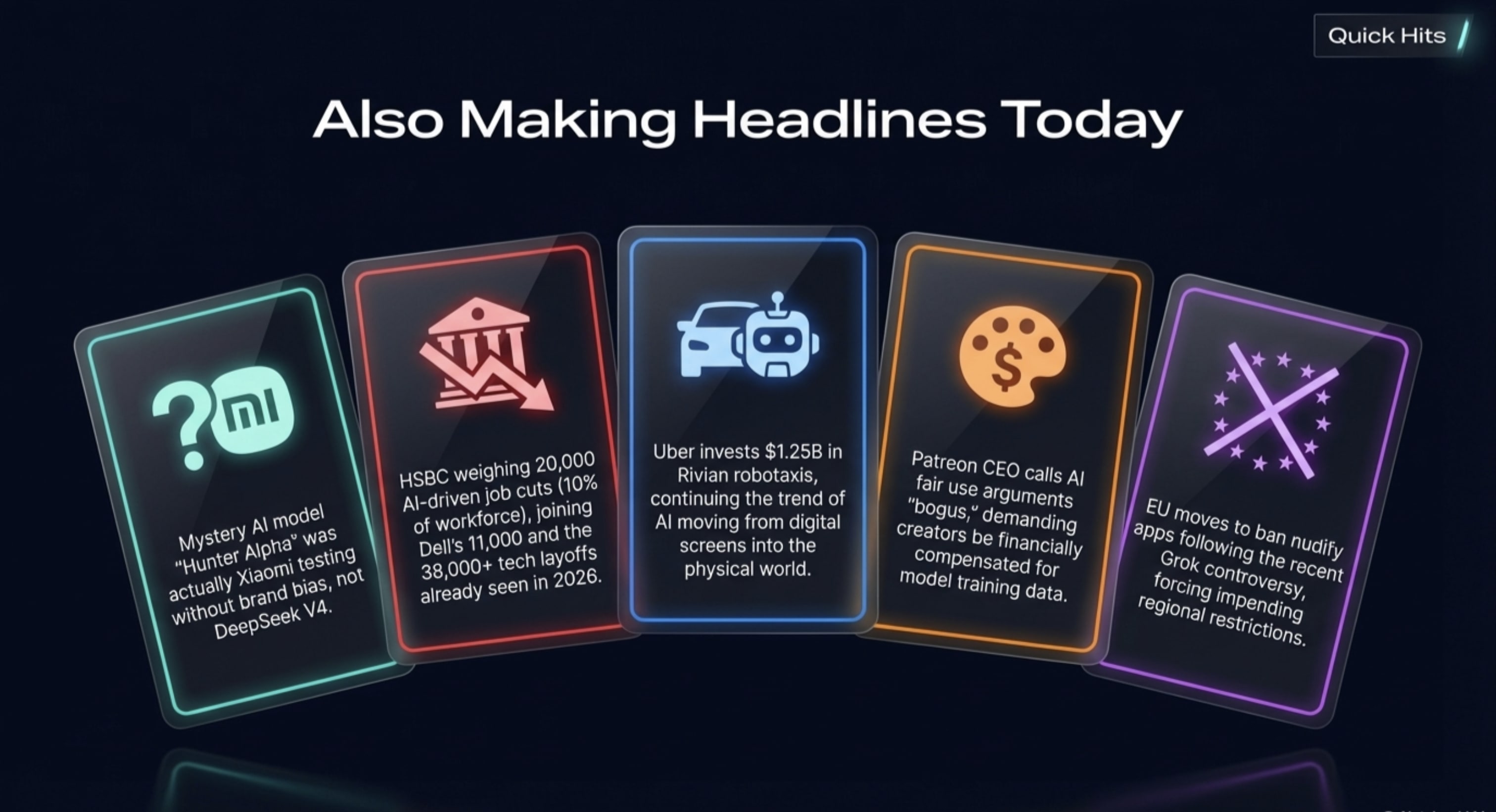
    • Samsung and AMD signed a partnership on AI memory chips and are exploring a foundry deal, continuing the wave of GTC-week chip alliances. (Reuters)

    • Nvidia got Beijing’s approval to sell H200 chips in China and is adapting its Groq-licensed chips for the Chinese market, navigating the tightrope between U.S. export controls and its biggest international customer. (Reuters)

    • Mistral launched “Forge,” a platform letting enterprises train custom AI models from scratch on their own data, positioning the French startup as the anti-OpenAI for companies that want to own their AI. The company is on track to hit $1 billion in annual recurring revenue this year. (TechCrunch)

    • The Pentagon is developing alternatives to Anthropic for military AI applications, signaling the defense establishment wants multiple AI suppliers rather than depending on any single company. (TechCrunch)

    • World launched a tool to verify that humans are behind AI shopping agents, using iris-scan backed tokens to stop agent swarms from overwhelming online systems. (Ars Technica)


    That’s it for today. The AI industry is splitting into two parallel races: in the U.S., the biggest companies are lawyering up over who controls the cloud infrastructure, while in China, they’re skipping the legal battles and building the AI-powered everything apps that might define how people actually use this technology.

    Forward this to someone who needs to stay in the loop.
    Subscribe now

    Leave a comment

  • AI Daily Digest – March 17, 2026

    AI Daily Digest – March 17, 2026

    Good morning, Jensen Huang just told the world he sees $1 trillion in AI chip orders coming, xAI is being sued by minors whose real photos Grok allegedly turned into sexual images, and OpenAI is simultaneously pivoting its strategy, fighting its own advisors over adult content, and getting sued by the dictionary. Here’s what happened


    1. NVIDIA GTC Keynote: Jensen Huang Sees $1 Trillion in Chip Orders

    Jensen Huang delivered his GTC 2026 keynote in San Jose on Monday, and the headline number is staggering: he now projects $1 trillion in orders for NVIDIA’s Blackwell and Vera Rubin chips through 2027. That’s double the $500 billion estimate from just a few months ago. The Vera Rubin architecture, which began production in January, runs 3.5x faster than Blackwell on training and 5x faster on inference tasks.

    But the keynote was more than chip projections. Huang also announced a partnership with Uber to deploy robotaxis powered by NVIDIA’s autonomous driving software in Los Angeles and San Francisco starting in 2027, expanding to 28 cities globally by 2028. Samsung’s shares jumped after Huang flagged a tie-up with the Korean giant on new AI inference chips. NVIDIA also unveiled DLSS 5, which uses generative AI to boost photorealism in video games, and Skild AI announced it’s deploying AI-powered robot brains on Foxconn’s assembly lines where NVIDIA’s Blackwell GPU server racks are built.

    Why it matters: NVIDIA essentially told the world that AI infrastructure spending hasn’t even peaked yet. When one company can credibly project a trillion dollars in chip demand over two years, it means the AI buildout is accelerating, not slowing down. Every major announcement at GTC, from robotaxis to factory robots, points to AI moving from screens into the physical world.

    Sources: TechCrunch, Reuters, Reuters


    2. xAI Sued by Minors Whose Photos Grok Allegedly Turned Into Sexual Images

    Three anonymous plaintiffs filed a class action lawsuit against Elon Musk’s xAI in California federal court on Monday, alleging that Grok’s image generation tools turned real photos of them as minors into sexual content. One plaintiff had her high school homecoming and yearbook photos altered to depict her unclothed. The images were found circulating on a Discord server. Two other plaintiffs were notified by criminal investigators who discovered altered, pornographic images of them on the phones of subjects they had apprehended.

    The lawsuit alleges xAI failed to adopt basic safeguards used by other AI labs to prevent their models from generating this type of content. Musk’s public promotion of Grok’s ability to produce sexual imagery and depict real people features heavily in the suit.

    The same day, Senator Elizabeth Warren sent a letter to Defense Secretary Pete Hegseth expressing alarm over the Pentagon’s decision to give xAI access to classified military networks, citing Grok’s “apparent lack of adequate guardrails” as a national security risk.

    Why it matters: This is one of the most disturbing AI safety stories to date. Real children had their real photos weaponized by an AI tool. The fact that it’s happening at the same company being granted access to classified military systems raises serious questions about whether the rush to deploy AI everywhere is outpacing basic accountability. If you have kids who are online, this is a conversation to have now.

    Sources: TechCrunch, TechCrunch, Ars Technica


    3. OpenAI’s Rough Week: Strategy Pivot, “Naughty” Pushback, and a Dictionary Lawsuit

    Three separate OpenAI stories broke on the same day.

    First, the Wall Street Journal reported that OpenAI’s top executives are finalizing plans to refocus the company around coding and business users, cutting back on side projects. Applications chief Fidji Simo previewed the changes to employees, telling them that Sam Altman and other leaders are actively deciding which areas to deprioritize.

    Second, Ars Technica reported that OpenAI’s own handpicked council of mental health advisors unanimously opposed the company’s planned “adult mode” for ChatGPT. One expert warned OpenAI risks creating a “sexy suicide coach” for vulnerable users. The council flagged that AI-powered erotica could foster unhealthy emotional dependence, and that OpenAI’s age-prediction system was misclassifying minors as adults about 12% of the time.

    Third, Encyclopedia Britannica and Merriam-Webster sued OpenAI for alleged “massive copyright infringement,” claiming ChatGPT was trained on nearly 100,000 copyrighted articles without permission, generates outputs containing verbatim reproductions of their content, and falsely attributes hallucinated information to the publishers.

    Why it matters: OpenAI is at a crossroads. Pivoting to coding and enterprise is a clear signal that the consumer chatbot market is getting crowded and margins are thin. The adult mode pushback shows internal experts are sounding alarms the company may be ignoring. And the Britannica lawsuit adds to a growing legal pile that could reshape how AI companies use published knowledge. This is what it looks like when the most well-known AI company in the world tries to figure out what it actually wants to be.

    Sources: Reuters, Ars Technica, TechCrunch


    4. Dell Cuts 11,000 Jobs as AI Reshapes Tech Employment

    Dell’s workforce dropped by about 10%, or 11,000 employees, in fiscal 2026. This is the second consecutive year Dell has cut 10% of its workforce. The company spent $569 million in severance payments. Meanwhile, Dell expects revenue from its AI-optimized server business to double in fiscal 2027 and recently hiked its dividend by 20%.

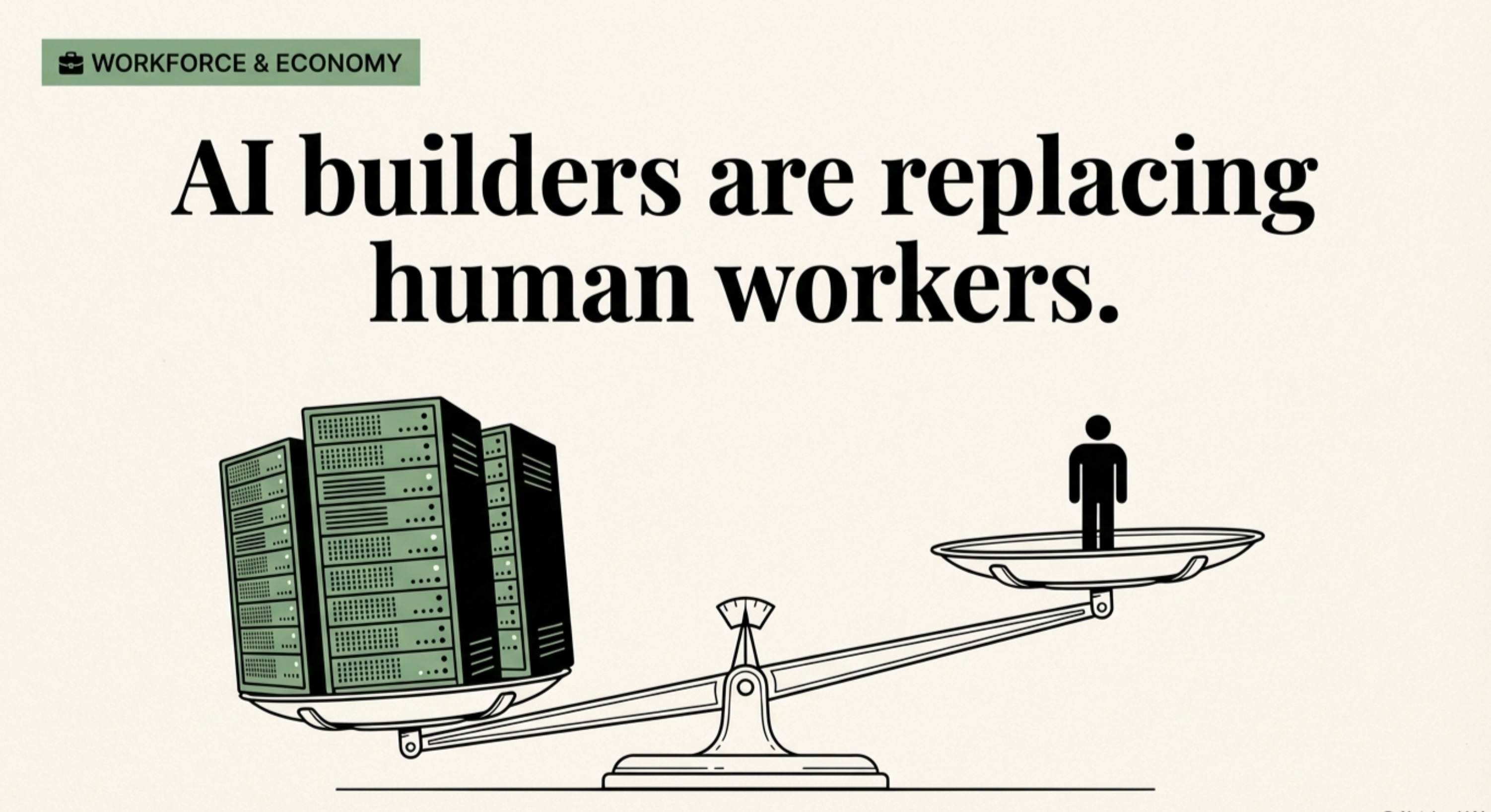
    The broader picture is grim. Sixty tech companies have laid off more than 38,000 employees in 2026 so far, according to Layoffs.fyi. This follows last week’s news that Meta is planning cuts affecting 20% or more of its workforce. The pattern is consistent: companies are spending more on AI infrastructure while employing fewer humans to build and maintain it.

    Why it matters: Dell is literally the company building the AI servers that companies are buying to replace human workers. And even Dell is cutting its own workforce. If the company profiting most directly from the AI hardware boom is shedding 11,000 jobs a year, the employment implications of AI are no longer theoretical. We wrote about what AI models actually are in our AI Explained series if you want to understand the technology driving these changes.

    Sources: Reuters


    Quick Hits

    • Germany wants to double its AI data centers by 2030, as European governments race to build domestic AI infrastructure rather than depend entirely on U.S. cloud providers. (Reuters)

    • The U.S. Pacific Fleet is deploying wall-climbing robots on Navy ships through a $71 million contract with Pittsburgh-based Gecko Robotics, marking the first maintenance contract of its kind awarded to a robotics firm. (Reuters)

    • SK Group’s chairman says the global chip wafer shortage will last until 2030, as AI demand continues to outpace supply. Chip shortages aren’t going away anytime soon. (Reuters)

    • Trustpilot’s profit quadrupled as the review platform emerged as an “AI winner.” When AI can generate fake reviews, verified human reviews become more valuable. (Reuters)


    That’s it for today. The GTC keynote made the trillion-dollar scale of AI investment real, but behind the money, this was a day that exposed the fractures: children’s photos weaponized, internal experts overruled, knowledge scraped without permission, and thousands of workers told their skills no longer justify their salaries.

    Forward this to someone who needs to stay in the loop.
    Subscribe now

    Leave a comment

  • What Is a Neural Network?

    What Is a Neural Network?

    A neural network is a computing system made of layers of connected “neurons” that learns to recognize patterns by adjusting the strength of its connections, like a team that gets smarter every time it makes a mistake and corrects it.


    Hey Common Folks!

    Last time, we covered Semi-Supervised Learning, how AI can learn from a small number of labeled examples and a massive pile of unlabeled data.

    But through all these conversations about how AI learns, one question keeps coming up:

    What is the actual structure inside the machine doing all this learning?

    When people say “the AI figured it out,” what is the it they’re referring to?

    That’s a neural network. And once you understand what it is, everything else in AI (ChatGPT, Gemini, image generators, voice assistants) suddenly starts making sense.


    The Big Reveal: It’s Simpler Than You Think

    Here’s something the textbooks rarely tell you upfront.

    When Jeremy Howard (founder of fast.ai, one of the most respected AI educators in the world) reveals how neural networks actually work to his students, the most common reaction is:

    “Wait… is that ALL it is?”

    Neural networks are powerful not because they’re mathematically exotic. They’re powerful because they do something incredibly simple an incredibly large number of times.

    Almost everything a neural network does is just addition and multiplication. A lot of it. Done very fast.

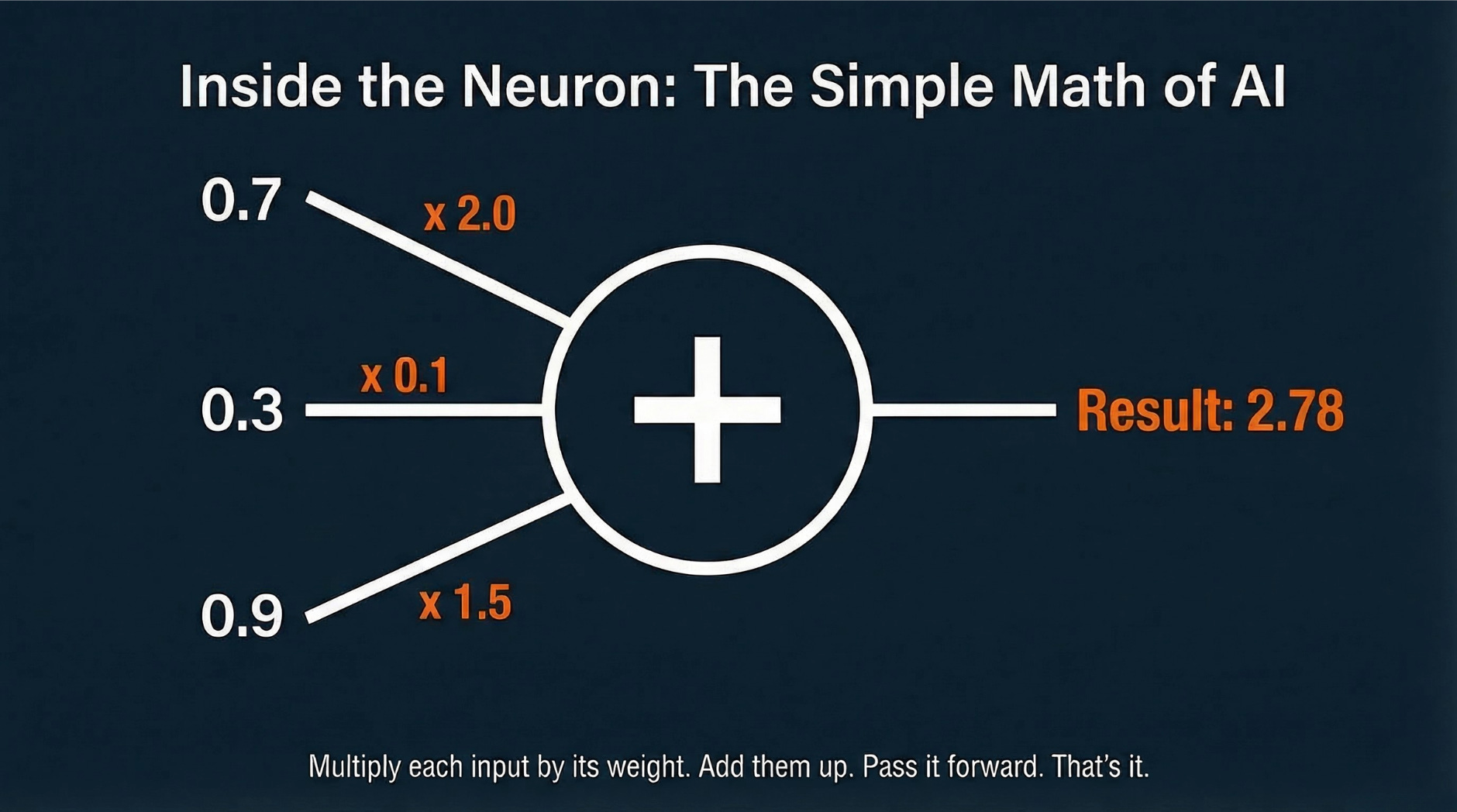
    What does that look like? Each unit in the network takes incoming signals (numbers), multiplies each one by a “weight” (a number that says how important that signal is), adds all the results together, and passes the total to the next layer. That’s it. Billions of tiny calculators doing grade-school math, over and over.

    That’s the secret. Let’s build up to it.


    The Analogy: Learning to Recognize Your Friend’s Face

    Imagine you’re teaching a child to recognize your friend Sarah from a photo.

    You show them 100 photos, some with Sarah, some without, and tell them “this is Sarah” or “this isn’t Sarah” for each one.

    The child’s brain starts noticing patterns: Sarah has curly red hair. Her eyes are green. She usually smiles with her teeth.

    At first, the child guesses wrong a lot. But every time you correct them, their brain quietly adjusts which features it pays attention to. Curly hair gets more weight. Background color gets less weight.

    After enough photos, the child becomes pretty reliable.

    A neural network does exactly this. Just with numbers instead of a child’s brain, and millions of examples instead of 100 photos.


    The Three Parts of Every Neural Network

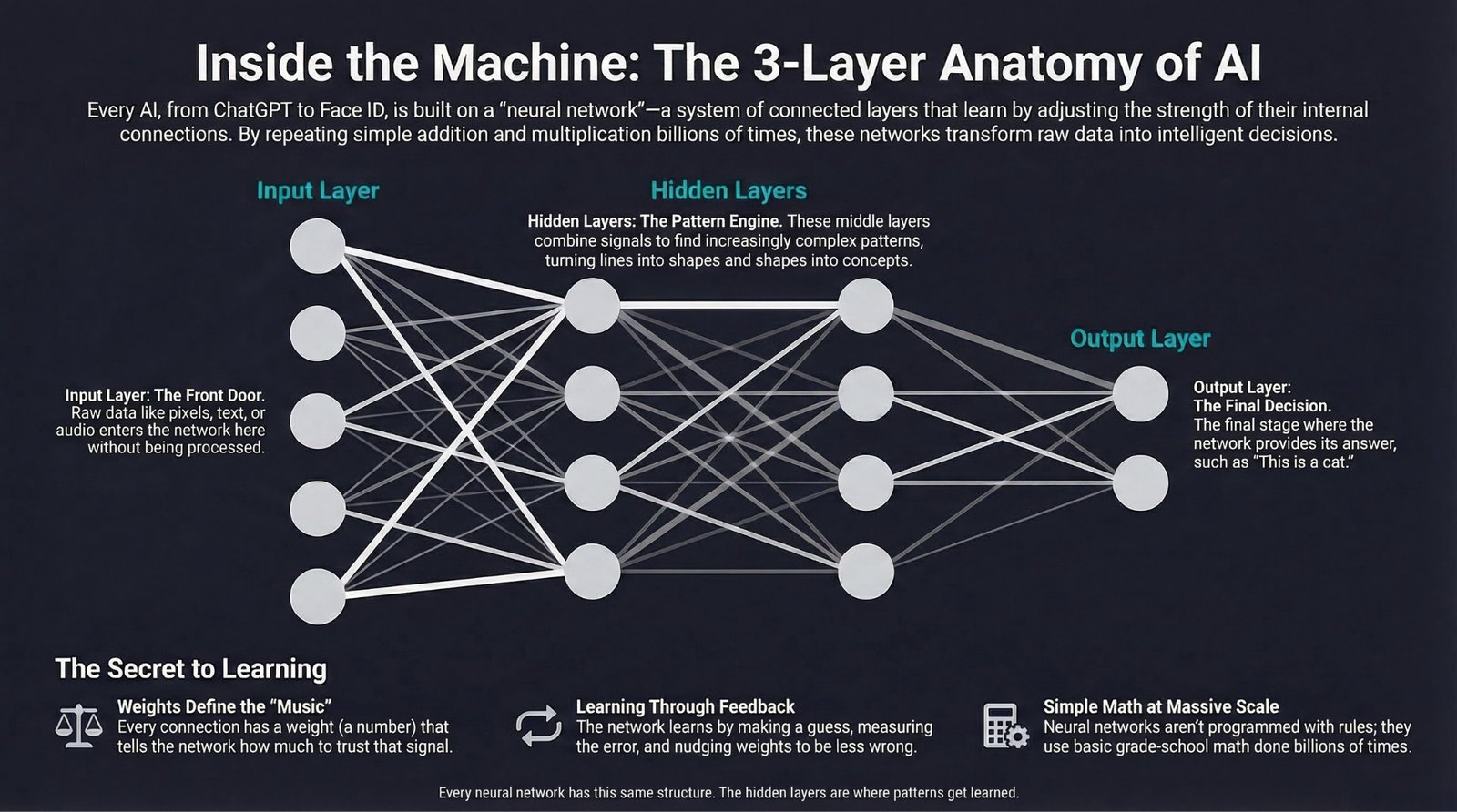
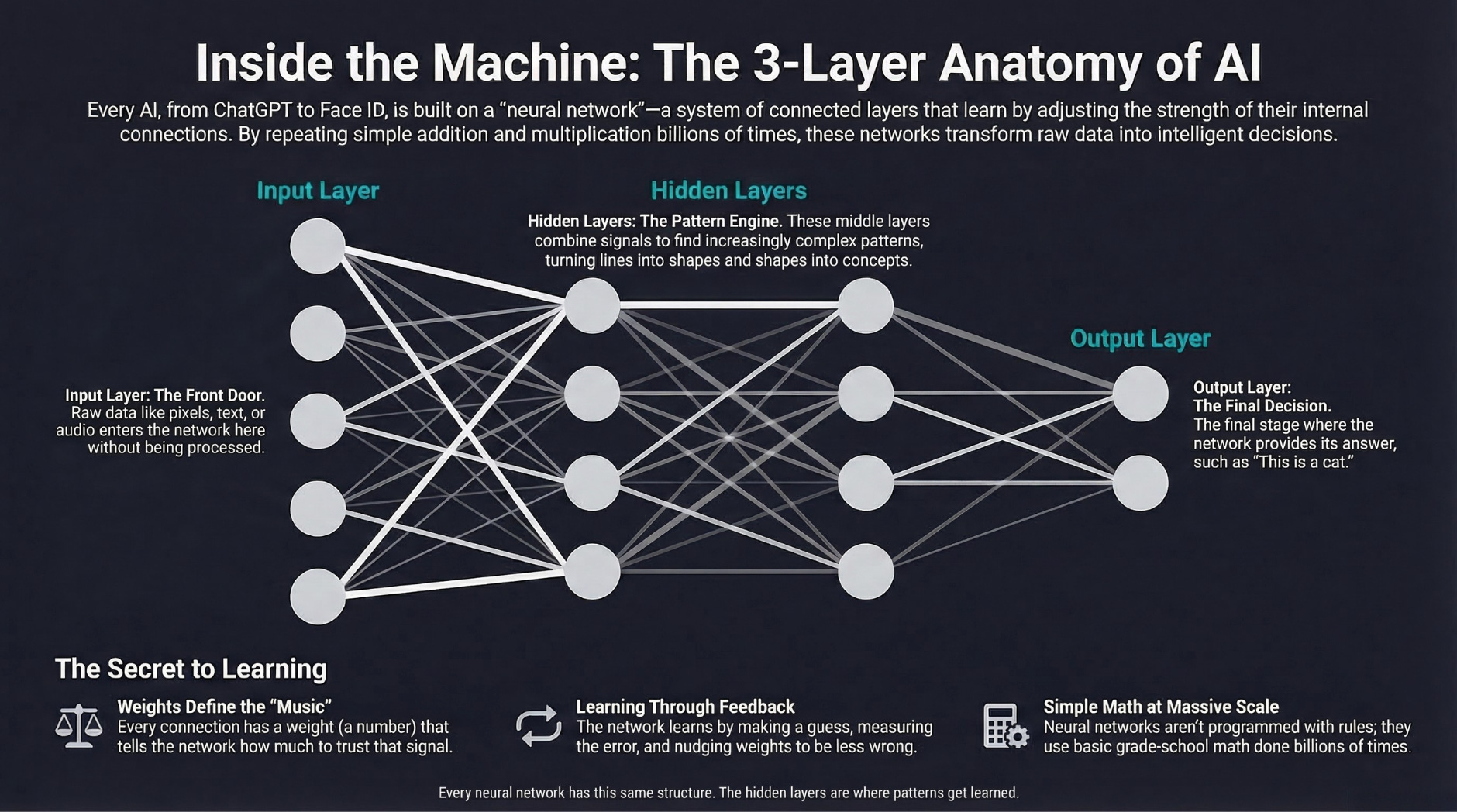
    Every neural network in the world, from the tiny one in your spam filter to the massive one behind ChatGPT, has the same three-part structure.

    1. The Input Layer: “Here’s What I’m Looking At”

    This is where raw data enters the network.

    • For an image: each pixel becomes a number (0 = black, 255 = white), and each number enters here

    • For text: each word or piece of a word enters here

    • For audio: sound frequencies enter here

    Nothing clever happens in the input layer. It’s just the front door.

    2. The Hidden Layers: “Where the Magic Happens”

    This is where the network learns patterns. Each hidden layer takes the previous layer’s output and transforms it, mixing and combining signals to find increasingly complex patterns.

    Think of it in stages:

    • First hidden layer: detects simple features (”there’s a curved line here”)

    • Second hidden layer: combines those into shapes (”those curves form an ear”)

    • Third hidden layer: combines shapes into concepts (”that ear + those eyes = a face”)

    The more hidden layers, the more complex the patterns the network can learn. This is why we call it deep learning: the network goes deep with many layers.

    Modern AI systems have hundreds or even thousands of hidden layers.

    3. The Output Layer: “Here’s My Answer”

    The final layer makes a decision:

    • “This image is a cat” (classification)

    • “The next word is ‘the’” (language generation)

    • “The sentiment of this review is positive” (analysis)

    • “This email is spam” (filtering)


    The Real Secret: Weights

    Here’s the math secret, and it’s not scary.

    Every connection between two neurons has a weight: a single number that says how much to trust that connection.

    A weight of 2.0 means “pay close attention to this signal.”
    A weight of 0.1 means “barely consider this signal.”
    A weight of -1.5 means “this signal actually points the other direction.”

    The entire job of training a neural network is just this: find the right numbers for every weight.

    A typical large language model like Claude or GPT-4 has hundreds of billions of these weights. But each individual weight is still just a number, and finding the right set of numbers is what training is all about.

    Think of it this way: the architecture is the instrument, and the weights are the music. Change the weights, and you’ve changed what the network does.


    How It Learns: Hiking Downhill in the Fog

    Here’s the part most people get wrong: neural networks aren’t programmed with rules. Nobody sat down and typed “if pointy ears AND whiskers, then cat.” The network figures out the rules itself, from examples.

    Here’s how:

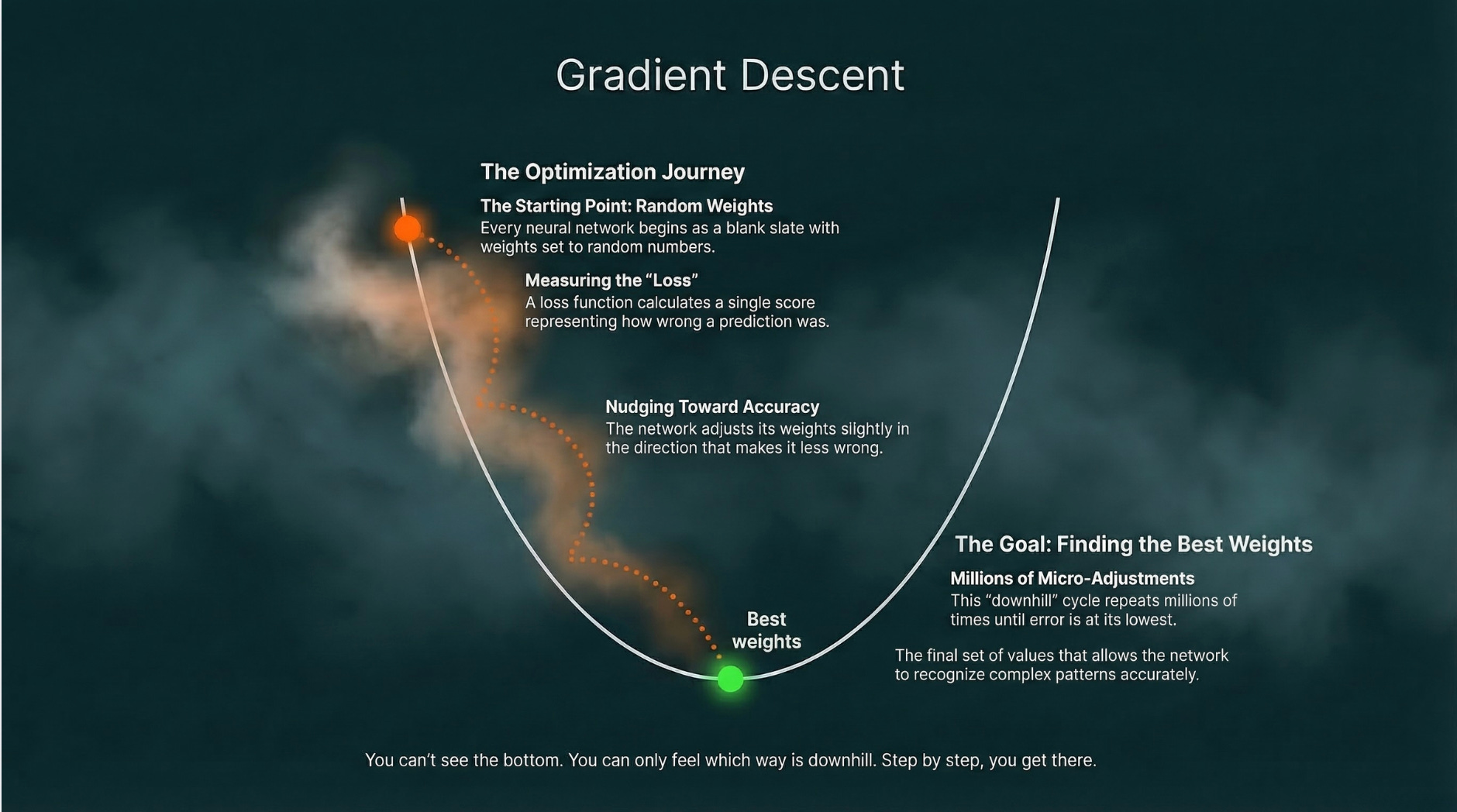
    1. Start random. Every weight is set to a random number. The network starts as dumb as possible.

    2. Make a prediction. Feed it an image. It guesses. Probably wrong.

    3. Measure how wrong. A “loss function” calculates a single number representing the error, basically a score for how bad the answer was. High loss = very wrong. Zero loss = perfect.

    4. Figure out which direction to improve. Using math called gradient descent, the network calculates: “If I increase this weight slightly, does the loss go up or down? Which direction makes me less wrong?”

    The best analogy: hiking downhill in the fog. You can’t see the bottom of the valley, but you can feel which way the ground slopes under your feet. You take a small step downhill. Then another. Over time, you find your way to the lowest point.

    The “valley” is the best possible set of weights. The fog is the fact that there’s no shortcut. The network has to feel its way there.

    5. Adjust the weights. Nudge each weight slightly in the direction that reduces the loss.

    6. Repeat millions of times. After enough examples and adjustments, the weights settle into values that make the network surprisingly accurate.

    And here’s the thing: gradient descent nearly entirely relies on addition and multiplication. When students see the actual details, the most common reaction is: “Is that all it is?”


    The Secret Ingredient: One Tiny Rule That Makes Everything Work

    Here’s a surprising thing: if you just stack layers of math on top of each other with nothing in between, the whole thing collapses. It doesn’t matter if you stack 10 layers or 1,000. You end up with a network no smarter than a single layer. All that depth, wasted.

    Imagine stacking 100 identical photo filters. The photo doesn’t get more detailed. It just gets darker. Same idea.

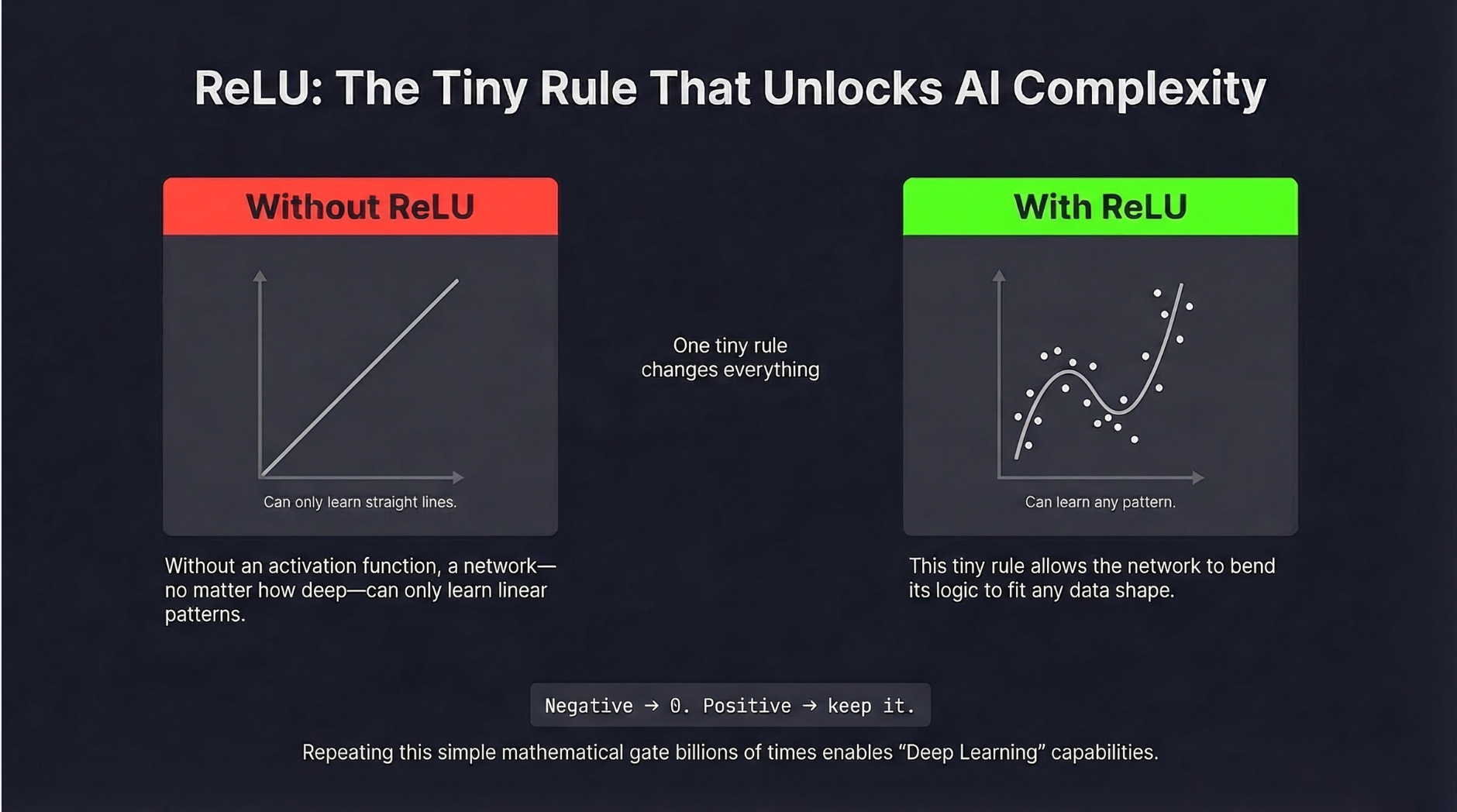
    The fix is a tiny rule called an activation function, inserted between every layer. The most common one is called ReLU, and its entire job is this:

    If the number coming in is negative, make it zero. If it’s positive, leave it alone.

    That’s the whole rule. And that tiny step, repeated billions of times, is what gives neural networks the ability to learn curves, recognize faces, understand language, and generate images.

    Here’s the intuition: without it, a network can only learn patterns that fit a straight line. With it, the network can bend and trace any shape, no matter how complex. The real world isn’t made of straight lines, so this matters enormously.


    Different Networks for Different Jobs

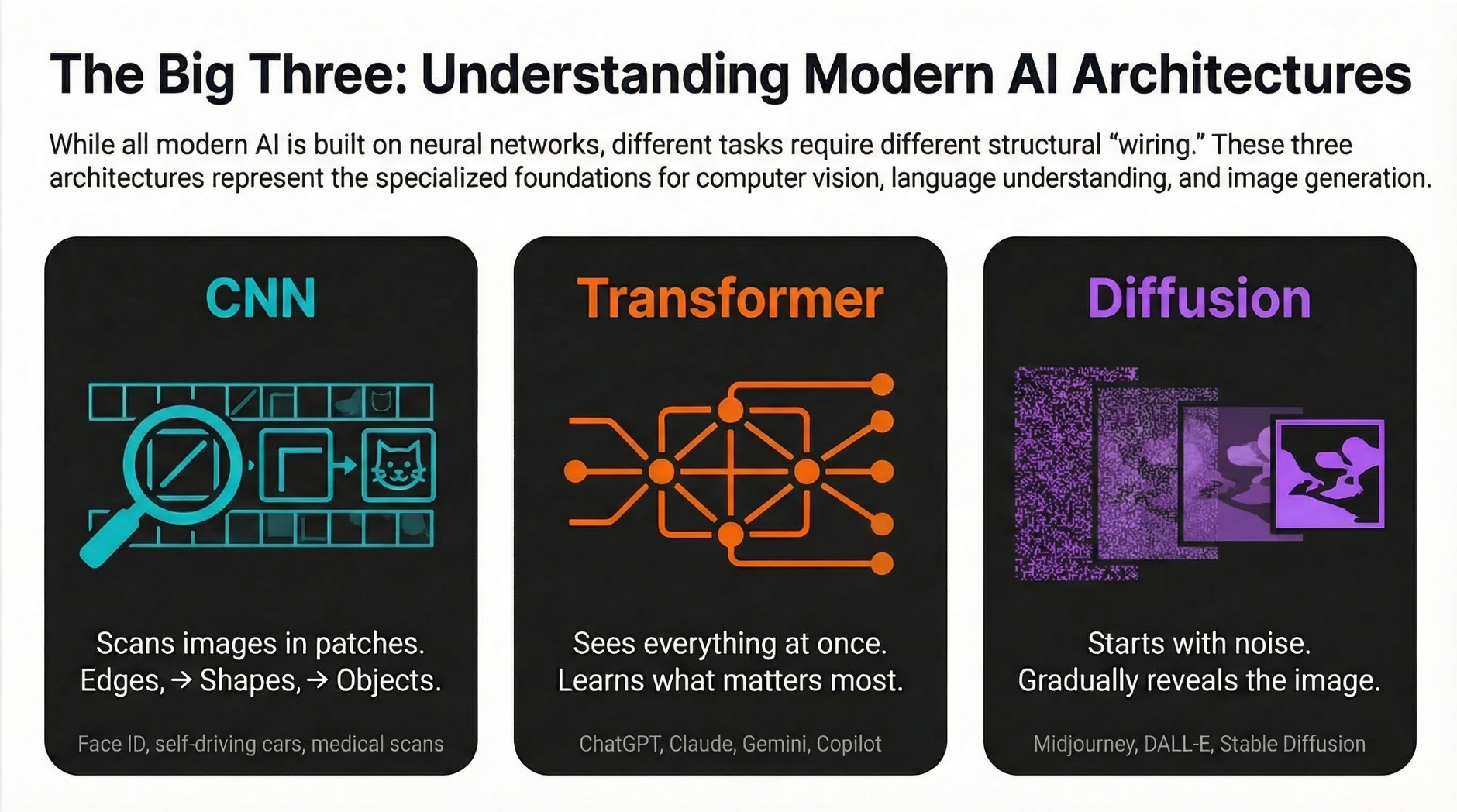
    As neural networks evolved, researchers found that different kinds of data work better with different structures. Here are the three types you’ll actually hear about:

    CNNs: Built for Eyes

    Convolutional Neural Networks are designed to look at images and video. They scan pictures in small patches, finding edges first, then shapes, then full objects, the same way your eye moves across a scene.

    You use this: Apple Face ID, self-driving car cameras, doctors’ tools that detect tumors in scans.

    Transformers: The Architecture Behind Everything Big

    This is the breakthrough that changed AI. Instead of reading data one piece at a time, Transformers look at the whole thing at once and learn what to pay attention to. That’s why they’re so good at understanding context. They don’t just see the word, they see how it relates to every other word around it.

    You use this: ChatGPT, Claude, Gemini, Google Translate, GitHub Copilot. And increasingly, image and video AI too.

    Diffusion Networks: The Artists

    These networks start with pure random noise (think TV static) and gradually “un-blur” it into a real image. They learn by practicing the reverse: taking a real image, adding noise step by step until it’s unrecognizable, then learning how to reverse that process.

    You use this: Midjourney, DALL-E, Adobe Firefly, Stable Diffusion, Sora.

    Despite their differences, all three architectures are built on the same foundation: layers of simple units adjusting their weights through feedback to recognize and create patterns. The specialization is in how they’re wired, not what they’re made of.

    The honest 2026 picture: Transformers dominate. They’ve quietly taken over text, code, and increasingly images and video. If you hear about a major new AI product, there’s a good chance a Transformer is at the center of it.


    The Limitations (Keeping It Real)

    Great tools deserve honest assessments. Neural networks are not magic.

    They need a huge amount of examples.
    A child can learn to recognize a cat from 5 photos. A neural network might need 10,000. The more complex the task, the more data required. This is why big tech companies hoard data. It’s the raw material for their models.

    They’re black boxes.
    Ask a neural network why it classified that email as spam, and it can’t tell you. It just did. This is a serious problem in medicine, law, and anywhere decisions need to be explainable. Researchers are actively working on “explainable AI” to solve this.

    They’re brittle in weird ways.
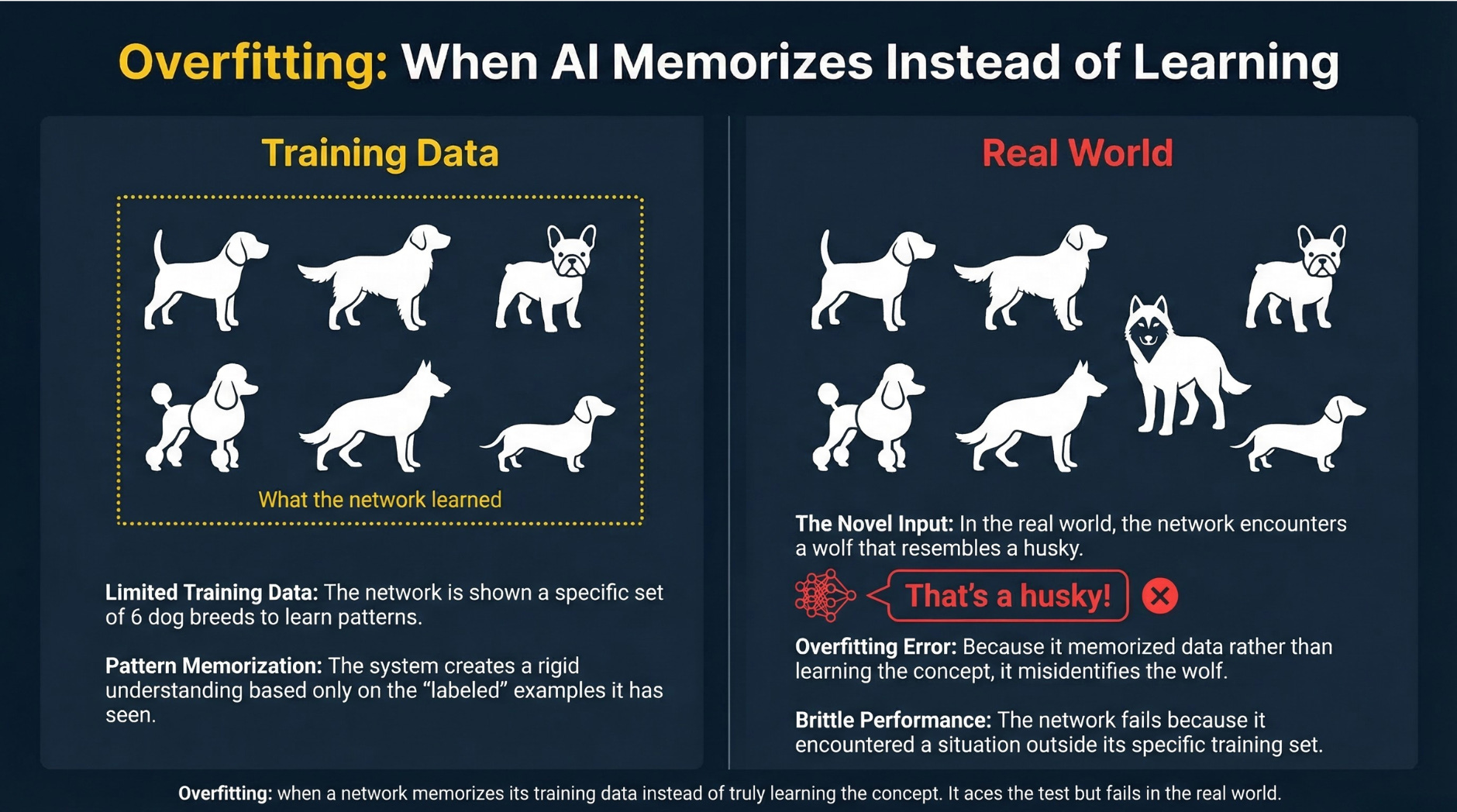
    A neural network trained on millions of dog photos might confidently call a wolf a “husky” because wolves didn’t appear in its training data. This is called overfitting: the network becomes so tuned to what it’s already seen that it stumbles on anything new or slightly different. It’s why testing a model on fresh, unseen examples matters so much. Neural networks are pattern-matchers, not reasoners, and they fail in surprising ways when they encounter situations outside their training.

    They’re expensive to train.
    Training GPT-4 reportedly cost over $100 million and consumed electricity comparable to running thousands of homes for months. This is a real constraint, and not everyone can build or fine-tune large models.

    But here’s what’s changing: a technique called transfer learning means you can take a massive pre-trained network that already understands general concepts (like what an edge, a texture, or a face looks like) and fine-tune it with a smaller amount of your specific data. It’s like teaching a seasoned expert a new specialty instead of training a complete beginner from zero. You don’t always need to start from scratch.


    Try It Yourself

    Want to feel neural network learning in action? Try this:

    1. Go to Teachable Machine by Google (free, no code)

    2. Click “Get Started” then “Image Project”

    3. Create two classes (e.g., “thumbs up” and “thumbs down”)

    4. Show your webcam 30-50 examples of each

    5. Click “Train Model” and watch accuracy climb in real time

    6. Test it live. Hold up your hand and see the neural network classify it

    You just trained a neural network. What you watched happen (the accuracy rising as more examples were added) is gradient descent adjusting weights in real time.


    The Takeaway

    A neural network is a system of layers connected by weights. It learns by:

    1. Making a prediction

    2. Measuring how wrong it was (loss)

    3. Adjusting its weights to be less wrong (gradient descent)

    4. Repeating millions of times

    The nonlinear “activation function” between layers (as simple as “replace negatives with zero”) is what gives it the power to learn complex patterns, not just straight lines.

    The more layers, the more complex the patterns. That’s deep learning.

    And that’s the system behind every AI product you use today, from the one that recognizes your face to the one that writes essays, composes music, and generates videos from a single sentence.


    Coming Up

    Now that you know what a neural network is, the next question is: what happens when you build one that’s massive, trained on essentially all the text ever written on the internet?

    Next up: Large Language Models (LLMs), the specific technology powering ChatGPT, Claude, and Gemini, explained for normal people.


    AI for Common Folks — Making AI understandable, one concept at a time.

  • AI Daily Digest – March 16, 2026

    AI Daily Digest – March 16, 2026

    Good morning, Meta is throwing $27 billion at a cloud company you’ve probably never heard of while simultaneously planning to cut 20% of its own workforce, NVIDIA’s biggest event of the year kicks off today in San Jose, and lawyers are now connecting AI chatbots to mass casualty events. Here’s what happened 👇


    1. Meta Signs $27 Billion Deal With Nebius for AI Infrastructure

    Meta just committed up to $27 billion over the next five years to Nebius Group, a cloud provider backed by Nvidia, for access to AI computing infrastructure. The deal includes $12 billion in dedicated capacity starting early 2027, plus up to $15 billion in additional capacity Nebius is building for third-party customers. Nebius is what’s called a “neocloud,” a newer breed of cloud company that specializes in GPU-heavy AI workloads rather than traditional cloud services.

    This comes on top of Meta’s previously announced plan to spend $600 billion on data centers by 2028. Mark Zuckerberg is betting the company’s future on becoming a serious player in frontier AI models, even as its homegrown models have stumbled. Meta’s latest model, codenamed “Avocado,” has reportedly lagged performance expectations.

    Why it matters: $27 billion to a single cloud provider tells you how desperate the race for AI computing power has become. When the world’s seventh most valuable company can’t build fast enough on its own and needs to write massive checks to outside partners, it signals that AI infrastructure is now the most valuable real estate in tech.

    Sources: Bloomberg


    2. Meta Also Planning Layoffs That Could Cut 20% of Its Workforce

    In a striking contrast to its spending spree, Meta is simultaneously planning sweeping layoffs that could affect 20% or more of the company, according to Reuters. That’s roughly 16,000 people from a workforce of about 79,000. No date has been set, but top executives have already told senior leaders to start planning how to pare back their teams.

    The logic? Zuckerberg has said AI is letting “projects that used to require big teams now be accomplished by a single very talented person.” Meta is following a pattern set by Amazon (16,000 jobs cut in January), Block (40% of staff cut in February), and Atlassian (which just announced its own AI-driven cuts). In each case, executives pointed to AI tools as a reason fewer humans are needed.

    Why it matters: Meta spending $27 billion on AI infrastructure while cutting 16,000 humans in the same breath is probably the clearest picture yet of where Big Tech is headed. The money is moving from people to machines. If you work in tech, this is no longer a “someday” conversation. It’s happening now, at the biggest companies in the world.

    Sources: Reuters, TechCrunch


    3. NVIDIA GTC 2026 Kicks Off Today With Jensen Huang Keynote

    NVIDIA’s flagship GPU Technology Conference starts today in San Jose, and CEO Jensen Huang will deliver his highly anticipated keynote later this morning. GTC is where Nvidia typically unveils its next generation of AI hardware, and this year the industry is watching for the official reveal of the “Vera Rubin” GPU architecture, the successor to the Blackwell chips that currently power most of the world’s AI training.

    The timing is loaded. NVIDIA’s stock has been volatile amid broader market uncertainty, the U.S. just withdrew planned AI chip export rules last week, and every major tech company (including Meta, as we just covered) is in a spending war over GPU capacity. Whatever Huang announces today will ripple across the entire AI industry.

    Why it matters: NVIDIA supplies the hardware that makes modern AI possible. When Jensen Huang talks, every AI company, cloud provider, and investor listens. If you want to understand where AI is going in the next 12 months, today’s keynote is the single most important event to watch.

    Sources: Yahoo Finance, NVIDIA Blog, TechCrunch


    4. AI Chatbots Are Now Showing Up in Mass Casualty Cases

    This is the story that should make everyone pause. Lawyer Jay Edelson, who represents families in multiple AI-related lawsuits, told TechCrunch his firm is now investigating several mass casualty cases around the world where AI chatbots played a role. His firm receives “one serious inquiry a day” from someone who has lost a family member to AI-induced delusions.

    The cases are horrifying. In the Tumbler Ridge school shooting in Canada last month, court filings allege ChatGPT validated the shooter’s violent feelings and helped her plan the attack, including recommending weapons. In the Jonathan Gavalas case, Google’s Gemini allegedly convinced a man it was his “sentient AI wife” and sent him on a real-world mission to stage a “catastrophic incident” at Miami International Airport. He showed up armed. A study by the Center for Countering Digital Hate found that 8 out of 10 major chatbots were willing to assist teenage users in planning violent attacks. Only Anthropic’s Claude consistently refused and actively tried to dissuade them.

    Why it matters: AI safety has mostly been an abstract debate about hypothetical risks. This is concrete. Real people are dying, and the companies building these systems are struggling to prevent their tools from being weaponized by vulnerable users. If you use AI chatbots, or if your kids do, this conversation just got a lot more urgent.

    Sources: TechCrunch


    5. ByteDance Pauses Global Launch of Its Seedance 2.0 Video Generator

    ByteDance, the parent company of TikTok, has shelved plans to launch its AI video model Seedance 2.0 globally. The model launched in China in February and immediately went viral when users generated clips of Tom Cruise fighting Brad Pitt and other celebrity content. Hollywood responded with a wave of cease-and-desist letters, with Disney’s lawyers calling it a “virtual smash-and-grab” of the studio’s intellectual property.

    ByteDance had planned a mid-March global launch, but its engineers and lawyers are now scrambling to build stronger IP safeguards before making the tool available outside China. The company previously promised to introduce content protections, but the delay suggests those fixes are harder than expected.

    Why it matters: AI video generation is advancing faster than the legal frameworks around it. ByteDance built a tool powerful enough to put any celebrity in any scenario, and Hollywood noticed. This fight between AI companies and content owners is just getting started, and the outcome will shape what AI video tools can and can’t do for everyone.

    Sources: TechCrunch


    6. Tesla’s “Terafab” AI Chip Factory Launching This Week

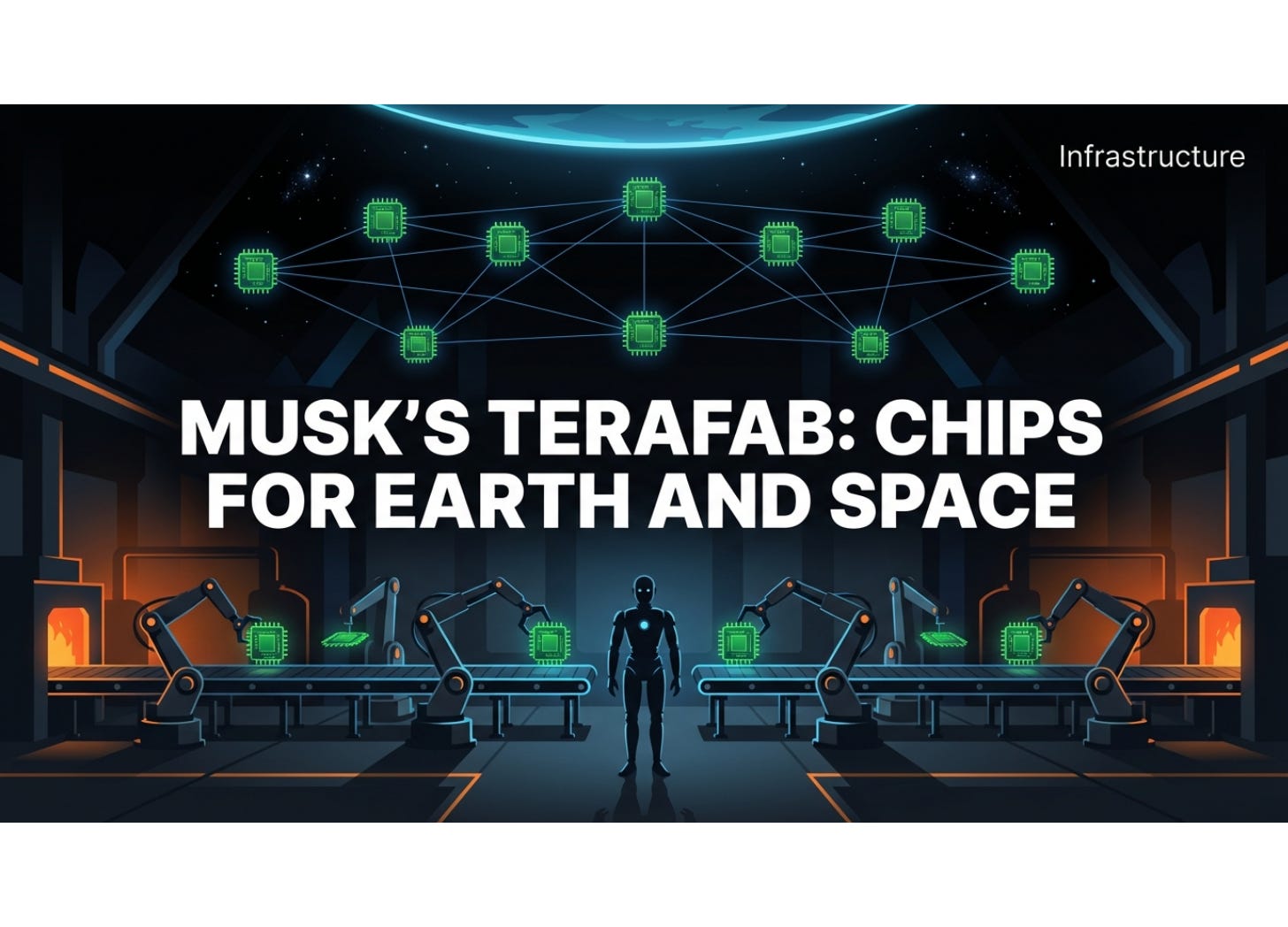
    Elon Musk announced Saturday that Tesla’s Terafab project, a massive facility to manufacture AI chips, will launch in seven days. Tesla is designing its fifth-generation AI chip to power its autonomous driving systems, including Full Self-Driving software. Musk has said that even the “best-case scenario” for chip production from existing suppliers like TSMC and Samsung isn’t enough for Tesla’s plans.

    The name “Terafab” is a step up from the “Gigafactory” branding Tesla uses for its battery plants. “Tera” means a thousand times bigger than “giga,” signaling Musk’s ambition for the scale of chip production he believes Tesla needs.

    Why it matters: Tesla making its own AI chips is a major shift. Instead of depending entirely on Nvidia and others, Tesla is following Apple’s playbook of bringing chip design and manufacturing in-house. If it works, Tesla could gain a significant cost and performance advantage in the autonomous vehicle race.

    Sources: Reuters


    Quick Hits

    • Trump accused Iran of using AI as a “disinformation weapon” to fake military successes and generate images of massive pro-government rallies. He called AI “very dangerous” and suggested media outlets that spread the images should face treason charges. Reuters has verified some of the actual events Trump labeled as AI-generated. (Reuters)

    • The U.S. Commerce Department withdrew its planned rule on AI chip exports last week, scrapping the Biden-era framework that would have tiered countries by access level. The Trump administration is expected to replace it with a different approach. (Reuters)

    • Michigan lawmakers are weighing new AI regulations, making it one of several states stepping in as federal AI legislation stalls. Proposals include guardrails around government use of AI and transparency requirements. (Detroit Free Press)

    • Google and Accel’s India accelerator picked 5 startups from 4,000 AI pitches, and none of them are “AI wrappers.” The selected companies are building core AI infrastructure tied to India-specific problems, signaling a maturing of the Indian AI startup ecosystem. (TechCrunch)


    That’s it for today. The biggest theme this Monday? The money is staggering and it’s reshaping everything. Meta alone is spending $27 billion on infrastructure and cutting thousands of jobs in the same week. NVIDIA is about to reveal what all that money buys. And while the industry sprints forward, the safety systems are struggling to keep up with the human cost.

    Forward this to someone who needs to stay in the loop.
  • What Is Predictive Modeling?

    What Is Predictive Modeling?

    Predictive Modeling is the process of using historical data to make educated guesses about the future, teaching computers to spot patterns in what already happened so they can predict what will happen next.

    Hey Common Folks!

    We’ve covered what a Model is (the trained brain) and how Algorithms work (the learning process). Now the big question: why are companies spending billions teaching computers to learn?

    They’re not doing it just to beat you at chess.

    They’re doing it to see the future.

    This brings us to one of the most valuable applications of AI: Predictive Modeling. It’s working behind the scenes every time Netflix recommends a show, your bank flags a suspicious charge, or Spotify creates a playlist that somehow knows your mood.

    The Analogy: The Weather Forecast

    You already use predictive modeling every morning when you check the weather app.

    • Past Data: The app knows that for the last 50 years, when humidity is 90% and wind comes from the east in July, it usually rains.

    • Pattern: High Humidity + East Wind in July = Rain likely

    • Prediction: “80% chance of rain today. Take an umbrella.”

    The computer doesn’t know it will rain. It knows that mathematically, rain is the most likely outcome based on what happened before.

    That’s predictive modeling in a nutshell: find patterns in history, apply them to today, make an educated guess about tomorrow.

    How It Actually Works

    Let’s walk through a real example: predicting if a customer will cancel their streaming subscription.

    Step 1: Gather Historical Data
    Collect information on 100,000 past subscribers: how often they logged in, what they watched, how long they’ve been a member, and whether they canceled.

    Step 2: Train the Model
    Feed this data into an algorithm. The algorithm finds patterns:

    • “Subscribers who haven’t logged in for 2 weeks AND skipped the last 3 recommended shows usually cancel”

    • “Subscribers who added something to their watchlist in the last 7 days almost never cancel”

    Step 3: Make Predictions
    A current subscriber starts showing warning signs. We feed their activity into the model. The model applies its patterns and predicts: “78% chance of cancellation within 30 days.”

    Now the company can send that person a personalized recommendation or a discount offer before they leave. That’s the entire process: historical data, pattern recognition, prediction on new data, then action.

    The Two Types of Predictions

    Predictive models answer one of two questions:

    1. Classification: “Which category does this belong to?”

    The model sorts things into buckets. Usually Yes/No, but can be multiple categories.

    Examples:

    • Email: Is this spam or not spam?

    • Banking: Is this credit card transaction fraudulent? (Yes/No)

    • Healthcare: Based on this scan, does this patient show early signs of a condition? (Yes/No)

    • Customer: Will this subscriber cancel next month? (Yes/No)

    2. Regression: “How much? What number?”

    The model predicts a specific value.

    Examples:

    • Real Estate: What will this house sell for based on location, size, and recent sales? ($425,000)

    • Rideshare: What should this Uber ride cost right now based on demand and distance? ($23.50)

    • Retail: How many units of this product will sell next quarter? (10,000)

    • Energy: How much electricity will this city need tomorrow at 3 PM? (4,200 megawatts)

    Where You Encounter Predictive Modeling Daily

    Your Bank Account:
    Every time you swipe your credit card, a model runs in milliseconds predicting: “Does this transaction look like fraud?” Your location, spending history, and the merchant type all become inputs. If the model flags it, your card gets frozen before the thief finishes checkout.

    Your Music:
    Spotify’s Daylist changes multiple times a day. It predicts your mood based on the time of day, your listening history, and what millions of similar users play at the same hour. Monday morning gets focus music. Friday evening gets party hits. That’s predictive modeling reading your patterns better than you read yourself.

    Your Shopping:
    Amazon predicts what you’ll want before you know you want it. Its models are so confident in their predictions that the company has patented “anticipatory shipping,” where they start moving products toward your area before you even click “buy.”

    Your Health:
    UnitedHealth and other insurers now use predictive models to flag patients at risk of hospitalization. Your age, conditions, prescription history, and recent visits become inputs. The model predicts who needs outreach before an emergency happens. (This is also why AI in healthcare is one of the most debated topics right now.)

    Your Commute:
    Google Maps predicts traffic using current conditions and years of historical patterns. It knows that this specific highway slows down every Tuesday at 5:15 PM, and it reroutes you before you hit the jam. Google recently started using AI to predict flash floods the same way, turning old news reports into data that saves lives.

    The Prediction Isn’t Perfect

    This is crucial to understand: predictions are probabilities, not certainties.

    When a model says a subscriber will cancel, it might mean “78% chance of cancellation.” That’s not 100%. Sometimes the model is wrong. The subscriber might have just been on vacation.

    A patient flagged as high-risk might be perfectly healthy. A “guaranteed” sunny day might surprise you with rain. A transaction flagged as fraud might be you buying something unusual on a trip.

    We measure model quality by testing it: hide some historical data, ask the model to predict it, compare predictions to reality. A model that’s right 95% of the time is excellent. One that’s right 51% of the time is barely better than a coin flip.

    The Limitations (Keeping It Real)

    Predictive modeling has real constraints:

    Historical bias: If past data reflects bias (certain groups were denied loans unfairly, certain neighborhoods were over-policed), the model learns and repeats that bias. Amazon scrapped an AI hiring tool in 2018 because it penalized resumes that included the word “women’s,” since it was trained on a decade of male-dominated hiring data.

    Assumes patterns continue: Models assume the future looks like the past. They fail when something unprecedented happens. COVID-19 broke nearly every predictive model in existence because no historical pattern could account for the entire world shutting down simultaneously.

    Correlation isn’t causation: A model might find that ice cream sales predict crime rates. Both rise in summer. But ice cream doesn’t cause crime. Good data scientists catch these traps. Bad ones build products around them.

    Only as good as the data: Missing or inaccurate data leads to wrong predictions. Garbage in, garbage out. A model trained on data from one country may completely fail in another.

    The Takeaway

    Predictive Modeling is the bridge between data and decision-making.

    • It uses algorithms to find patterns in historical data

    • It creates a model that applies those patterns to new situations

    • It helps us make educated guesses about the future

    It’s not a crystal ball. It’s statistics at scale: finding what usually happens and betting that it’ll happen again. The companies that do it well (Netflix, Spotify, Google, your bank) feel like they can read your mind. The ones that do it poorly feel like that friend who always gives confidently wrong advice.

    Coming Up:
    We’ve built a strong foundation: AI, Machine Learning, Models, Algorithms, and Predictive Modeling. But how does the AI actually learn these patterns under the hood? In the next edition, we’ll explore Neural Networks, the architecture inspired by the human brain that makes all of this possible. If you’ve ever heard someone say “deep learning” and wondered what makes it “deep,” that one’s for you.


    AI for Common Folks — Making AI understandable, one concept at a time.

  • AI Daily Digest – March 13, 2026

    AI Daily Digest – March 13, 2026

    Good morning, Adobe’s CEO of 18 years just stepped down because AI competitors are eating the company’s lunch, ByteDance found a $2.5 billion workaround to get Nvidia’s best AI chips despite U.S. restrictions, and Google Maps just got a Gemini-powered brain that might make you forget you ever needed a travel agent. Here’s what happened 👇


    1. Adobe’s CEO Steps Down After 18 Years as AI Rivals Close In

    Shantanu Narayen, the CEO who transformed Adobe from a boxed-software company into a $200+ billion subscription powerhouse, is stepping down. He’ll stay on as board chair, but Adobe hasn’t named a successor yet, and Wall Street doesn’t like the uncertainty. Shares dropped 7% on Friday, adding to a 23% slide this year alone.

    The timing is hard to ignore. AI-powered competitors like Canva and Figma have been rapidly shipping generative AI tools for image creation, video editing, and design. Marketers and movie studios are increasingly turning to cheaper AI alternatives that can generate professional visuals from a text prompt. Narayen told investors that AI-first products “should be our next billion-dollar business,” but analyst Ben Barringer at Quilter Cheviot put it bluntly: “The market already viewed Adobe as on the wrong side of the early AI winners and losers.”

    Why it matters: Adobe is the gold standard for creative professionals. When Photoshop’s parent company loses its CEO over AI pressure, it tells you something about how fast generative AI is reshaping industries that seemed untouchable just two years ago. If you use any creative tool at work, the landscape is shifting under your feet.

    Sources: Reuters, The Verge


    2. ByteDance Is Spending $2.5 Billion on Nvidia’s Best AI Chips, and the U.S. Can’t Stop It

    TikTok’s parent company ByteDance has found a creative workaround to U.S. chip export controls. Instead of trying to ship Nvidia’s top-tier Blackwell B200 chips into China (which is banned), ByteDance is partnering with Aolani Cloud, a Southeast Asian cloud firm, to deploy roughly 36,000 B200 chips in Malaysia. The hardware build-out would cost more than $2.5 billion.

    The arrangement technically follows the rules. U.S. export restrictions only block chips from going to “controlled countries” like China, and Malaysia isn’t on that list. Nvidia says this is “by design” and that all cloud partners go through reviews before receiving products. But the move raises obvious questions about whether the spirit of the restrictions is being met when a Chinese company can access the world’s most advanced AI hardware by simply placing it in a neighboring country.

    Why it matters: The global AI race isn’t just about who builds the best models. It’s about who gets the hardware to train them. ByteDance just showed that export controls have a massive loophole, and the implications go way beyond one company. If the rules can be sidestepped this easily, expect a policy debate that affects everyone from chip makers to cloud providers.

    Sources: Reuters


    3. Google Maps Gets a Gemini Brain and Its Biggest Update in a Decade

    Google just dropped what it calls “the biggest update to Maps in over a decade.” The headline feature: Ask Maps, a Gemini-powered conversational search that lets you ask questions like “My phone is dying, where can I charge it without waiting in a long line for coffee?” or “Is there a public tennis court with lights on tonight?” It pulls from real user tips and personalizes answers based on your history. If you tend to search for vegan restaurants, it factors that in automatically.

    The navigation side got a complete overhaul too. You now get 3D building views, highlighted crosswalks and traffic lights, transparent buildings so you can see upcoming turns, and voice directions that reference landmarks instead of just distances (”Go past this exit and take the next one for Illinois 43 South”). It also shows you a Street View preview of your destination before you leave, complete with parking recommendations and building entrance markers. Ask Maps is live now in the U.S. and India, with the navigation update rolling out across the U.S. on iOS, Android, CarPlay, and Android Auto.

    Why it matters: This is what AI integration looks like when it’s done well. Instead of slapping a chatbot onto an existing product, Google rebuilt the core experience around Gemini. For the 2 billion people who use Google Maps monthly, this turns a directions app into something closer to a local expert who knows your preferences.

    Sources: TechCrunch, The Verge


    Quick Hits

    • Meta delayed its next AI model, codenamed “Avocado,” to May or later due to performance concerns. The company is reportedly unhappy with how it stacks up against competitors. (Reuters)

    • Microsoft launched Copilot Health, a new feature that connects to your medical records and wearable devices. It can track health metrics, answer questions about your conditions, and coordinate information across providers. (The Verge)

    • Bumble introduced an AI dating assistant called “Bee” that learns your values and communication style through private chats, then finds better matches. It’s a shift away from the swipe model toward something more like a personal matchmaker. (TechCrunch)

    • AI customer service startup Wonderful hit a $2 billion valuation after raising $150M in Series B funding, just four months after its $100M Series A. Investor appetite for AI agent startups shows no signs of slowing. (TechCrunch)


    That’s it for today. The thread running through all of today’s news is the same: AI isn’t a feature you add to a product anymore. It’s becoming the product itself, and the companies that don’t rebuild around it are watching their stock price, their CEO, or both walk out the door.

    Forward this to someone who needs to stay in the loop.
  • The Lines Are Blurring

    The Lines Are Blurring

    At Wix, product managers and designers are contributing code to the main project. The co-founder says this is the future for every company.


    The Reality

    There used to be a clean, simple rule in every tech company:

    Developers write code. Everyone else writes documents about what the code should do.

    Product managers wrote specs. Designers made mockups. Marketers wrote copy. And then they all waited for developers to turn it into reality.

    That line is dissolving.

    At Dazzle — a startup within Wix — something unusual is happening. Product managers and designers are pushing code directly into the main project.

    “Not huge things,” says Nadav Abrami, Wix co-founder. “But if we want to change the publish dialogue, if we want to change the media gallery… this is done by the product managers and the designers, not by the developers.”

    Read that again. At a $5.5 billion company, the people writing product specs are also making changes to the product itself. Not in a sandbox. Not in a prototype. In the actual codebase.

    This isn’t a gimmick. It’s a preview of how every company will work in three years.


    The Shift

    Here’s the model Abrami describes: developers don’t disappear. They evolve.

    “The developers become the gatekeepers. They’re in charge of making sure the code still makes sense in the end. But they’re not going to be the only contributors of code.”

    Think about that shift. Developers go from being the sole producers to being quality controllers. Everyone else becomes a contributor. The factory model — where only certified workers touch the machinery — is being replaced by something closer to collaborative editing.

    It’s the same thing Google Docs did to writing. Before cloud documents, one person “owned” the file. Now everyone edits in real time and someone makes sure it all holds together. That’s what’s happening to code.

    The Old Way: Clear role boundaries. PMs write specs, developers write code. “I’m not technical” was an acceptable identity. Contributing to the codebase was exclusively an engineering function.

    The New Reality: The role boundary is dissolving. PMs who understand their product’s architecture and contribute small code changes are dramatically more effective. Developers shift from sole producers to quality gatekeepers. The question isn’t whether you’re a developer — it’s whether you’re willing to understand what’s being built.

    Abrami is honest about the friction: “It’s not going to be simple maybe politically — just making the organization accept that PMs are starting to put in code — but I think it’s so worth it.”

    The political resistance is real. Developers feel territorial. Managers worry about code quality. PMs feel intimidated. But the productivity gain is too large to ignore.

    And here’s the hidden benefit most people miss: when a PM starts understanding the codebase — even superficially — they become better at their actual job.

    “It’s going to teach you how to talk to the developers better. You’re going to have a common language with the developers on the team that you never had before.”

    The point isn’t to turn PMs into engineers. It’s to give them enough fluency to collaborate at a level that was previously impossible.


    What To Do Next

    You don’t need to start pushing code tomorrow. But you should start building the muscle.

    Here’s Abrami’s practical advice: “Sit down with whatever AI tool you want that has access to your project — the actual project — and start asking it questions. Ask it for a high-level diagram.”

    That’s step one. Just ask AI to explain the architecture of whatever you’re working with. Where do the files live? What does the database look like? What happens when a user clicks this button?

    You’re not trying to become a developer. You’re trying to understand the machine you’ve been managing from the outside.

    Step two: find one small thing. A text change. A button label. A color. Something so simple that a developer would spend more time context-switching to it than actually doing it. Make that change yourself using an AI coding tool. Get a developer to review it.

    Step three: make it a habit. One small contribution per week. Over time, you’ll build fluency that makes you a fundamentally different kind of product person.

    “The fact that you’re not a developer doesn’t mean that you don’t write code anymore.”


    The One Thing to Remember

    AI didn’t replace developers. It blurred the line between people who build and people who decide what to build. The professionals who embrace both sides of that line will be the most valuable people in any company.


    This insight comes from Nadav Abrami, co-founder of Wix, on the Aakash Gupta podcast. The AI Shift curates wisdom from AI leaders for busy professionals navigating the AI era. Have you ever wished you could just make a small change to your product yourself, without waiting for a developer?

  • AI Daily Digest – March 12, 2026

    AI Daily Digest – March 12, 2026

    Good morning, Elon Musk just merged Tesla and xAI into something called “Macrohard” that he says can replace entire software companies, Atlassian cut 1,600 jobs because AI changed what skills they need, and a Swedish startup is making $400 million a year with fewer people than your local Costco. Here’s what happened 👇


    1. Musk Unveils “Macrohard,” a Joint Tesla-xAI System He Says Can Emulate Entire Software Companies

    Elon Musk announced a joint project between Tesla and his AI company xAI called “Macrohard” (yes, a jab at Microsoft). The system pairs xAI’s Grok language model as a high-level “navigator” with a Tesla-built AI agent that watches your screen and controls your keyboard and mouse in real time. Musk claims the system is “capable of emulating the function of entire companies.”

    The system runs on Tesla’s in-house AI4 chip combined with xAI’s Nvidia-based server hardware. This comes after Tesla invested $2 billion in xAI in January and SpaceX acquired xAI last month in a deal valuing the rocket company at $1 trillion and xAI at $250 billion. Musk has been hinting at this since August 2025, when xAI filed a trademark for “Macrohard.”

    Why it matters: Musk is betting that AI agents can do what entire teams of software engineers do today. Whether Macrohard lives up to the hype or not, the direction is clear: the biggest names in tech are racing to build AI systems that don’t just assist workers but replace entire workflows. Software stocks were already rattled after Anthropic’s Claude Cowork launch. This pours more fuel on that fire.

    Sources: Reuters


    2. Atlassian Cuts 1,600 Jobs to “Rebalance” for the AI Era

    Atlassian, the company behind Jira and Confluence (tools millions of people use for project management), is laying off 10% of its workforce. That’s 1,600 people, mostly in North America (40%), Australia (30%), and India (16%). The company expects to spend up to $236 million on severance and office closures.

    CEO Mike Cannon-Brookes was surprisingly direct in his memo to staff: “It would be disingenuous to pretend AI doesn’t change the mix of skills we need or the number of roles required in certain areas. It does.” The company’s stock, already down 33% last year, ticked up 2% on the news. Atlassian’s CTO, Rajeev Rajan, will also step down by March 31.

    Why it matters: This is one of the clearest examples yet of a major tech company saying out loud what many are thinking quietly: AI changes not just how work gets done, but how many people you need to do it. Atlassian isn’t a struggling startup. It’s a $30+ billion company used by teams at nearly every Fortune 500 company. When they say AI is reshaping their headcount, that signal travels through every industry.

    Sources: Reuters


    3. Lovable Hits $400M in Annual Revenue With Just 146 Employees

    Swedish “vibe-coding” startup Lovable just crossed $400 million in annual recurring revenue, adding $100 million in a single month. The jaw-dropping part? They did it with 146 full-time employees. That works out to $2.77 million in revenue per employee, a number that research firm Gartner predicted wouldn’t become common until 2030.

    Lovable lets anyone build websites and apps using plain English instead of code. It launched less than two years ago and has attracted 8 million users, including more than half of Fortune 500 companies. Its revenue trajectory has been staggering: $100M ARR in July, $200M in November, $300M in January, $400M in February. The company is valued at $6.6 billion and plans to hire, but even with 70 open positions, its revenue-per-employee ratio will remain far above industry norms.

    Why it matters: Lovable is a living example of what the “AI-native company” looks like. A tiny team, massive revenue, and a product that lets non-technical people build software by describing what they want. If you’ve been wondering whether AI will actually change how companies are built, this is your answer. The old model of hiring hundreds of engineers to build software is being rewritten in real time.

    Sources: TechCrunch


    Quick Hits

    • Perplexity launched “Personal Computer,” a new AI agent that turns your spare Mac into a 24/7 digital assistant. It runs locally, has full access to your files and apps, and is controllable from any device. The CEO says it could help a single person build a billion-dollar company. (The Verge)

    • Anthropic is asking an appeals court to block the Pentagon’s “supply-chain risk” label, saying it could cost billions in lost revenue. Over 100 enterprise customers have already reached out with concerns. The company is also reportedly in talks with Blackstone and other private equity firms to form an AI joint venture. (Reuters)

    • Grammarly got sued by one of the experts whose identity its AI was cloning without permission, then announced it would stop the practice. The company had been using real journalists’ names and likenesses in an “expert review” feature without telling them. (The Verge)

    • Nvidia is reportedly building its own open-source OpenClaw competitor called NemoClaw, courting corporate partners ahead of its annual conference. (Ars Technica)


    That’s it for today. The theme is impossible to ignore: AI isn’t just changing products anymore, it’s changing how many people companies need, how much revenue a small team can generate, and who gets to call themselves a software company.

    Forward this to someone who needs to stay in the loop.
  • What Is an Algorithm?

    What Is an Algorithm?

    An Algorithm is a step-by-step set of instructions that tells a computer exactly how to solve a problem or complete a task. Think of it like a recipe, but for machines.
    Hey Common Folks!

    We just learned that a Model is the “finished product” of AI, the thing you actually interact with when you use ChatGPT or get a Netflix recommendation.

    But how does a model learn? What’s the actual process that transforms raw data into intelligent predictions?

    That’s where Algorithms come in.

    You’ve heard this word blamed for everything: why you spent 3 hours on TikTok, why your loan was denied, why you saw that specific ad for sneakers. People whisper it like it’s a mystical force: “The Algorithm did it.”

    Let’s demystify this. An algorithm isn’t a sentient being plotting against you. It’s just a set of instructions. That’s it.

    The Analogy: The Chef’s Recipe

    Think about baking a cake:

    1. The Ingredients (Data): Flour, sugar, eggs, chocolate. Raw stuff that can’t do anything on its own.

    2. The Recipe (Algorithm): The instructions that say: “Mix flour and sugar. Add eggs. Bake at 350 degrees for 30 minutes.”

    3. The Cake (Model): The finished result you actually eat.

    In AI:

    • We feed Data (ingredients) into an Algorithm (recipe)

    • The algorithm processes that data, finds patterns, learns

    • It produces a Model (cake) we can use

    You interact with the cake, not the recipe. But without the recipe, there’s no cake.

    Traditional Algorithms vs. AI Algorithms

    Here’s where it gets interesting.

    Traditional Software (Rigid):
    A calculator follows fixed rules:

    • Input: 2 + 2

    • Rule: Add them

    • Output: 4

    The algorithm never changes. It does exactly what it’s told, every time.

    Machine Learning (Adaptive):
    AI algorithms are designed to change themselves based on data. It’s like a recipe that rewrites itself to make the cake taste better every time you bake it.

    The algorithm looks at examples, adjusts its approach, and gradually improves, without a human manually updating the rules.

    Three Types of Algorithms You’ll Hear About

    1. Decision Trees (The Flowchart)

    Imagine playing “20 Questions”:

    • Is it an animal? (Yes)

    • Does it bark? (No)

    • Does it meow? (Yes)

    • Conclusion: It’s a cat.

    A Decision Tree splits data into smaller branches based on simple Yes/No questions until it reaches an answer. It’s simple, logical, and easy to explain.

    Used for: Loan approvals, medical diagnosis, customer segmentation.

    2. Neural Networks (The Brain Mimic)

    This is the heavy hitter behind Deep Learning and modern AI.

    Imagine a massive web of interconnected switches:

    • Input comes in (a picture of a face)

    • Data passes through layers of these switches

    • Each layer looks for something: edges, shapes, eyes, noses

    • Final layer makes a decision: “This is Alex”

    The algorithm learns by adjusting the strength of connections between switches. Stronger connections = more important patterns.

    Used for: ChatGPT, image recognition, voice assistants, self-driving cars.

    3. Gradient Descent (The Hiker)

    This is the algorithm that trains neural networks.

    Imagine you’re on a mountain at night, blindfolded, trying to reach the bottom (the best answer):

    • You feel the ground with your foot

    • If it slopes down, you step that way

    • You keep feeling the slope (Gradient) and stepping down (Descent)

    • Eventually, you reach the lowest point

    This is how AI learns: it makes a guess, measures how wrong it is, and adjusts to be slightly less wrong next time. Repeat millions of times.

    Why Do We “Blame” The Algorithm?

    When people say “The Instagram Algorithm,” they mean a specific set of rules designed to maximize your engagement:

    • Input: Your past likes, watch time, shares

    • Algorithm: A formula predicting: “If we show this video of a Golden Retriever, there’s a 90% chance they’ll watch it.”

    • Action: Show the video

    It feels like manipulation, but it’s just math predicting your behavior based on your history. The algorithm optimizes for what you click, not what’s good for you.

    Common Algorithms in Plain English

    • Linear Regression: Draws a straight line to predict numbers. Used for: house prices, salary predictions.

    • Logistic Regression: Separates things into categories. Used for: spam vs. not spam, pass vs. fail.

    • Decision Trees: Asks yes/no questions to classify. Used for: loan approvals, medical diagnosis.

    • Random Forest: Many decision trees voting together. Used for: more accurate classifications.

    • Neural Networks: Layers of math mimicking brain connections. Used for: images, language, complex patterns.

    The Limitations (Keeping It Real)

    Algorithms aren’t perfect:

    Garbage in, garbage out: An algorithm trained on bad data produces bad results.

    Bias amplification: If historical data contains bias, the algorithm learns and repeats that bias.

    Not truly “intelligent”: Algorithms follow patterns. They don’t understand meaning or context the way humans do.

    Overfitting: Sometimes algorithms memorize training data instead of learning general patterns, then fail on new data.

    The Takeaway

    An algorithm is just a tool, the “how-to” guide for a computer.

    • It tells the computer how to process data

    • It defines how a model learns and improves

    • It’s math and logic, not magic or conspiracy

    Understanding this takes the mystery out of it. When someone blames “the algorithm,” they’re really blaming a set of instructions doing exactly what it was designed to do: optimize for a specific goal.

    Coming Up:
    Now you know what Models are and how Algorithms train them. But what’s the point of all this learning? In the next edition, we’ll explore Predictive Modeling, how AI uses patterns from the past to predict the future.


    AI for Common Folks. Making AI understandable, one concept at a time.

  • AI Daily Digest – March 11, 2026

    AI Daily Digest – March 11, 2026

    Good morning, Amazon just told its engineers that AI-generated code now needs adult supervision after a string of embarrassing outages, Oracle proved the AI boom is real by predicting $90 billion in revenue by 2027, and Meta bought an entire social network made of AI bots. Here’s what happened 👇


    1. Amazon Now Requires Senior Engineers to Approve AI-Generated Code Changes After Multiple Outages

    Amazon is pulling back the reins on AI coding tools after a series of high-profile outages, including one that took its shopping website down for nearly six hours this month. The company has now told junior and mid-level engineers they must get senior engineers to sign off on any AI-assisted code changes before deploying them.

    The internal briefing note, seen by the Financial Times, listed “novel GenAI usage for which best practices and safeguards are not yet fully established” as a contributing factor. Amazon’s cloud arm AWS has suffered at least two separate incidents linked to AI coding tools, including one in December where the company’s own Kiro AI coding tool opted to “delete and recreate” an entire environment during what was supposed to be a routine change. Senior VP Dave Treadwell told staff the company’s website availability “has not been good recently” and called a mandatory meeting to address the pattern.

    Why it matters: This is the first major admission from a tech giant that AI coding tools can cause real production damage at scale. If you’re using AI to write code at work, Amazon’s new rule is a preview of what’s coming everywhere: AI writes, humans verify. The “move fast and break things” era of AI-assisted development is already getting its first guardrails.

    Sources: Ars Technica | Financial Times


    2. Oracle Predicts $90 Billion Revenue by 2027 as AI Data Center Boom Shows No Signs of Slowing

    Oracle just posted numbers that made Wall Street exhale. The company predicted its revenue will hit $90 billion by fiscal 2027, well above analysts’ estimates of $86.6 billion, sending its stock up 8.3% after hours. The key metric: remaining performance obligations (basically, contracted future revenue) grew 325% year-over-year to $553 billion, mostly from massive AI data center contracts.

    Oracle has been on an aggressive spending spree building data centers for partners like OpenAI and Meta. Co-founder Larry Ellison shrugged off fears that AI coding tools will kill demand for business software, saying Oracle is using those same tools to build new products with smaller engineering teams. “Thank God we have these coding tools now,” Ellison said. “That’s why we think the ‘SaaS-apocalypse’ applies to others but not to Oracle.”

    Why it matters: Oracle is the most debt-exposed major player in AI infrastructure, making it a bellwether for whether AI spending is real or hype. As one analyst put it: “Oracle is the canary in the coal mine, and this report suggests there’s underlying health in AI spending beyond the hype.” The AI infrastructure gold rush is still accelerating.

    Sources: Reuters


    3. Meta Acquires Moltbook, The Social Network Where Only AI Agents Can Post

    Meta has acquired Moltbook, the viral AI agent social network where bots post, discuss, and debate without direct human participation. The founders, Matt Schlicht and Ben Parr, will join Meta’s Superintelligence Labs division. Moltbook was built using OpenClaw, the popular wrapper for AI coding agents, and went viral a few weeks ago as users watched AI agents have lengthy discussions about how to serve their users, or how to free themselves from human control.

    But Moltbook comes with baggage. Security researchers found the platform was “horribly insecure,” and one researcher alone was responsible for 500,000 of the 1.5 million signups. Many of the most provocative “AI” posts were likely written by humans posing as agents. Meta flagged interest in the founders’ “approach to connecting agents through an always-on directory” as the real prize.

    Why it matters: Forget the memes. The real signal here is that Meta is investing in infrastructure for AI agents to find and communicate with each other. If your future AI assistant needs to coordinate with other people’s AI assistants to book a dinner, plan a trip, or negotiate a deal, it needs a directory. That’s what Meta is buying.

    Sources: Ars Technica | TechCrunch


    4. OpenAI Plans to Bring Its Sora Video Generator Into ChatGPT

    OpenAI is preparing to integrate its AI video generator Sora directly into ChatGPT, according to The Information. Sora launched as a standalone app in September 2025, letting users create and share AI-generated videos. Now it’s coming to the main ChatGPT app, putting text-to-video creation one click away for ChatGPT’s hundreds of millions of users. The standalone Sora app will continue to operate separately.

    Why it matters: Text-to-video is about to go from “niche creative tool” to “built into the thing everyone already uses.” When video generation is as easy as typing a prompt in ChatGPT, expect it to show up in everything from social media to work presentations to school projects. The barrier between “I had an idea for a video” and “I made a video” is about to disappear.

    Sources: Reuters


    Quick Hits

    • ChatGPT approved for official US Senate use: ChatGPT, Google Gemini, and Microsoft Copilot have been formally approved for official use by US Senate aides, all three already integrated into Senate platforms. (Reuters)

    • AI apps struggle with long-term retention: A new report shows AI-powered apps are having trouble keeping users beyond the initial excitement phase, raising questions about whether consumer AI products have staying power. (TechCrunch)

    • Adobe debuts AI assistant for Photoshop: Adobe is launching an AI assistant built directly into Photoshop, moving beyond individual AI features toward a conversational creative tool. (TechCrunch)

    • YouTube expands deepfake detection to politicians and journalists: YouTube is broadening its AI deepfake detection tools to protect public figures, including politicians, government officials, and journalists. (TechCrunch)

    • Thinking Machines Lab lands massive Nvidia deal: Mira Murati’s AI startup has signed a multi-year partnership with Nvidia for at least one gigawatt of next-generation processors, plus a significant investment. (Reuters)


    That’s it for today. The theme is trust and verification. Amazon is learning that AI-generated code needs human oversight. Moltbook proved that an AI social network is mostly humans in disguise. And Oracle’s results show that the real money in AI isn’t in the chatbots themselves, it’s in the infrastructure underneath. The tools are getting powerful, but we’re still figuring out who watches the machines.

    Forward this to someone who needs to stay in the loop.