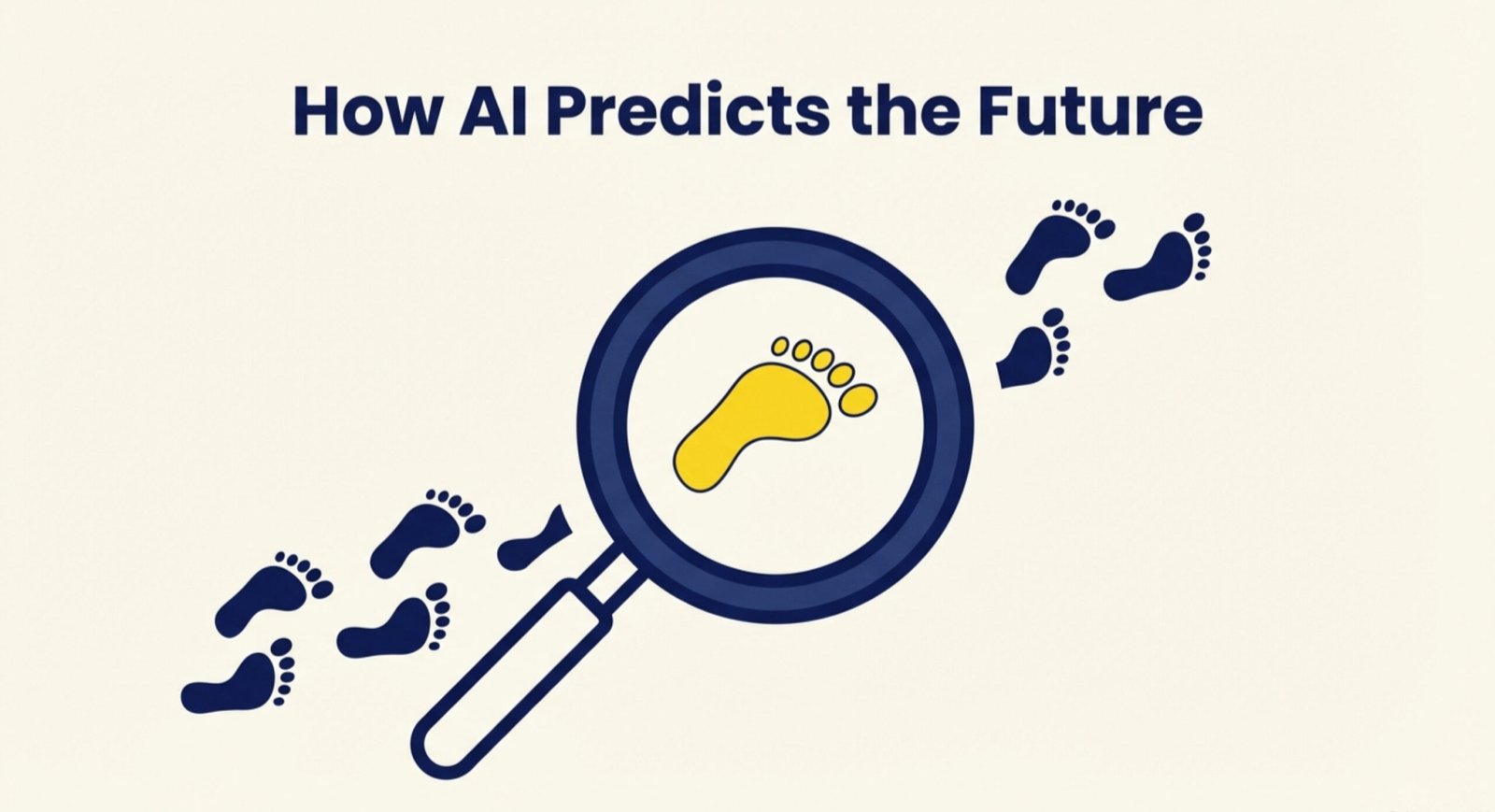
Predictive Modeling is the process of using historical data to make educated guesses about the future, teaching computers to spot patterns in what already happened so they can predict what will happen next.
Hey Common Folks!
We’ve covered what a Model is (the trained brain) and how Algorithms work (the learning process). Now the big question: why are companies spending billions teaching computers to learn?
They’re not doing it just to beat you at chess.
They’re doing it to see the future.
This brings us to one of the most valuable applications of AI: Predictive Modeling. It’s working behind the scenes every time Netflix recommends a show, your bank flags a suspicious charge, or Spotify creates a playlist that somehow knows your mood.
The Analogy: The Weather Forecast
You already use predictive modeling every morning when you check the weather app.
-
Past Data: The app knows that for the last 50 years, when humidity is 90% and wind comes from the east in July, it usually rains.
-
Pattern: High Humidity + East Wind in July = Rain likely
-
Prediction: “80% chance of rain today. Take an umbrella.”
The computer doesn’t know it will rain. It knows that mathematically, rain is the most likely outcome based on what happened before.
That’s predictive modeling in a nutshell: find patterns in history, apply them to today, make an educated guess about tomorrow.
How It Actually Works
Let’s walk through a real example: predicting if a customer will cancel their streaming subscription.
Step 1: Gather Historical Data
Collect information on 100,000 past subscribers: how often they logged in, what they watched, how long they’ve been a member, and whether they canceled.
Step 2: Train the Model
Feed this data into an algorithm. The algorithm finds patterns:
-
“Subscribers who haven’t logged in for 2 weeks AND skipped the last 3 recommended shows usually cancel”
-
“Subscribers who added something to their watchlist in the last 7 days almost never cancel”
Step 3: Make Predictions
A current subscriber starts showing warning signs. We feed their activity into the model. The model applies its patterns and predicts: “78% chance of cancellation within 30 days.”
Now the company can send that person a personalized recommendation or a discount offer before they leave. That’s the entire process: historical data, pattern recognition, prediction on new data, then action.
The Two Types of Predictions
Predictive models answer one of two questions:
1. Classification: “Which category does this belong to?”
The model sorts things into buckets. Usually Yes/No, but can be multiple categories.
Examples:
-
Email: Is this spam or not spam?
-
Banking: Is this credit card transaction fraudulent? (Yes/No)
-
Healthcare: Based on this scan, does this patient show early signs of a condition? (Yes/No)
-
Customer: Will this subscriber cancel next month? (Yes/No)
2. Regression: “How much? What number?”
The model predicts a specific value.
Examples:
-
Real Estate: What will this house sell for based on location, size, and recent sales? ($425,000)
-
Rideshare: What should this Uber ride cost right now based on demand and distance? ($23.50)
-
Retail: How many units of this product will sell next quarter? (10,000)
-
Energy: How much electricity will this city need tomorrow at 3 PM? (4,200 megawatts)
Where You Encounter Predictive Modeling Daily
Your Bank Account:
Every time you swipe your credit card, a model runs in milliseconds predicting: “Does this transaction look like fraud?” Your location, spending history, and the merchant type all become inputs. If the model flags it, your card gets frozen before the thief finishes checkout.
Your Music:
Spotify’s Daylist changes multiple times a day. It predicts your mood based on the time of day, your listening history, and what millions of similar users play at the same hour. Monday morning gets focus music. Friday evening gets party hits. That’s predictive modeling reading your patterns better than you read yourself.
Your Shopping:
Amazon predicts what you’ll want before you know you want it. Its models are so confident in their predictions that the company has patented “anticipatory shipping,” where they start moving products toward your area before you even click “buy.”
Your Health:
UnitedHealth and other insurers now use predictive models to flag patients at risk of hospitalization. Your age, conditions, prescription history, and recent visits become inputs. The model predicts who needs outreach before an emergency happens. (This is also why AI in healthcare is one of the most debated topics right now.)
Your Commute:
Google Maps predicts traffic using current conditions and years of historical patterns. It knows that this specific highway slows down every Tuesday at 5:15 PM, and it reroutes you before you hit the jam. Google recently started using AI to predict flash floods the same way, turning old news reports into data that saves lives.
The Prediction Isn’t Perfect
This is crucial to understand: predictions are probabilities, not certainties.
When a model says a subscriber will cancel, it might mean “78% chance of cancellation.” That’s not 100%. Sometimes the model is wrong. The subscriber might have just been on vacation.
A patient flagged as high-risk might be perfectly healthy. A “guaranteed” sunny day might surprise you with rain. A transaction flagged as fraud might be you buying something unusual on a trip.
We measure model quality by testing it: hide some historical data, ask the model to predict it, compare predictions to reality. A model that’s right 95% of the time is excellent. One that’s right 51% of the time is barely better than a coin flip.
The Limitations (Keeping It Real)
Predictive modeling has real constraints:
Historical bias: If past data reflects bias (certain groups were denied loans unfairly, certain neighborhoods were over-policed), the model learns and repeats that bias. Amazon scrapped an AI hiring tool in 2018 because it penalized resumes that included the word “women’s,” since it was trained on a decade of male-dominated hiring data.
Assumes patterns continue: Models assume the future looks like the past. They fail when something unprecedented happens. COVID-19 broke nearly every predictive model in existence because no historical pattern could account for the entire world shutting down simultaneously.
Correlation isn’t causation: A model might find that ice cream sales predict crime rates. Both rise in summer. But ice cream doesn’t cause crime. Good data scientists catch these traps. Bad ones build products around them.
Only as good as the data: Missing or inaccurate data leads to wrong predictions. Garbage in, garbage out. A model trained on data from one country may completely fail in another.
The Takeaway
Predictive Modeling is the bridge between data and decision-making.
-
It uses algorithms to find patterns in historical data
-
It creates a model that applies those patterns to new situations
-
It helps us make educated guesses about the future
It’s not a crystal ball. It’s statistics at scale: finding what usually happens and betting that it’ll happen again. The companies that do it well (Netflix, Spotify, Google, your bank) feel like they can read your mind. The ones that do it poorly feel like that friend who always gives confidently wrong advice.
Coming Up:
We’ve built a strong foundation: AI, Machine Learning, Models, Algorithms, and Predictive Modeling. But how does the AI actually learn these patterns under the hood? In the next edition, we’ll explore Neural Networks, the architecture inspired by the human brain that makes all of this possible. If you’ve ever heard someone say “deep learning” and wondered what makes it “deep,” that one’s for you.
AI for Common Folks — Making AI understandable, one concept at a time.
Leave a Reply